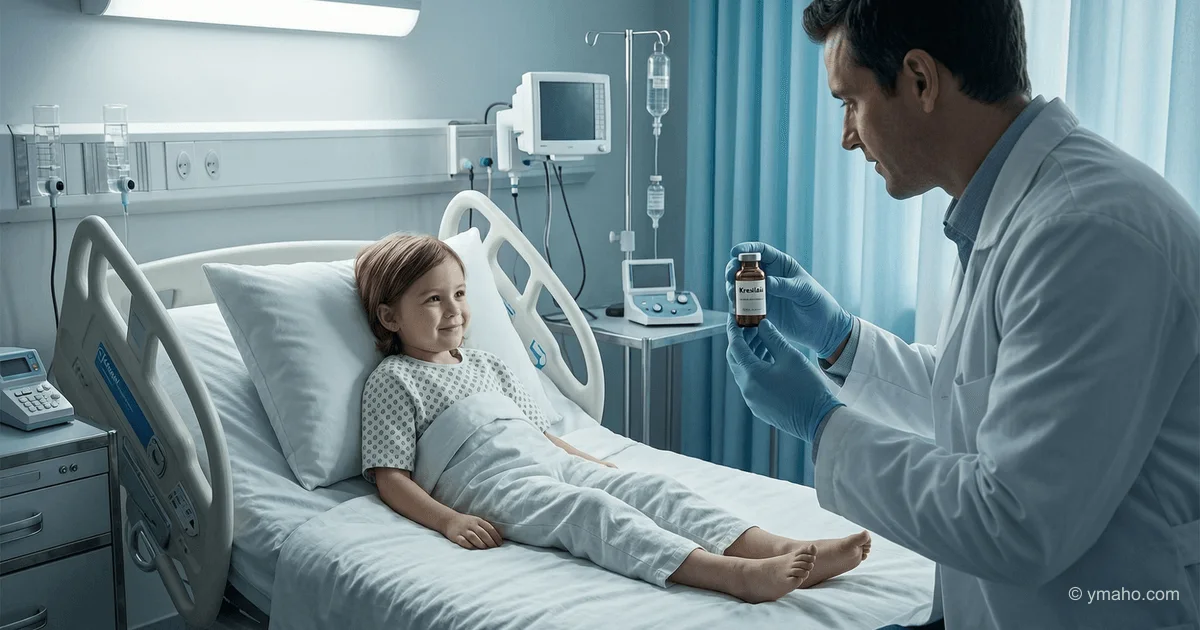
FDA Approves First Stem Cell Gene Therapy for Children with Severe LAD-I
The FDA has approved Marne-Cel (marnetegragene autotemcel) for the treatment of severe leukocyte adhesion deficiency type I (LAD-I) in children. This is the first gene therapy using the patient's own stem cells for this ultra-rare immunodeficiency disorder.
The Bottom Line: What's Really Happening
The FDA has approved Kresladi (marnetegragene autotemcel) — the first gene therapy using the patient's own stem cells for treating severe leukocyte adhesion deficiency type I (LAD-I) in children. This is not just another orphan drug approval. It signals that the regulator is ready to make decisions on gene therapies based on surrogate biomarkers rather than long-term clinical outcomes. Kresladi received accelerated approval, and continued registration hinges on confirming long-term clinical benefit in ongoing studies and a post-marketing registry.
The real news is not the drug itself, but the business model behind it. Rocket Pharmaceuticals, a company with a market cap of about $381 million and a cash burn rate of roughly $190 million over the past 12 months, immediately monetized the Priority Review Voucher (PRV) attached to the approval, selling it for $180 million. This deal extends the company's runway into the second quarter of 2028. The FDA, unintentionally, has created an ideal financial instrument for biotech: accelerated approval → PRV → non-dilutive capital.
Timeline and Context
The FDA's approval on March 26, 2026, was not smooth. Rocket filed its initial BLA in October 2023, received priority review, but then the FDA issued a complete response letter requesting additional CMC (Chemistry, Manufacturing and Controls) information. The company withdrew the application, regrouped, negotiated with the FDA on "limited" additional data, and resubmitted. The regulator set a PDUFA date of March 28, 2026, and met the deadline.
This is the second time in Rocket's history that the FDA has requested additional CMC information for this product. The precedent is important: it shows that manufacturing issues for gene therapy are not a fatal barrier. The regulator is open to iterative dialogue. But each iteration costs money. Rocket survived the delay only because investors were willing to wait.
The clinical basis for approval is an open-label, single-arm study (NCT03812263) in 9 children. Nine patients. No control group. The primary endpoint was 100% survival without transplantation at 1 year and throughout the follow-up period. Secondary endpoints included a 74.45% reduction in annualized incidence of infectious hospitalizations, an 81.95% reduction in prolonged infections, and an 84.90% reduction in prespecified serious infections compared to the pre-therapy period. Serious adverse events were related to myeloablative conditioning with busulfan, not the gene product itself.
Who Wins and Who Loses
Winners
Rocket Pharmaceuticals and its shareholders. Selling the PRV for $180 million with a market cap of $381 million is an extraordinary event. Analysts at Leerink Partners and Chardan raised target prices to $11, and BofA Securities to $9. Meanwhile, Jefferies warns that Kresladi revenue is unlikely to exceed $50 million. But that doesn't matter. The PRV money is already in the bank and will fund AAV programs for Danon disease, PKP2-ACM, and BAG3-DCM. Kresladi is a Trojan horse that brought the company liquidity for entirely different projects.
Children with severe LAD-I who lack an HLA-matched sibling donor. The incidence is estimated at 1 in 100,000–200,000 live births in the US, with most cases being severe. Without therapy, children do not survive into their second decade. The only alternative is allogeneic hematopoietic stem cell transplantation, which carries significant morbidity and mortality in the absence of a matched sibling donor. Kresladi eliminates the donor search problem.
Holders of AAV and lentiviral gene therapy platforms. The approval of Kresladi sets a precedent for the entire class of ex vivo lentiviral vector therapies. Every subsequent applicant with a similar platform can reference this precedent in FDA negotiations, especially regarding CMC requirements.
Losers
Patients for whom Kresladi is not suitable. The indication is clearly defined: severe LAD-I, biallelic variants in ITGB2, and no HLA-matched sibling donor. Patients with less severe forms or with an available donor are left out. For an ultra-rare disease with a population of perhaps fewer than 100 patients in the US, this means some will receive a potentially curative therapy while others will not, with the boundary determined by genetics and family structure.
Competitors developing allogeneic off-the-shelf therapies. Kresladi is an autologous therapy. It requires harvesting the patient's cells, ex vivo modification, and reinfusion. This is logistically complex and expensive. But it has been approved. Companies that invested in universal donor cells for LAD-I now must prove the advantage of an approach that the market may not see—their potential audience is even smaller than before.
What the Media Isn't Saying
Insight #1: The PRV is a hidden government subsidy for biotech that distorts the market. A priority voucher is an asset that the FDA gives away for free, and companies sell for real money. $180 million for a piece of paper that allows expedited review of another application. Buyers are typically Big Pharma, willing to pay for a 4-month reduction in review time. Essentially, the government subsidizes rare disease R&D not through direct grants, but by creating a tradable financial instrument. Rocket got $180 million not for selling a drug, but for selling the right to speed up a bureaucratic process. How effective this capital allocation mechanism is remains an open question.
Insight #2: 9 patients in a pivotal trial—and zero graft failures. This is an almost implausible result. Allogeneic transplantation for LAD-I carries significant risks of graft failure and GVHD. Kresladi showed 0% graft failure in a sample of 9 patients. But 9 patients is not a population. It suggests that the real graft failure rate could be higher, but it didn't appear in this sample. The post-marketing registry, which the FDA required as a condition of accelerated approval, will reveal the real picture. If graft failure starts to appear in a broader population, the FDA will face a familiar dilemma: withdraw approval or relax requirements for confirmatory trials.
Insight #3: The indication "without an HLA-matched sibling donor" is a clever but cynical trick. Rocket deliberately narrowed the indication, excluding patients with an available matched sibling donor. This reduced the burden of proof: there is no need to prove superiority over the standard of care because these patients have no standard of care. Transplantation from an incompatible donor is not a standard; it's a desperate measure. Thus, Kresladi is compared not to allogeneic transplantation, but to the natural course of the disease. A single-arm trial becomes ethically and methodologically justified. Clever. But it means data on relative efficacy against transplantation are absent.
Forecast: Next 30 Days and 90 Days
30 Days (by June 6, 2026)
Rocket will announce the price of Kresladi. Given its ultra-orphan status and the "one-time curative therapy" model, the expected price ranges from $1.5 million to $2.5 million per treatment. For comparison, Zolgensma launched at $2.1 million. Negotiations with payers will begin immediately, but the primary insurer in this segment is Medicaid, since patients are children with severe congenital disease. Rocket will also begin process qualification for its vector. Producing lentivirus for a single dose at a 30-liter scale costs roughly $300,000 at internal academic GMP facility prices alone, excluding plasmids, testing, and release. Commercial production will be significantly more expensive, and the first patients may wait weeks for therapy due to logistical complexities.
90 Days (by August 5, 2026)
The first commercial patients will receive Kresladi infusions. Rocket will report this in quarterly earnings, and the market will watch the real-world safety profile. Any case of graft failure or clonal expansion will be a negative catalyst for the stock.
Rocket's CF team will begin allocating the $180 million from the PRV sale across pipeline programs. Priority will be Danon disease and PKP2-ACM. This is sensible: the Danon disease market is valued significantly higher than LAD-I. For Rocket, Kresladi is a proof of concept—not so much medical, but regulatory and financial. The company has shown it can bring a gene therapy to approval and fund the next stage without diluting shareholders.
The FDA will begin design review of the post-marketing confirmatory study. The key question: will the agency require a randomized comparison with allogeneic transplantation? If so, this will be a complex ethical and practical challenge: how to randomize a LAD-I patient without a matched sibling donor between gene therapy and a mismatched transplant? If not, Kresladi will remain on the market under accelerated approval for years, and the precedent for other ultra-rare diseases will be strengthened.
Finally, holders of other PRVs will begin reassessing prices. Rocket's deal set a benchmark of $180 million. For comparison, in 2024–2025, PRVs sold in the range of $100–150 million. The new level suggests that Big Pharma is willing to pay a premium for accelerated review in an environment where pipelines are full and the FDA is tightening data requirements. This is a silent signal to the market: rare pediatric disease designation is not just a regulatory advantage, but a real financial asset.
— Editorial Team









