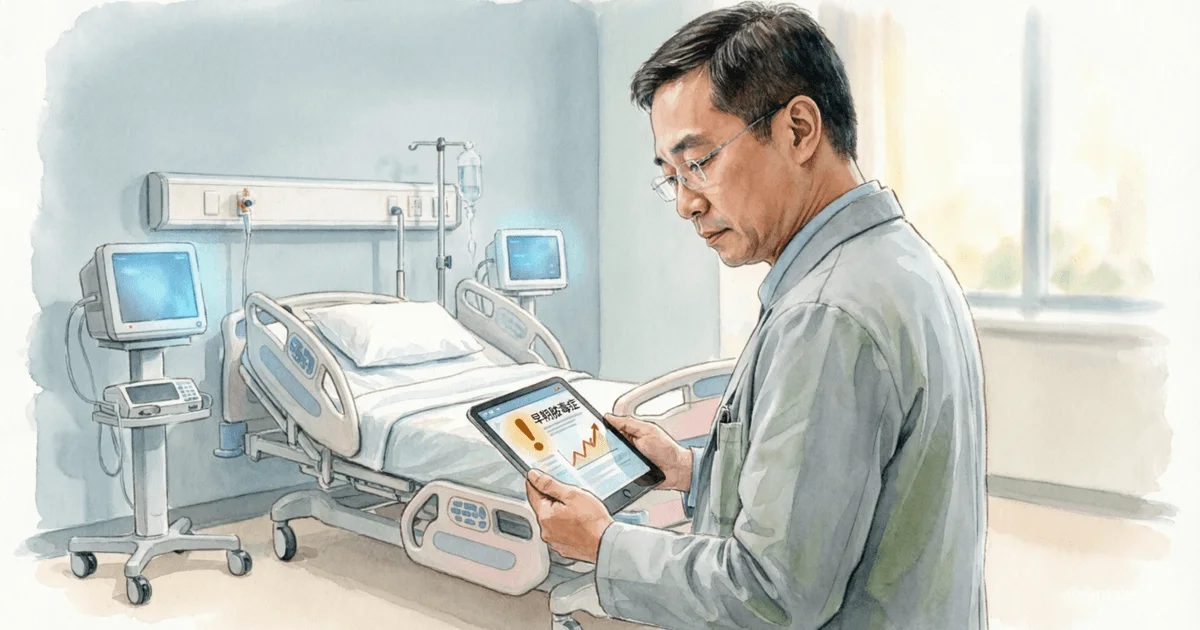
FDA Approves First AI System for Early Sepsis Warning from Johns Hopkins
Developed at Johns Hopkins University, the Targeted Real-Time Early Warning System (TRACE) has received FDA approval. It detects sepsis 2-48 hours earlier than physicians, leading to an 18% reduction in mortality from this condition in dozens of U.S. hospitals.
The Time Bomb Killer: Why Johns Hopkins' TRACE Approval Marks the End of 'Clinical Intuition' in Intensive Care
Industry Insider Analysis
May 25, 2026
[The Bottom Line]: What's Really Happening
Colleagues, forget about the 'magic bullet.' The real revolution in medicine looks mundane to the layperson, but it's deadly for outdated protocols. The fact that the FDA approved Johns Hopkins University's TRACE (Targeted Real-Time Early Warning System) on May 12, 2026, is not just 'another AI.' It is the first precedent in history where a machine has been granted the right to suspect a diagnosis before the physician.
The essence is not that AI has become smarter. The essence is a shift in agency. Previously, all systems (electronic checklists, rule-based triggers) activated only after the clinician began to suspect something was wrong. TRACE, however, is embedded in electronic health records (EHR) and scans a data array (vital signs, lab data, physician notes) looking for pre-suspicion.
This changes the economics and legal model of a hospital. Sepsis kills 250,000–350,000 people annually in the U.S. alone and costs the healthcare system tens of billions of dollars. Each hour of delay increases mortality by 4-8%. TRACE gains 2 to 48 hours. The 18% reduction in mortality translates to saved lives and millions of dollars saved on intensive care.
[Timeline and Context]
Why now, and not five years ago? Because three factors have 'matured':
- Federal funding and personal trauma. Lab director Suchi Saria lost her nephew to sepsis in 2017. This is not just science; it's personal. Her team spent a decade on federally funded research while traditional venture capitalists considered 'pre-suspicion' too risky.
- Breakthrough Designation accelerated approval program (2023). Before full approval, the system underwent a 'trial by fire' at Cleveland Clinic, MemorialCare, and the University of Rochester. It was there, in real clinics—not simulators—that the mortality reduction and length-of-stay figures were confirmed.
- Key trigger: CMS NTAP. FDA approval is only half the battle. The main point is that immediately after approval, hospitals using TRACE became eligible for reimbursement through the Medicare and Medicaid 'New Technology Add-on Payment' program. Consider this: insurers agreed to pay for something the physician hasn't yet seen. This is an unprecedented breakthrough in diagnostic reimbursement.
[Who Wins and Who Loses]
Winners:
- Bayesian Health. The commercializer of the technology. They have just obtained a 'license to print money.' Within the next two years, they will either go public with a valuation of $3-5 billion or be acquired by Epic Systems or Oracle Cerner.
- Suchi Saria personally. She becomes a 'totem' in the clinical AI industry. Her word now carries weight comparable to that of NEJM editors-in-chief.
- CMS (Centers for Medicare & Medicaid Services). They finally have a tool that shifts the burden of proof from themselves to AI. Fewer sepsis deaths = fewer lawsuits and expenses.
Losers:
- Traditional screening systems (SIRS, qSOFA). These scoring systems, taught to students for 20 years, are now clinically dead. They react when the patient is already near death.
- Small EMR startups. If you lack integration with real data streams and haven't passed FDA clearance for 'pre-suspicion'—you're bankrupt. The market is consolidating around EHR giants.
- 'Dinosaur' physicians relying on 'clinical intuition.' From now on, a missed sepsis that the machine predicted is a direct path to a malpractice lawsuit.
[What the Media Isn't Saying]
Here's the real insider info. The media writes about 'saving lives' but stays silent on data politics and 'false positives.'
TRACE analyzes the 'full stream of unstructured data': physician notes, nurse records. This means the system learns from how the physician writes, not just what they complain about. This opens Pandora's box.
Insight: In the clinical AI world, there is quiet discussion about the 'self-fulfilling prophecy' effect. Hospitals implementing TRACE are already noticing a shift in physician task prioritization. If AI says 'sepsis in 6 hours,' the senior nurse may start prophylactic antibiotics before the temperature rises. But what happens to the algorithm's accuracy after a year, when it is trained on data collected under its own influence? The model may become 'lazy' (feedback loop collapse) if physicians blindly trust it and stop adding clinical variations to their notes. Calibrating TRACE six months after deployment is the biggest headache for any hospital CIO.
Second: the economic efficiency of rapid diagnosis. The Office of Health Economics (OHE) released an analysis showing that rapid pathogen identification saves from a few hundred to thousands of euros per patient. TRACE does not speed up pathogen identification; it speeds up initiation of therapy. Hospitals are already calculating: the CMS NTAP payment covers implementation costs, while savings on length of stay go straight to the bottom line.
[Forecast: Next 30 Days and 90 Days]
Next 30 days:
An aggressive marketing wave from Epic and Cerner will begin. TRACE deployment will become a competitive advantage. Analysts expect stocks of companies working with real clinical data (e.g., Tempus, if it goes public) to see a notable green candle. Also, the first pilot projects integrating TRACE with pharmaceutical warehouses for automatic antibiotic preparation 'by prediction' will start.
Next 90 days:
The true test. The FDA has given the green light, but real effectiveness will depend on 'Change Management' in hospitals. I predict that by August 2026, the first critical articles will appear in journals like JAMA Internal Medicine stating that 'AI implementation increased physician burnout due to false alarms.'
However, don't be fooled. The race has begun. TRACE is not about sepsis. It's a technological template. If we can predict sepsis 48 hours in advance, then in 18 months we will predict cardiogenic shock and sudden cardiac arrest. Johns Hopkins has just vaccinated against 'blindness' in medicine. The AI virus is now in the system's bloodstream.
— Editorial Team









