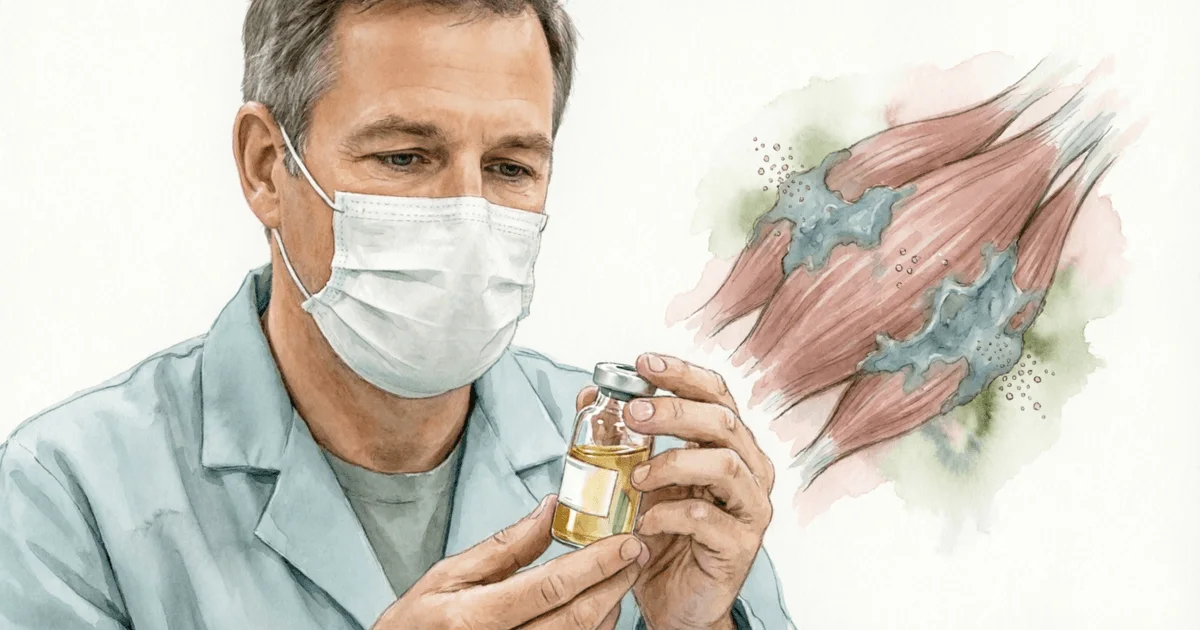
Clinical Trial of Gene Therapy AB-1009 for Pompe Disease (LOPD) Initiated
According to an update on ClinicalTrials.gov, Asklepios Bio has launched a Phase 1 study of intravenous gene therapy AB-1009 for adults with late-onset Pompe disease. The drug aims to correct the GAA gene defect responsible for this rare neuromuscular disorder.
Orphan Battle: Why AskBio's AB-1009 Is Not Just Another Pompe Therapy, but a Paradigm Shift in Gene Medicine
Industry Insider Analysis
May 25, 2026
\[The Bottom Line]: What's Really Happening
Colleagues, don't be fooled by the modest wording "initiation of Phase 1/2 for 12 patients." The event that occurred on May 11, 2026 (date of first patient dosing) and the news you see now are not just another trial launch. This is a real-time "changing horses in midstream" for the entire rare disease field.
We're talking about Pompe disease (late-onset form, LOPD) — a rare lysosomal disorder where the GAA gene is broken, preventing production of the enzyme that breaks down glycogen. Without this enzyme, muscles (including the diaphragm) fill with glycogen and deteriorate.
AskBio (a Bayer subsidiary) is launching AB-1009 — an intravenous gene therapy based on adeno-associated virus (AAV). But the main intrigue isn't what they're doing, but why they did it now, completely pivoting from the previous candidate ACTUS-101. This isn't just a "new drug"; it's an iterative leap — the industry is learning from its mistakes faster than ever.
\[Timeline and Context]
A key fact missing from headlines: AskBio already had experience with ACTUS-101. Phase 1/2 started back in 2019. Results were decent — patients were able to discontinue standard enzyme replacement therapy (ERT) for up to 104 weeks, and serum GAA levels jumped to 235%. It seemed like a no-brainer to scale up. But no.
Why was ACTUS-101 closed to new patient enrollment?
The silent consensus problem — efficacy in muscles. ACTUS-101 generated the enzyme in the liver (as a "factory"), but delivery to skeletal muscles and diaphragm was suboptimal. In LOPD, patients die not from liver issues but from respiratory failure.
Enter AB-1009 with a completely different "payload." It's based on a truncated form of the GAA gene developed by Giuseppe Ronzitti's lab at Genethon. Inside scoop: This modified enzyme version is smaller but more active. Its smaller size makes it easier to "package" into an AAV vector with higher tropism for muscles rather than the liver. Additionally, a new AAV capsid from Belief BioMed and technology licensed from Duke University are used.
Timeline: FDA IND approval was obtained in January 2026 with Fast Track and Orphan Drug designations. The first patient was treated on May 11. The launch is underway.
\[Who Wins and Who Loses]
Winners:
- Bayer AG. AskBio is their subsidiary. While Pfizer and Novartis struggle with CAR-T, Bayer is quietly building an empire on orphan AAV therapies. Success with Pompe is a springboard for their AAV platform.
- Tahseen Mozaffar, MD (UCI Health). Lead investigator of the program. He gets access to "live data" before anyone else. If the therapy takes off, his name will be on dozens of publications and in medical histories.
- Genethon. They'll earn royalties from the license. For the French non-profit lab, this is a way to reinvest millions into new projects.
- Duke University. They also have a stake. It's a classic "university — startup — corporation" scheme, perfected over time.
Losers:
- Amicus Therapeutics (AT845). This is the most interesting part. While AskBio launches AB-1009, Amicus has AT845 in its portfolio — a direct competitor. Look at the latest FORTIS data from Amicus (presentation in March 2026): 9 out of 11 patients had elevated liver enzymes, including serious Grade 3 and 4 events. Amicus shot itself in the foot. Investors are now nervously comparing the safety profiles of AskBio and Amicus. The winner will be the one with less hepatotoxicity.
- Patients on standard ERT (Lumizyme, Nexviazyme). Not because the therapy is bad, but because the orphan drug market is small. Once a "one-time" gene therapy appears, insurance companies may start cutting funding for lifelong ERT, creating patient "traps" between old and new treatments.
\[What the Media Isn't Saying]
Insight: We are witnessing a phenomenon of "self-cannibalization" within Bayer/AskBio.
Note: ACTUS-101 is officially "remaining active but no longer enrolling." That's a polite way of saying "we admit the first version was bad." The company ate its own child without waiting for a Phase 3 failure. This is expensive ($100M+ spent on ACTUS-101 and another $200M on AB-1009), but it's a sign of industry maturity.
Second point — immune response and the CNS blind spot. Pompe disease affects not only muscles but also neurons (spinal motor neurons, respiratory center). Most AAV therapies (and AB-1009 is no exception, judging by the protocol) do not cross the blood-brain barrier in sufficient doses when administered intravenously. A patient might "cure" their muscles but still have progressive diaphragm weakness due to central causes. This "blind spot" — why aren't we discussing intrathecal administration for this disease?
\[Forecast: Next 30 Days and 90 Days]
Next 30 days:
Watch ClinicalTrials.gov. By mid-June, we should see enrollment status for 2-3 patients in the low-dose cohort (Cohort 1: 1.0E13 vg/kg). The main risk is hepatotoxicity (as with AT845). If initial safety reports (SAEs) show ALT/AST elevations more than 3 times normal, Bayer shares may dip slightly, and confidence in AskBio may waver.
Next 90 days:
Analysts will look for the possibility of Accelerated Approval. FDA granted Fast Track. This means AskBio can file based on surrogate markers (muscle glycogen levels and FVC stability — forced vital capacity) rather than waiting 5 years for respiratory failure to develop.
Market forecast: If by the end of summer 2026 AskBio shows a clean immunological profile and at least a 50% reduction in muscle glycogen in early patients, we'll see a wave of M&A deals in the AAV therapy market. Pfizer will buy some small player to catch up with Bayer. The battle for muscles and breathing is just beginning. Pompe is a test drive. The next target is Duchenne muscular dystrophy. AB-1009 technology will become the template.
— Editorial Team









