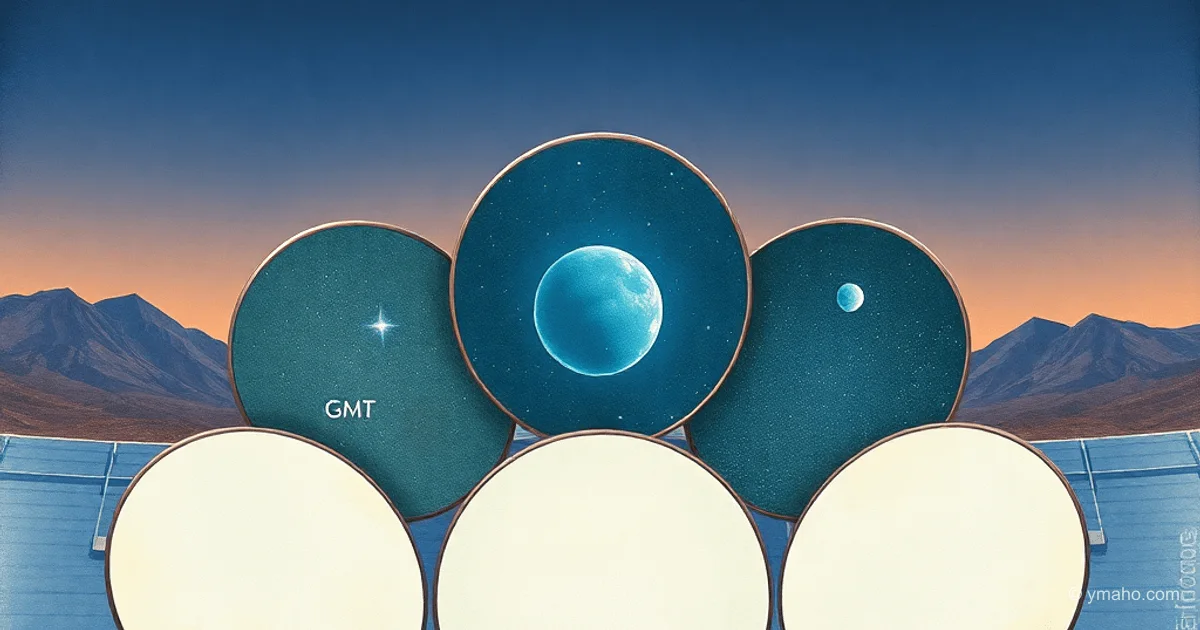
Giant Magellan Telescope Could Reveal Alien Worlds — If It Gets Built
A massive new telescope on the verge of construction could soon let us see planets around distant stars in stunning detail — and maybe even spot signs of life. But it all hinges on whether scientists can secure enough funding over the next year or two.
Why This Telescope Is Different
Most giant telescopes being built today use dozens or even hundreds of small mirror segments glued together to form one huge light-collecting surface. The Giant Magellan Telescope (GMT), however, takes a different approach: it uses seven enormous individual mirrors arranged like flower petals, with one in the center and six surrounding it. Each mirror is 8.4 meters (27.5 feet) across — the largest single-piece mirrors ever made for astronomy.
This design isn’t just about size. It’s about clarity. Think of it like using a single high-quality camera lens instead of stitching together photos from several phone cameras. The result? Sharper images with less distortion — especially important when you’re trying to see a tiny, dim planet next to a blindingly bright star.
How It Sees Through Earth’s Wobbly Air
Even the clearest night sky distorts starlight because of turbulence in our atmosphere — that’s why stars “twinkle.” To fix this, the GMT uses something called adaptive optics. Its seven secondary mirrors are only 2 millimeters thick and can change shape thousands of times per second, pushed by tiny magnets responding to real-time measurements of atmospheric blur.
Imagine holding a flexible mirror under a running faucet and constantly bending it so the reflected image stays steady — that’s adaptive optics, but done with extreme precision and speed. This lets the GMT achieve resolution sharp enough to spot details on a baseball from 100 miles away.
Hunting for Life Beyond Earth
One of the GMT’s biggest goals is studying exoplanets — worlds orbiting other stars. Using a device called a coronagraph, it will block out a star’s glare to reveal nearby planets. Then, an instrument named G-CLEF will analyze the planet’s light to detect gases like oxygen, methane, or water vapor in its atmosphere.
Finding certain combinations of these gases could hint at biological activity — not proof of aliens, but a strong clue that a planet might be habitable, or even inhabited.
Peering Back to the Universe’s Teenage Years
Beyond alien worlds, the GMT will look deep into space — and therefore far back in time — to study galaxies as they were 10 to 11 billion years ago. This was the universe’s peak era of star formation, but we’ve never clearly seen how gas flows in and out of young galaxies to fuel that process.
“The gas has been too faint to map,” says astronomer Gwen Rudie. “GMT will create the first detailed maps of gas around individual galaxies, connecting star birth and death to the cosmic recycling system that shapes galaxies like our own.”
The Race Against Time and Budget
The GMT is already partly built. Its mount — a 128-foot-tall, 2,600-ton steel structure — is being assembled in Illinois. Foundations are poured in Chile’s Atacama Desert, one of Earth’s best stargazing spots. Over $1 billion has been invested so far.
But the U.S. National Science Foundation capped funding for giant telescopes at $1.6 billion total — not enough for both the GMT and its rival, the Thirty Meter Telescope. So scientists are urgently seeking private donations and international partners to reach the $2+ billion needed.
If successful, the GMT could begin observations in the early 2030s, joining other next-gen telescopes like the European Extremely Large Telescope.
What Does This Mean for Regular People?
You won’t get to look through the GMT yourself, but its discoveries could reshape how we see our place in the cosmos. Finding even one potentially habitable world would ignite global conversation about life beyond Earth. Understanding galaxy evolution helps explain how our own Milky Way — and ultimately Earth — came to be. And the tech developed for its mirrors and sensors often finds uses in medicine, imaging, and manufacturing.
Most importantly, history shows that every time we’ve built a more powerful eye on the universe, we’ve been surprised. As Rudie puts it: “The most remarkable discoveries will be the ones we haven’t even imagined yet.”
Key takeaways
- The Giant Magellan Telescope uses seven giant mirrors for ultra-sharp views of space.
- Its adaptive optics correct for atmospheric blur in real time, enabling unprecedented clarity.
- It aims to analyze atmospheres of distant planets for possible signs of life.
- It will map invisible gas flows in ancient galaxies to understand how stars form.
- Full construction depends on securing over $2 billion in public and private funding by 2028.
— Editorial Team









