GLP-1 Drugs Are Changing Eating Habits and Creating a Crisis in the Fast Food Industry
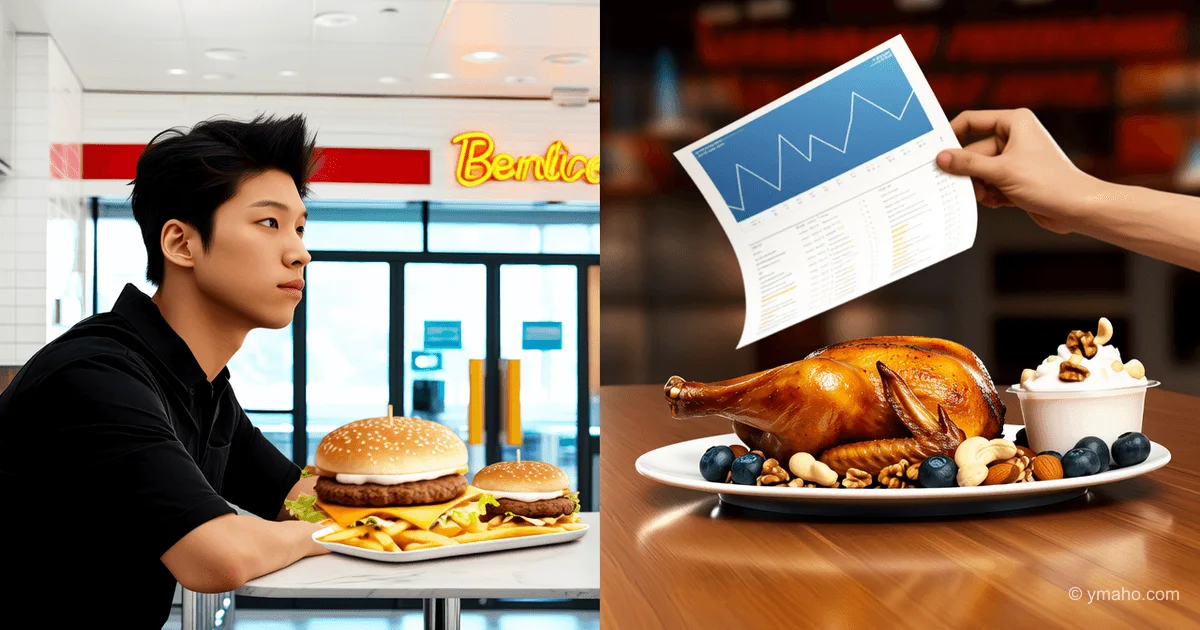
The sharp rise in popularity of weight loss drugs, taken by one in eight American adults, is driving demand for protein-rich food. This has led to a serious drop in sales and stock prices of major fast food chains like McDonald’s and Wendy’s.
The Ozempic Effect: How a $1,000-a-Month Injection Is Reshaping the Global Food Industry
What’s Really Happening
The GLP-1 agonist market is valued at $73.39 billion in 2026 and is projected to reach $254.19 billion by 2034, with a CAGR of 16.8%. But market cap figures aren’t the most interesting part. What’s fascinating is what’s happening at the intersection of pharma and the food industry.
One in eight American adults is already taking GLP-1 drugs. According to Cornell University, households with a user of such medications cut spending on fast food and dining out by 8% over six months. McDonald’s stock has fallen 7% since the start of 2024, while the S&P 500 has risen 50%. Wendy’s is 46% below its 52-week high, and Wingstop is 66.7% below.
But the fast food crisis is just the tip of the iceberg. GLP-1 doesn’t just reduce calorie intake. These molecules turn off “food noise”—the constant internal monologue about food that researchers call a key driver of impulse purchases. And this isn’t changing restaurant menus—it’s changing the neurobiology of consumer choice.
Timeline and Context
The story has unfolded rapidly. In 2024, Gallup recorded 6% of American adults on GLP-1. By the end of 2025, it was 12%. JPMorgan forecasts the number of users in the US will grow from the current 10 million to 30 million by 2030.
The food industry didn’t react immediately. The first signals came from data on declining sales of snacks and sweets. A Pogo study based on transaction data from 12,000+ verified GLP-1 users and follow-up video interviews showed that cookies, chips, and candies didn’t just “see a sales drop”—they simply ceased to exist in the consumer’s mental map. One respondent baked Christmas cookies in December; by March, they were still untouched.
At the same time, a counter-trend emerged: Greek yogurt, protein bars, lean meat, and electrolyte drinks. In the UK, AHDB found that 85% of GLP-1 users eat less overall, but 43% increased their consumption of protein-rich foods—meat and fish.
Who Wins and Who Loses
Winners are manufacturers with high-protein portfolios. Coca-Cola, through Fairlife and other protein lines, is already capitalizing on this shift. Red meat producers are seeing a premium demand: GLP-1 users buy less meat by volume but are willing to pay more for quality. Greek yogurt is becoming a staple—about half of Pogo respondents named it a purchase that either appeared for the first time or significantly increased in their basket.
Pharma giants Eli Lilly and Novo Nordisk are obvious beneficiaries, with a market growing at 16.8% annually.
Losers are classic fast food chains with a “large portion for a low price” model. Restaurant stocks are showing a historic divergence from the market. Ultra-processed snack makers stand to lose up to $12 billion in sales over a decade in the US alone, according to EY-Parthenon.
But there are also less obvious victims. Alcohol producers. GLP-1 users report physical intolerance to alcohol—it causes faster intoxication and bloating, so many cut back without even making a conscious decision.
And another victim: the very concept of “impulse buying” in retail. When the consumer’s “food noise” is turned off, the basic mechanism that has driven snack marketing at the checkout for decades disappears.
What the Media Isn’t Saying
Insight: Household-level data systematically underestimates the true scale of the shift.
Researchers at Pogo identified a critical methodological problem: scanner data at the household level masks individual shifts. A woman buying groceries for a family of six with teenagers keeps roughly the same basket—but her personal consumption has radically changed. If you measure GLP-1’s impact only at the household level, you systematically underestimate the effect.
Second, the trend is cyclical, not linear. Users who stop taking the drug due to cost or insurance limitations report that their eating habits return within 1-2 weeks. This means the market will fluctuate in waves: expanded access, contraction from discontinuations, then renewed expansion. Brands planning for a linear decline in demand will be unprepared for such volatility.
Third, “food noise” turned out not to be a metaphor but a measurable neurobiological phenomenon. A study presented at the European Congress on Obesity used the validated Food Noise Questionnaire and showed a 4.05-point drop in one month for those taking GLP-1, versus 1.15 for the control group. This means GLP-1 doesn’t just change behavior—it changes the neurological substrate. And that, in turn, means that returning to old eating habits after stopping the drug isn’t a matter of willpower, but a matter of neurochemistry reverting to its original state.
Forecast
Next 30 days (through mid-June 2026):
Expect a series of quarterly reports from restaurant chains that will continue to disappoint. Companies that haven’t adapted their menus to the “protein demand” will face particularly harsh market reactions. Meanwhile, expect announcements from retailers about launching special lines for GLP-1 users—“smaller portions, higher protein, cleaner ingredients.”
Snack makers will start actively acquiring protein-focused startups. M&A deals in this segment will accelerate—big players have realized that organic growth in their traditional categories is no longer possible.
Next 90 days (through mid-August 2026):
By the end of summer, we’ll see the first serious analytical reports on GLP-1’s impact on the insurance industry. When the $1,000-per-month drug cost is weighed against savings from treating obesity, diabetes, and cardiovascular disease, insurers will begin expanding coverage. This will accelerate adoption—and, consequently, intensify pressure on the food industry.
A key risk is the formation of two parallel consumer realities. Households with GLP-1 users shift to a protein-forward diet and cut fast food. Households without access to the drugs (due to financial or insurance reasons) remain in the old consumption pattern. The food industry will be forced to serve two fundamentally different markets simultaneously—and that is operationally more expensive than any uniform trend.
The main strategic takeaway: GLP-1 is not “just another demand factor.” It is an exogenous shock comparable in scale to the advent of the internet for retail. The difference is that the internet changed the sales channel, while GLP-1 changes the buyer’s neurobiology. Adapting to that is an order of magnitude harder.
— Editorial Team









