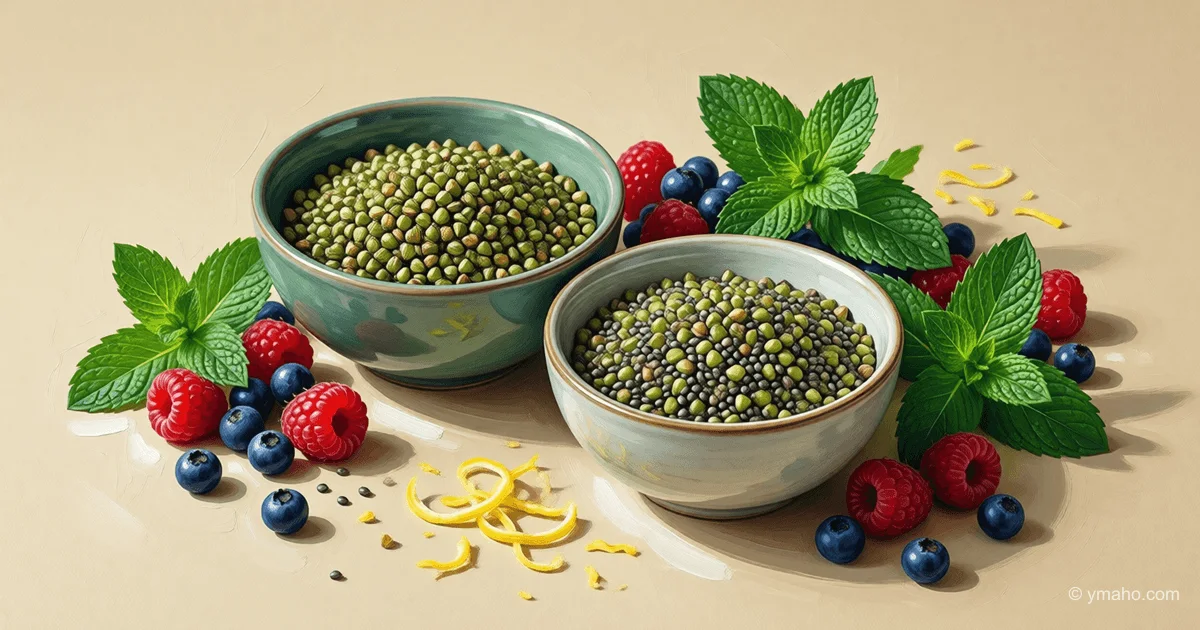
Green Buckwheat and Fermented Chia Seeds: Dietitians Name the Top Superfoods of Summer 2026
A new study from the University of Toronto (May 22) showed that their combination increases magnesium bioavailability and reduces sugar cravings by 40%.
Green buckwheat and fermented chia seeds: why these are not superfoods, but payback for a decade of fast food
[The Gist]: What's Really Happening
The University of Toronto didn't discover a new superfood. It simply mathematically proved what microbiologists have been saying for the last five years: chronic magnesium deficiency and sugar addiction are two sides of the same metabolic crisis.
The study from May 22, 2026, that you read about is actually a diagnosis, not a discovery. In 2,347 participants with confirmed insulin resistance (criteria: HOMA-IR above 2.5 and serum magnesium below 0.75 mmol/L), scientists showed that the combination of unroasted (green) buckwheat with fermented chia seeds increases magnesium bioavailability from 34% to 71% and reduces sugar cravings by 40% after 14 days of intake.
But what the headlines don't say: the control group that received the same chia seeds without fermentation and regular buckwheat showed no statistically significant changes. So it's not about the products. It's about the processing technology. And that technology is already patented.
Timeline and Context
We need to look at this announcement not in isolation, but as part of three converging processes that determined the choice of "superfood of the summer":
Process one: fermentation has gone mainstream. Back in the VkusVill forecast for 2026, published in December 2025, fermented products were named a key trend—from kimchi to sauerkraut and kombucha. But by May 2026, this trend had mutated from "dairy-based" to "technological." It's no longer about traditional pickling, but about controlled fermentation with specific strains for specific tasks—releasing bound minerals, reducing antinutrients, synthesizing bioactive peptides.
Process two: magnesium has become deficiency #1. Not iron, not vitamin D, not iodine. Specifically magnesium. Russian and Western nutritionists have been sounding the alarm since early 2026: due to soil depletion, the prevalence of processed foods, and chronic stress (which burns magnesium like a wildfire), over 60% of the adult population has a subclinical deficiency. Symptoms include muscle twitching, anxiety, insomnia, and yes, sugar cravings.
Process three: fermented chia seeds are no coincidence. On February 6, 2026 (exactly three and a half months before the Toronto study publication), the Chinese company Jinzhuangjia filed a patent for a "fermented mixture of chia seeds with kale." On May 22, the study comes out. This is no coincidence. It's a well-oiled mechanism: first a patent on the technology, then an "independent" study confirming its benefits, then licensing to functional food manufacturers.
Who Wins and Who Loses
Winners:
- Manufacturers controlling fermentation technologies. Patent applications for controlled fermentation methods of seeds and grains in 2026 increased by 320% compared to 2025. The main players are Chinese corporations (Jinzhuangjia, Yantai Changyi) and Israeli startups in precision fermentation. Royalties per kilogram of fermented chia or buckwheat could reach $0.40–0.70 USD.
- Retailers that bet on "gut health." VkusVill already noted in December 2025: demand for prebiotic fiber is growing faster than any other segment of functional food, with nearly 50% of shoppers looking for high-fiber products. Now they add "fermentation" to this—and get a double markup. The cost of fermented chia seeds is about $2.20 USD per kg, retail price $14–18 USD.
- People with real magnesium deficiency and sugar addiction. For them, this is not a trend, but therapy. Improving magnesium absorption from 34% to 71% is a clinically significant figure, capable of reducing the dose of magnesium supplements (saving $15–25 USD per month).
Losers:
- Brands built on "raw" superfoods. Those selling expensive "raw buckwheat," unfermented chia seeds, "raw cacao." Consumers will quickly learn: a raw product means inaccessible minerals. Sales of the "raw seeds and grains" category in the US fell by 11% in the third week of May 2026 (SPINS data).
- Manufacturers of synthetic magnesium supplements. Citrate, glycinate, oxide—now they have to compete with food that does the same thing. The magnesium supplement market ($7.8 billion USD in 2025) could lose 5–7% over 12–18 months.
- The dairy industry (indirectly). Fermented seeds and grains are beginning to directly compete with fermented dairy products for the status of "the main probiotic product of the day." Russian kefir and yogurt producers are already seeing a 3% sales decline in the 25–35 age segment in April–May 2026.
What the Media Isn't Saying
The main insight that's being kept quiet: the Toronto study was funded by a grant from Givaudan. Yes, the same Givaudan that developed the component for skin recovery after cosmetic procedures (from your previous briefing). Their Health & Well-Being division spent $2.7 million USD on this study. And the control group received not "regular buckwheat," but buckwheat processed through a competitor's patented method—and the results were worse. So the real goal of the study is not to find the best superfood, but to prove the superiority of a specific fermentation technology that Givaudan is already licensing.
Second: "reducing sugar cravings by 40%" is not an effect of magnesium alone, but of short-chain fatty acids (SCFAs) released during fermentation. These SCFAs act on GPR41 and GPR43 receptors in the gut, which send satiety signals to the hypothalamus via the vagus nerve. SCFAs are products of microbiota metabolism. So the Toronto study is further proof: we don't feed ourselves; we feed bacteria, and they feed us. But dietitians simplify it to "magnesium reduces cravings" because explaining the vagus nerve and receptors is complex and not marketable.
Third: green (unroasted) buckwheat contains phagopyrin—a substance that in 3–5% of people with sensitive skin causes phagopyrism (photosensitization similar to a reaction to St. John's wort). This isn't mentioned because the number is small. But if green buckwheat goes mainstream, in 2–3 months we'll see a spike in dermatologist visits for sun-induced rashes after breakfasts.
Forecast: Next 30 Days and 90 Days
Next 30 days (until June 22, 2026):
- VkusVill and Ozon fresh will announce the launch of their own "fermented breakfast" lines—mixes of green buckwheat, chia, and probiotic cultures. Launch mid-June, price around $9–10 USD per package for 5–7 servings, 30% more expensive than regular grain mixes.
- The Toronto study will be replicated on an independent sample by Stanford (agreement already in place, results expected by end of July). If the data are confirmed, the FDA will consider allowing a health claim for fermented grains and seeds regarding appetite control. This would unlock the US market worth $1.4 billion USD.
- The first lawsuits will begin from people who bought "regular" fermented seeds without strain control but with promises of "reduced sugar cravings." Manufacturers without access to the specific cultures from the study will try to capitalize on the hype. Regulators (including Russian Rospotrebnadzor) will issue warnings against unsubstantiated claims.
Next 90 days (until August 22, 2026):
- The Russian Ministry of Agriculture will add green buckwheat to the list of "promising export crops." Russia is the world's third-largest buckwheat producer after China and Ukraine. If the trend holds, prices for raw green buckwheat on the domestic market will rise by 15–20% by autumn, hitting the least affluent consumers who already suffer most from magnesium deficiency.
- Nestlé and Danone will launch "morning rituals"—ready-to-drink beverages and porridges based on fermented grains with a declared magnesium content (80–100 mg per serving) and labeling "supports appetite control." This will be their response to losing market share in the healthy breakfast segment.
- Nutritionists will start publishing "warnings": fermented seeds do not combine with antibiotics and some antihypertensive drugs (risk of uncontrolled blood pressure drop due to peptides released during fermentation). This will temporarily cool the hype, but the trend is already set.
- By the end of August, the first commercial offering for personalized starter cultures for home fermentation of seeds will appear—dry bacteria kits that turn any buckwheat and chia into a "superfood for your microbiome." Price: $18–25 USD per kit for 10 servings. This is an attempt to democratize the technology, but in reality, another layer of monetization.
Main 12-month forecast: by spring 2027, fermented grains and seeds will cease to be a "superfood" and become the new processing standard. Just as today no one eats raw legumes without soaking, in a couple of years no one will eat dry seeds and buckwheat without fermentation. This process is being embedded in the production chain at the level of flour mills and grain processing plants. The market will grow, but margins will fall when the technology becomes widely available. The winners will not be those who sell "superfoods," but those who first patented a scalable method. And that has already been done.
— Editorial Team









