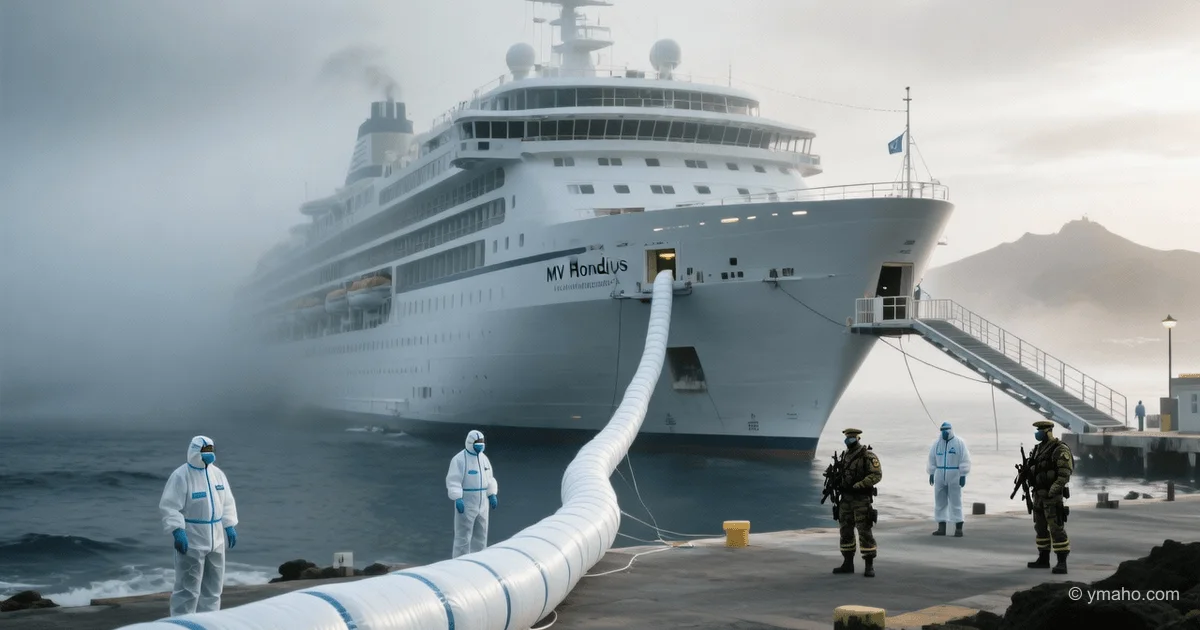
WHO Coordinates Evacuation of Cruise Ship Due to Outbreak of Human-to-Human Transmitted Hantavirus
WHO Director-General arrives in Spain to coordinate disembarkation of passengers from MV Hondius, where a rare 'Andes virus' capable of human-to-human transmission has been confirmed. Three passengers have died, and around 150 people are expected to be evacuated in Tenerife.
Hantavirus on a Cruise Ship: Anatomy of a Crisis That Could Have Been Avoided
Saturday's briefing in Madrid set the record straight: the WHO Director-General is personally flying to Tenerife to coordinate the arrival of the MV Hondius. An unprecedented sight—the head of the global health organization heading to meet a cruise ship with fewer than 150 passengers on board. To an outside observer, it looks like overkill. To an insider, it's a carefully orchestrated political spectacle, driven by something far greater than fear of a virus.
The Core: What's Really Happening
Formally, the WHO is coordinating the evacuation of passengers from a vessel where an outbreak of the Andes hantavirus has been confirmed—the only strain in this family capable of human-to-human transmission. Eight cases, three deaths, an incubation period of up to six weeks. But the real story isn't about the virus.
The real story is about post-COVID global health bureaucracy that cannot afford to make the same mistake twice. Tedros Adhanom Ghebreyesus, whose reputation was severely damaged during the COVID-19 pandemic, is turning a local outbreak into a demonstration of the effectiveness of the International Health Regulations. He isn't just meeting the ship—he is staging the 'right' response to a threat, the one the WHO failed to organize in Wuhan in January 2020.
Spain agreed to take the ship after a personal phone call between Tedros and Prime Minister Pedro Sánchez. The key word here is 'personal.' The WHO chief is using direct contacts with heads of state to bypass the multi-day diplomatic red tape in which any other international coordination would drown. This isn't crisis response—it's a drill for protocols written after 2020.
Timeline and Context
The countdown doesn't start on April 6, when the first patient felt symptoms. Nor on March 20, when the ship left Argentina. It starts on May 2, when the Netherlands, through the EWRS, notified the ECDC of a cluster of an unknown disease with severe respiratory symptoms.
Events then unfolded rapidly: on May 3, a PCR test confirmed hantavirus in a passenger evacuated to South Africa. By May 6, seven cases, three deaths. Geneva University Hospitals sequenced the virus and confirmed the Andes strain. By May 7, BNO News, BBC, and Politico picked it up—the information wave began.
The ship remained off the coast of Cape Verde, whose government refused docking. Cape Verde only agreed to medical evacuation of three patients—and that with WHO coordination. Prime Minister Ulisses Correia e Silva's message was clear: patients yes, ship no.
The decision to redirect the ship to Tenerife was made on Monday, May 4. Sánchez agreed, but with strict conditions: the ship does not enter port, passengers have no contact with the local population, and repatriation occurs directly through a sealed corridor at the port of Granadilla de Abona.
Who Wins and Who Loses
WHO wins—and it's the main beneficiary. The organization gets a case study of 'how to act,' which will be dissected at health assemblies for the next three years. Tedros, whose term ends in 2027, is shaping his legacy: he wants to go down in history not as the man who lost the COVID-19 pandemic, but as the architect of a revamped global response system.
ECDC wins—the European center deployed the EU Health Task Force in the field for the first time. Two experts and two EPIET fellows are working directly on the ship. Protocols are being tested that could theoretically be used in a bioterrorist attack or the next pandemic.
Canary Islands tourism loses—and this is an unexpected loser. The €17 billion industry gets the association 'Tenerife—hantavirus' two weeks before the high season starts. The island government is already recording the first booking cancellations, despite zero risk to the population. Protests by port workers in Granadilla are just the tip of the iceberg.
Oceanwide Expeditions loses—the Dutch operator, whose business is built on expedition cruises to remote regions. Insurance coverage for such an incident, according to industry data, does not exceed $10-15 million. Reputational losses are much higher: the clientele for such cruises are wealthy retirees from Northern Europe and the US, extremely sensitive to biorisks.
What the Media Isn't Saying
First non-obvious insight: the WHO is working with diagnostic kits provided by Argentina. 2,500 test systems were sent to five countries. Why does this matter? Because the Andes hantavirus is endemic to the Andes, and there are no global commercial tests for it. Argentina remains the only country with established expertise and production capacity. The WHO found itself dependent on national laboratories whose validation protocols differ from FDA or EMA standards.
Second non-obvious insight: the ECDC imposed a 6-week quarantine for contacts—a measure that the US CDC and UKHSA would never have agreed to for a respiratory virus with moderate lethality. This directly contradicts the 'low risk' narrative being publicly promoted. Behind closed doors, it's said that the true purpose of the quarantine is not epidemiological but administrative: to buy time to track all 23 nationalities across 12 countries.
Third non-obvious point: a positive test in a 69-year-old British man in intensive care in Johannesburg means the NHS will have to track not only passengers but also medical staff in South Africa who had contact with the patient before isolation. This is an intercontinental chain of contacts that will almost certainly lead to at least one secondary case outside the ship.
Forecast: Next 30 Days
First week (May 10-16): The ship arrives in Tenerife. Repatriation of 147 passengers and crew will take 48-72 hours. Spanish military aircraft will evacuate 14 Spanish citizens to Gómez Ulla Hospital in Madrid. Other EU citizens will be flown out by planes from France, Germany, Belgium, Ireland, and the Netherlands under the European Civil Protection Mechanism.
Second to third week (May 17-30): Peak case detection period. The incubation period for the Andes strain is up to 6 weeks, but the median is 2-3 weeks. Another 3-7 cases are expected among passengers who left the ship in Saint Helena on April 24. UKHSA is already tracking 7 Britons who disembarked on Saint Helena—two voluntarily self-isolated, five have not yet returned to the UK. The US is monitoring three in Georgia and Arizona.
Fourth week: Publication of genomic analysis. Geneva University Hospitals have already sequenced the virus. The phylogenetic tree is expected to show a link to Argentine isolates from the Bariloche region—the site of a bird-watching tour attended by the first patient couple before boarding.
Forecast: Next 90 Days
Second half of June: The WHO will present a response report at the World Health Assembly. The document will be positioned as the 'gold standard' for applying the IHR (2005).
July: The ECDC will release updated hantavirus guidelines—the first since 2016. The main change will involve risk assessment protocols for the cruise industry and air travel.
August: Two parallel processes will unfold. Scientific—publications in Lancet Infectious Diseases and Emerging Infectious Diseases. Legal—Oceanwide Expeditions will start receiving the first lawsuits from the families of the deceased. Lawyers will argue that the company failed to warn passengers about the risks of visiting hantavirus-endemic areas in Argentina.
The money question: the total economic damage to the cruise industry from this incident, by conservative estimates, will be around $450-500 million—including booking cancellations, insurance payouts, and enhanced sanitary protocols.
The main non-obvious takeaway from this whole story: the WHO is not afraid of the Andes hantavirus. The WHO is afraid of repeating the mistake of 2020. The MV Hondius is not a cruise ship—it's a floating testing ground for a new paradigm of global response. And every official involved in this operation knows: if the protocols work in Tenerife, they will work anywhere. If not, the organization won't get a second chance to repair its reputation.
— Editorial Team









