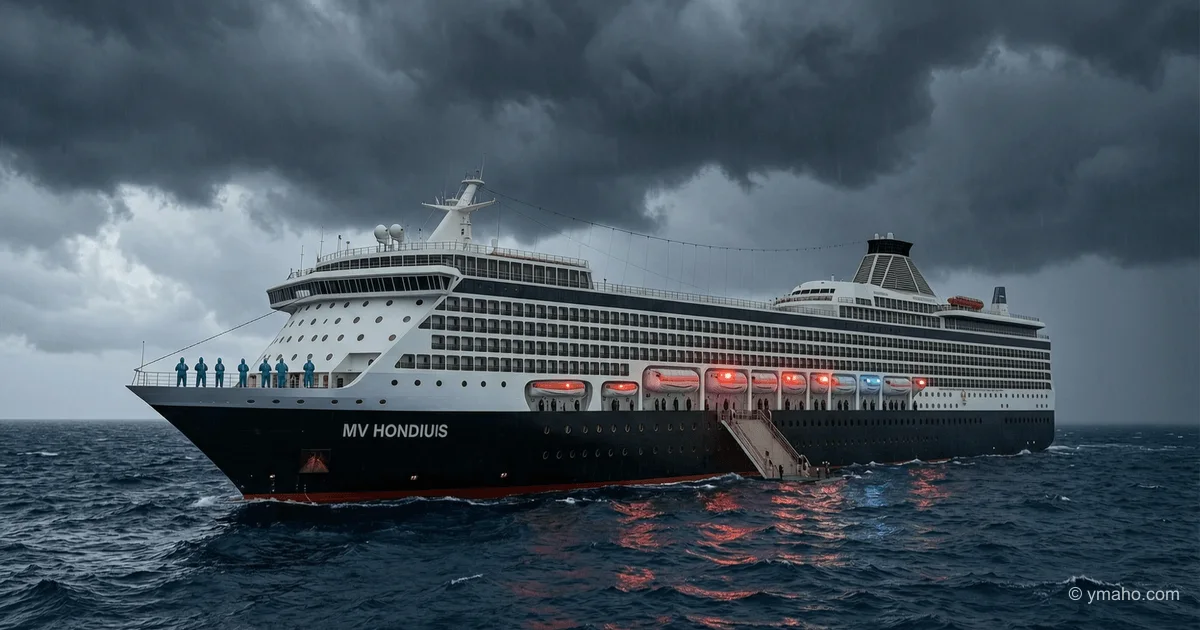
WHO: Hantavirus Outbreak on Cruise Ship Affects Multiple Countries
The World Health Organization (WHO) has reported an outbreak of hantavirus infection on a cruise ship in the South Atlantic. Seven cases have been registered (2 confirmed, 5 suspected) with three fatalities; WHO assesses the overall risk to the global population as low and is coordinating international response measures.
The Core: What Is Really Happening
On board the MV Hondius, a Dutch-flagged cruise ship sailing from Ushuaia, Argentina to the Cape Verde Islands, an outbreak of hantavirus cardiopulmonary syndrome (HCPS) has unfolded—an extremely rare disease with a fatality rate reaching 50% in South America. As of May 6, 2026, seven cases have been registered: two laboratory-confirmed by PCR, five suspected. Three people have died—citizens of the Netherlands and Germany. One patient remains in intensive care in Johannesburg, another is hospitalized in Zurich after disembarking and returning to Switzerland.
The key fact distinguishing this outbreak from routine zoonotic incidents: molecular typing conducted by the National Institute for Communicable Diseases (NICD) of South Africa identified the Andes virus (ANDV)—the only hantavirus with documented human-to-human transmission. The official WHO hypothesis is that primary infection occurred in Argentina before boarding, and the virus then spread among passengers in the ship's confined space. It is this—not just the outbreak itself—that is the true cause for international concern.
Timeline and Context
The events unfolded amid a complete information blackout for nearly a month. A retrospective analysis published by WHO in DON 599 reconstructs the picture:
- April 1, 2026: MV Hondius departs Ushuaia. On board are 147 people (88 passengers, 59 crew) of 23 nationalities, including citizens of nine EU/EEA countries.
- April 6: A male passenger develops fever, headache, and diarrhea.
- April 11: He dies on board from respiratory failure. The body remains on the ship.
- April 24: The body is removed from the ship at Saint Helena Island. His wife, who also had gastrointestinal symptoms, disembarks.
- April 25-26: The woman dies at Johannesburg airport while attempting to fly to the Netherlands.
- April 27: A third passenger is evacuated from Ascension Island to South Africa with severe pneumonia.
- May 2: PCR testing in South Africa confirms hantavirus. The UK notifies WHO under the IHR mechanism. That same day, a fourth passenger dies on board.
- May 4: The ship anchors off Praia, Cape Verde. WHO activates three-level coordination.
The media misses a crucial point: WHO learned of the outbreak a month after the first case—and only because South Africa performed an extended PCR panel on a patient after ruling out all standard respiratory pathogens. The ship's doctor evidently had neither diagnostic capabilities nor awareness of hantavirus. The first body remained on board for 13 days.
Winners and Losers
Winners
National public health institutes with ready sequencing infrastructure. South Africa's NICD performed confirmatory diagnostics and is now conducting whole-genome sequencing of the virus. This gives South Africa unique molecular epidemiological data on ANDV, which normally circulates only in South America. The country gains operational experience in intercontinental containment—a competency that directly translates into negotiating weight in the IHR.
Medical evacuation operators. Three medical evacuations—to South Africa, the Netherlands, and Switzerland—with logistics via Cape Verde and the Canary Islands. Each operation costs between $40,000 and $120,000 depending on distance and isolation level. Insurers and specialized companies like International SOS are seeing increased demand for emergency medical transport from remote regions.
Regulatory agencies promoting the pandemic treaty. WHO uses the incident to demonstrate the functionality of the 2005 IHR mechanisms and the EMT-ERCC agreement with the EU. Acting Director for Epidemic Preparedness Maria Van Kerkhove coordinates actions across five countries through national IHR focal points. This is an argument for extending negotiations on pathogen sharing, which have stalled since 2025.
Losers
The polar and expedition cruise industry. MV Hondius is an ice-class expedition vessel owned by Dutch company Oceanwide Expeditions. The itinerary included landings in mainland Antarctica, South Georgia, Tristan da Cunha, Saint Helena, and Ascension Island. Biosecurity on such routes has traditionally focused on invasive species and ecosystem disruption, not zoonoses transmitted from wild rodents to humans. Insurance premiums for expedition cruises will inevitably rise after this incident, possibly by 15-25%.
The tourism sector of the Canary Islands. Madrid's decision to send the ship to Tenerife met strong resistance from local authorities. Canary Islands President Fernando Clavijo publicly stated: "There is no information justifying a three-day transit of the ship to the Canaries." The conflict between the central government and the autonomous region has already damaged the islands' reputation as a safe destination—even though the risk is assessed as "very low."
Passengers on the flight from Saint Helena to Johannesburg. The confirmed ANDV case in the woman who took this flight on April 25 triggered contact tracing on the air route. South Africa has already tracked 42 of 62 identified contacts. Even though ANDV transmission requires close and prolonged contact, the psychological effect for these people is comparable to the COVID-19 experience.
What the Media Is Not Saying
Insight #1: ANDV is the only hantavirus capable of human-to-human transmission, and this changes containment protocols. The standard dogma of hantavirus epidemiology is "zoonosis, humans are dead-end hosts." But ANDV breaks this rule. ECDC explicitly states: human-to-human transmission is documented for close and prolonged contact. The confined space of a cruise ship with common areas is an ideal environment for such a scenario. Indeed, this is why ECDC applied the precautionary principle: consider all 147 people on board as close contacts. This radically expands the definition of persons under surveillance—45 days of active symptom monitoring for all.
Insight #2: WHO activated the Contingency Fund for Emergencies, but the funding scale is undisclosed. The phrase "WHO allocated funds from the Emergency Fund" sounds routine. However, the CFE is a rapid response tool that can unlock up to $500,000 within 24 hours without bureaucratic procedures. Given that coordination spans five countries, three medical evacuations, sample shipment to the Pasteur Institute in Dakar, and field presence in Cape Verde, expenses likely approach the upper limit.
Insight #3: The absence of Chinese tourists on board is not a coincidence but a structural pattern. The Chinese embassy in Cape Verde promptly stated that no Chinese citizens were on the ship. This reflects a broader trend: after COVID-19, Chinese outbound tourism remains concentrated on Asian destinations, and long-haul route recovery is extremely slow. The cruise industry, having lost a key growth driver from the 2010s, is forced to refocus on European and American retirees—precisely the demographic that predominated among MV Hondius passengers.
Forecast: Next 30 Days and 90 Days
30 Days (until June 6, 2026)
ANDV sequencing will be completed at NICD and/or the Pasteur Institute in Dakar. Expect publication of genomic data that will either confirm the Argentine origin of the strain or point to an unexpected source. ECDC and WHO will issue updated risk assessments.
The ship will arrive in Tenerife. Despite protests from Canary authorities, passengers will be disembarked under medical supervision. Each will receive instructions for symptom monitoring over 45 days. This will be a logistical test for the Spanish healthcare system—147 people from 23 countries to track after disembarkation.
Oceanwide Expeditions will face a wave of litigation. Families of the deceased—citizens of the Netherlands and Germany—are highly likely to file lawsuits. The question of whether passengers were informed about zoonotic risks during landings will become a subject of legal proceedings.
The stock market for cruise companies will show volatility. Although WHO emphasizes "low global risk," headlines about three deaths on a cruise ship will inevitably affect bookings. Shares of Carnival Corporation, Royal Caribbean, and Norwegian Cruise Line may drop 3-7% before the market realizes the isolated nature of the incident. Analysts draw an analogy with the norovirus outbreak on Oasis of the Seas in 2019—a short-term decline followed by recovery within a quarter.
90 Days (until August 5, 2026)
The 45-day monitoring period for all contacts will expire. If no secondary cases occur in destination countries—and ECDC assesses this risk as "extremely low"—the incident will be classified as an isolated outbreak with limited human-to-human transmission in a closed environment.
WHO will publish a final report with recommendations for the expedition cruise industry. These will likely include: pre-voyage screening for endemic zoonoses based on itinerary, strengthening shipboard medical capabilities (including access to real-time PCR diagnostics), and isolation protocols for undiagnosed respiratory illnesses. The industry will likely resist mandatory implementation, citing costs.
Argentina and Chile—countries where ANDV is endemic—will face diplomatic inquiries about the state of hantavirus surveillance. In 2025, the Region of the Americas reported 229 cases with 59 deaths (CFR 25.7%). This incident will inevitably draw attention to the quality of rodent surveillance in Patagonia and Tierra del Fuego—especially given that provincial authorities have stated there are no registered cases, contradicting WHO data on ANDV endemicity in Argentina.
Clinical teams in South Africa and Switzerland will publish case reports on treating severe HCPS. Given that ribavirin has shown no efficacy for hantavirus pulmonary syndrome and no specific antiviral treatment exists, therapeutic experience—extracorporeal membrane oxygenation, careful fluid management, vasopressors—will be a valuable contribution to the evidence base for future outbreaks.
The main takeaway for bio- and travel security professionals: ANDV has shown that a zoonosis can evolve into limited human-to-human transmission under suitable conditions—and a cruise ship proved to be an ideal environment. This is not a pandemic scenario, but a warning that the boundary between "zoonosis" and "infection with a human reservoir" is thinner than previously thought.
— Editorial Team









