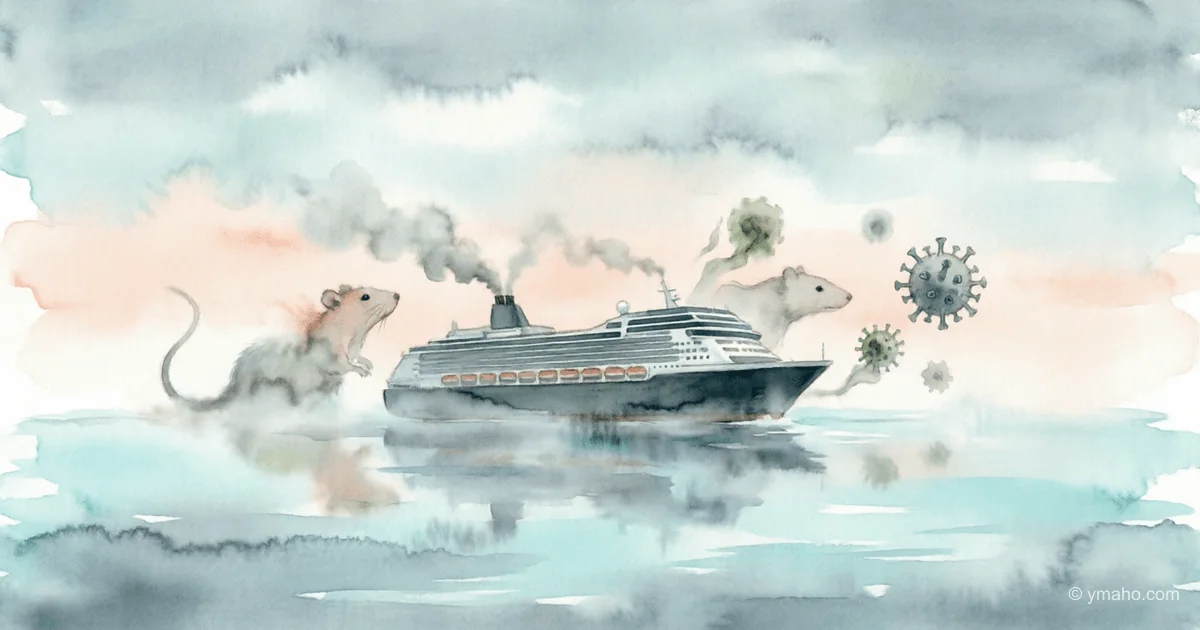
WHO Reports Hantavirus Outbreak on Cruise Ship with Three Fatalities
As of May 4, seven cases (two confirmed) of severe acute respiratory illness have been reported on a vessel traveling through the South Atlantic. WHO is coordinating an international investigation, assessing the risk of global spread as low, though the possibility of limited human-to-human transmission is being studied.
The hantavirus outbreak on the cruise ship MV Hondius is not a regional incident nor a repeat of COVID-19. It is the first documented episode of Andes orthohantavirus spreading in a confined environment of an international transport hub. The key issue is not the three deaths, but that a virus with a fatality rate of up to 50% and the ability for limited human-to-human transmission has crossed the geographic and environmental barrier between its natural reservoirs and the global mobile population.
By May 10, the number of confirmed cases reached seven, with two more awaiting verification. The vessel, which departed Ushuaia on April 1, 2026, visited remote locations in the South Atlantic, including mainland Antarctica, before anchoring off Cape Verde. Among the 147 people on board are citizens of 23 countries. The incubation period of up to 42 days means that potentially infected individuals have already dispersed to the US, Canada, Europe, and Australia.
Timeline and Context
The alert came on May 2, 2026: the UK National IHR Focal Point notified WHO of a cluster of severe acute respiratory illnesses on board a Dutch-flagged vessel. Laboratory confirmation of hantavirus was obtained in South Africa on May 2. The key decision—identifying the strain specifically as Andes virus—was announced by WHO on May 6.
Andes orthohantavirus is endemic to the southern Andes—Argentina and Chile. In 2025, 229 cases and 59 deaths were reported there, with a CFR of 25.7%. The reservoir is the long-tailed rice rat (Oligoryzomys longicaudatus). Infection typically occurs through inhalation of aerosolized rodent excrement. However, Andes is the only hantavirus for which human-to-human transmission has been proven, occurring through close and prolonged contact.
This fact makes the MV Hondius cluster a precedent. Previous episodes of human transmission were recorded in stationary communities—families, rural settlements, healthcare workers. Now, the virus has entered an environment with high density, closed ventilation, intense social interaction, and—critically—subsequent aviation dispersion of contacts.
Winners and Losers
Cynically, there are several winners. Diagnostic system manufacturers—CDC has already activated testing through its laboratory network, sent Health Alert Network messages on May 8 and 18, and recommended retesting 72 hours after symptom onset. Every suspected case in the US, Europe, and Asia means an order for PCR panels. Second are pharmaceutical companies with broad-spectrum antivirals in their pipelines. Hantavirus has no specific therapy or vaccine—only supportive care and ECMO in severe cases. Any candidate showing in vitro efficacy against Bunyavirales gains an argument for accelerated approval. Third are developers of portable biosafety systems. The US has already repatriated 17 citizens in "biocontainment chambers" to Nebraska. This case will catalyze government procurement of isolation transport modules.
The losers are obvious. The cruise industry, still recovering from the reputational damage of COVID-19. Operator Oceanwide Expeditions specializes in polar expeditions. Their business model involves long autonomous voyages with remote landings. One such incident will lead to stricter IMO sanitary protocols and likely a 30–50% increase in insurance premiums. Healthcare systems in countries where passengers have returned: the Andes virus incubation period is up to 42 days. Each returnee requires long-term monitoring, isolation, and testing. Twenty-two contacts of a French passenger are already being traced. The cost of one such case ranges from $50,000 to $150,000 for laboratory logistics, quarantine measures, and epidemiological investigation.
What the Media Isn't Saying
The first blind spot is aviation contact. Patient 2—a 69-year-old woman—left the ship on Saint Helena on April 24, flew commercial to Johannesburg, and died in the emergency room on April 26. She was symptomatic during the flight. Contact tracing of flight passengers has been initiated, but full results have not been published. Moreover, a Dutch KLM steward was hospitalized in Amsterdam with suspected hantavirus after contact with an infected passenger in Johannesburg. This means the "cruise—aviation—hospital" chain has already materialized, and we are only seeing the tip of the iceberg.
The second non-obvious point: the US decision to ignore the 42-day isolation recommended by WHO. Tedros Adhanom Ghebreyesus directly stated that this "may carry risks." CDC limited itself to monitoring and recommending self-isolation, but not quarantine. The reason is not medical but legal: a federal quarantine order in the US is a politically toxic tool after COVID-19, and the administration avoids it at all costs. If even one of the 17 repatriated passengers develops symptoms and transmits the virus in a community setting, a Congressional investigation will follow.
Forecast: Next 30 Days and 90 Days
In the next 30 days, the number of confirmed cases will reach 12–15. This is not exponential growth but a manifestation of the incubation period. Some passengers who disembarked on April 24 are only now entering the symptom window. Special attention to Australia and New Zealand: four Australians and one New Zealander remained on board as of May 10. If they develop symptoms after returning, it will create a trans-Pacific surveillance axis.
In the 90-day perspective, I expect institutional consequences of two types. First, WHO will initiate a revision of recommendations for biological risk management on cruise ships. Vessel Sanitation Program standards, focused on gastroenteritis, will seem archaic. Requirements for ventilation systems, isolation cabins, and onboard diagnostics will be rewritten. Second, the FDA and EMA will receive at least two applications for breakthrough designation for antivirals targeting hantaviruses. The hantavirus therapy market is too small for commercial development under normal conditions, but the MV Hondius precedent creates a regulatory pull.
The main takeaway is the fragility of the global biosafety architecture. The virus did not mutate or acquire new properties. It simply entered an unfamiliar environment—and that was enough to generate, within 30 days, a cross-border incident with three deaths, evacuations, political friction between WHO and the US, and unplanned costs in the tens of millions of USD. COVID-19 began with isolated pneumonias. And the Andes virus on MV Hondius is not a repeat of that scenario, but a reminder that the architecture that created the vulnerability has not changed.
— Editorial Team









