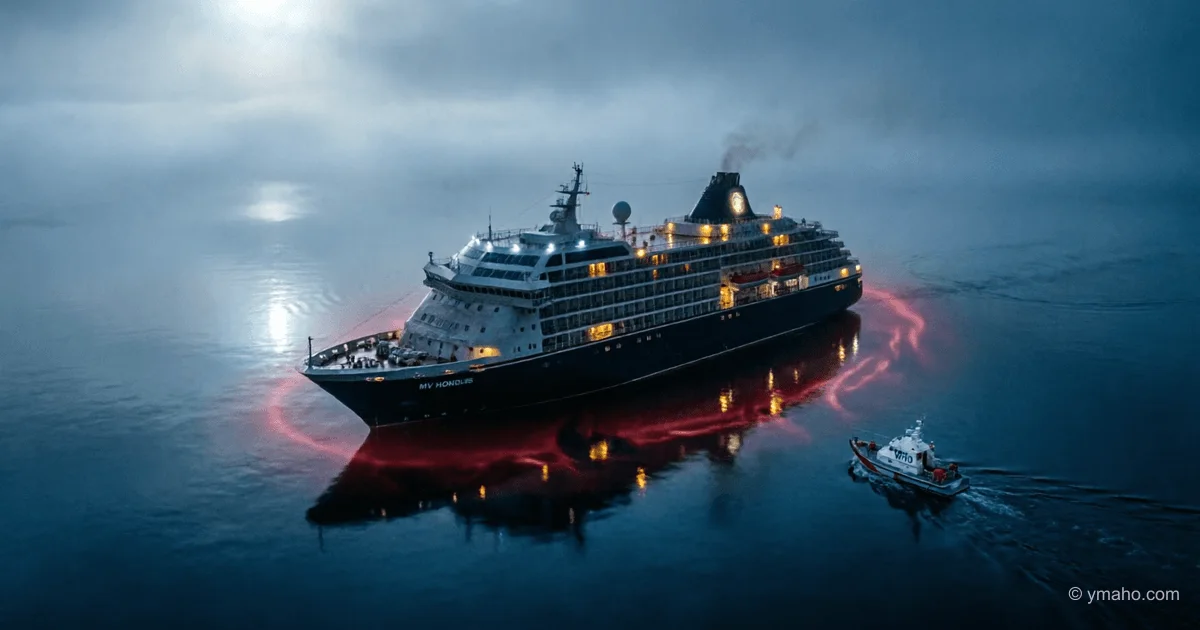
WHO Investigates Deadly Hantavirus Outbreak on Cruise Ship
The MV Hondius has reported a suspected hantavirus outbreak: three dead, one in intensive care. WHO is coordinating evacuation and epidemiological investigation. The virus is transmitted by rodents and can cause severe respiratory syndrome.
Hantavirus in international waters: why the outbreak on a cruise ship has become a global test for health diplomacy
Introduction
The cruise ship MV Hondius, sailing from Ushuaia, Argentina, to Cape Verde, has become the center of an international emergency. As of May 3, 2026, the World Health Organization confirmed an outbreak of hantavirus infection on board, claiming three lives and leaving one passenger in intensive care. The incident, which began as a local medical problem, quickly escalated into a multilateral crisis involving WHO, the governments of the Netherlands, South Africa, and Cape Verde. The situation is complicated by port authorities refusing to dock the ship, the virus's long incubation period, and the hypothetical—though extremely rare—possibility of human-to-human transmission in the confined environment of the vessel.
Event Details and Timeline
The MV Hondius is a Polar Class 6 ice-strengthened vessel owned by the Dutch company Oceanwide Expeditions, specializing in polar cruises. On board are approximately 150 passengers and 71 crew members. The ship departed Ushuaia about three weeks ago, traveling through Antarctica, the Falkland Islands, and South Georgia, with its final destination in Cape Verde.
The timeline of events is as follows:
The first to fall ill was a 70-year-old Dutch national. Symptoms—fever, headache, diarrhea—appeared on the leg from Ushuaia to Saint Helena. The man died on board, and his body was temporarily placed on Saint Helena, a British Overseas Territory in the South Atlantic.
His 69-year-old wife also felt unwell and left the ship, intending to fly to the Netherlands. However, at Johannesburg Airport in South Africa, she lost consciousness and later died in hospital. The third fatality occurred on board; the body remains on the ship.
A laboratory-confirmed case of hantavirus is a 69-year-old British citizen who is in intensive care in Johannesburg. Two more crew members with symptoms remain on the MV Hondius. In total, WHO counts six affected individuals: one confirmed case and five suspected.
According to Marine Traffic, the ship has been anchored off the coast of Cape Verde near the capital Praia for at least a day, without permission to disembark.
Context: What Is Known About Hantavirus
Hantaviruses are a family of viruses whose natural reservoir is small mammals, primarily rodents. Human infection occurs mainly through inhalation of aerosolized particles from the excrement of infected animals. Less commonly, the virus is transmitted through bites or scratches.
The incubation period ranges from one to eight weeks—a critical factor in the current situation, as new cases among passengers and crew may not appear immediately.
Clinically, hantavirus causes two main syndromes. Hantavirus pulmonary syndrome begins with fatigue, fever, and muscle aches, followed by headaches, dizziness, and gastrointestinal symptoms; when respiratory manifestations develop, mortality reaches approximately 38%. Hemorrhagic fever with renal syndrome involves kidney damage, internal bleeding, and acute kidney failure; about 150,000 cases are reported annually worldwide, mainly in Europe and Asia.
There is no specific treatment; supportive care is provided, including oxygen support, mechanical ventilation, and dialysis if necessary.
A key question for epidemiologists is whether hantavirus is transmitted from person to person. The scientific consensus leans toward human-to-human transmission being extremely rare, and debate continues in the medical literature about whether it occurs at all. Professor Paul Griffin from Mater Health Services in Australia characterizes such transmission as "extremely rare." Microbiologist Siouxsie Wiles emphasizes that hantavirus outbreaks are usually sporadic and quickly die out.
Logistical Impasse: Denial of Port Services
The most acute aspect of the situation is the inability to evacuate the sick ashore. Authorities in Cape Verde have denied the ship permission to disembark passengers and crew, fearing the introduction of infection into the country. Local doctors visited the ship to assess the condition of two ill crew members, but permission for their evacuation has not been granted.
Meanwhile, Dutch authorities have initiated a repatriation operation for the sick. Oceanwide Expeditions stated: "The Dutch authorities have agreed to lead a joint effort to organize the repatriation of two symptomatic individuals from the MV Hondius from Cape Verde to the Netherlands." However, the operation depends on many factors, including local authorities' permission for the patients to leave.
WHO Director-General Tedros Ghebreyesus said the organization is "facilitating the medical evacuation of two symptomatic passengers, conducting a full risk assessment, and supporting those affected on board," adding: "Rapid coordinated action is critical to contain risks and protect public health."
Impact and Significance
For public health. The MV Hondius incident is not so much an epidemiological catastrophe (six cases do not pose a large-scale threat) as a test of the international health response system's readiness for unusual situations. An outbreak in the confined environment of a cruise ship in international waters creates jurisdictional uncertainty: which country is responsible for evacuation, treatment, and quarantine measures?
Cape Verde's refusal to accept the ship illustrates a growing trend of "health isolationism," familiar from the early stages of the COVID-19 pandemic. This precedent could have long-term consequences for the cruise industry and international maritime law.
For the cruise industry. The MV Hondius is a premium vessel, with 11-day tours costing between $13,000 and $15,000. The incident undermines confidence in the safety of polar cruises, a growing market segment. Oceanwide Expeditions has already suffered reputational damage, and the industry as a whole may face stricter sanitary requirements for routes passing through regions with natural foci of zoonotic infections.
For epidemiology. The MV Hondius case raises several questions for the scientific community. First, the source of infection: passengers could have been infected ashore during one of the stops (Falkland Islands, South Georgia), or an infected rodent could have been present on board. Second, the mechanism of spread: if human-to-human transmission occurred, it would require a revision of understanding of hantavirus epidemiology. Epidemiologist Michael Baker also proposes an alternative hypothesis: passengers could have been infected independently before boarding, and the long incubation period led to synchronous symptom onset during the voyage.
For global health systems. Virus sequencing, initiated by WHO, should determine whether the cases are linked and identify the specific hantavirus strain. This will guide further preventive measures and recommendations for countries along the ship's route.
Reactions of Key Players
WHO is acting in a coordinating role, lacking direct authority to compel states to accept the ship. The organization has announced a full epidemiological investigation, including additional laboratory testing and virus sequencing.
South Africa has been most active in providing medical care—the confirmed patient was hospitalized in Johannesburg. South African Department of Health spokesperson Foster Mohale provided detailed information on the timeline.
The Netherlands, as the ship's flag state, initiated the repatriation operation. The Dutch Ministry of Foreign Affairs confirmed the deaths of two Dutch citizens.
Cape Verde took the hardest line, effectively blocking disembarkation. However, local doctors were allowed on board for medical examination, indicating an attempt to balance humanitarian obligations with protecting their own population.
Oceanwide Expeditions, the ship's operator, confirmed a "serious medical situation" on board and stated that the link between the three deaths and hantavirus has not yet been established. The company also said that "the exact cause and possible connection are being investigated."
Forecast and Conclusions
The coming days will be decisive for resolving the crisis. Repatriation of the sick crew members to the Netherlands is a priority, but its implementation depends on negotiations with Cape Verde. The refusal to disembark sets a dangerous precedent: a ship with potentially infectious patients remains in international waters, and the possibility of providing qualified care diminishes with each passing hour.
The medium-term task is to complete the investigation. The answer to whether the virus was transmitted from person to person will determine the scale of necessary quarantine measures. If human-to-human transmission is confirmed, all 220 people on board will have to be considered a contact group with appropriate monitoring. If the hypothesis of independent infection from a common natural source is confirmed, the focus will shift to identifying and eliminating that source.
Long-term consequences of the incident will affect international maritime law. A situation where a port state can deny a ship humanitarian disembarkation of the sick reveals a gap in the International Health Regulations. It is likely that WHO and the International Maritime Organization will initiate the development of protocols for such situations.
Notably, the incident occurred just a few years after the COVID-19 pandemic, which also began with signals of an unclear respiratory infection. However, the scale is fundamentally different: hantavirus does not have the contagiousness of coronavirus, and even in the worst-case scenario, its pandemic potential is close to zero. This allows the MV Hondius situation to be viewed precisely as a system test—and so far, this test reveals serious cracks in coordination between national interests and global health security.
Epidemiological conclusions will become clear within one to eight weeks—the incubation period of hantavirus. If no new cases appear on board during this time, the crisis can be considered contained, and attention will shift to systemic lessons and reforms.
— Editorial Team









