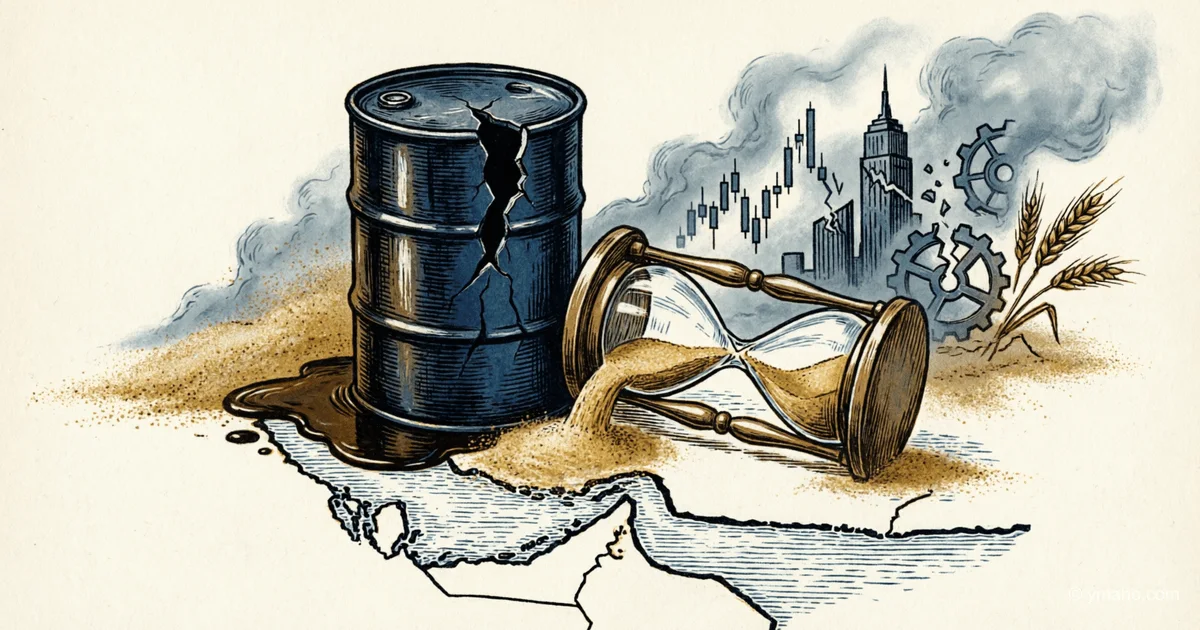
Head of RDIF Warns of Catastrophic Consequences of War in the Middle East
Russian Presidential Special Representative Kirill Dmitriev stated that the absence of peace in the region will lead to a catastrophic irreversible collapse. He thus commented on reports of a possible 60-day extension of the truce between the US and Iran.
A cry of despair or a backroom deal: who really needs the 'catastrophic collapse' from the head of RDIF
Author's analytical review
[The Gist]: What is really happening
Kirill Dmitriev is not just the head of the Russian Direct Investment Fund. He is a man who has been under US sanctions since 2025, yet regularly meets with Steve Witkoff and Jared Kushner. He is a communication channel between the Kremlin and the Trump administration when official diplomatic channels fail.
And when such a man writes on social media X: 'The world needs peace to avoid a catastrophic irreversible collapse,' this is not philanthropy. It is a bargaining position.
What is really happening? Dmitriev comments on rumors of a possible 60-day extension of the truce between the US and Iran. The Financial Times reports that the parties are close to an agreement that includes a phased reopening of the Strait of Hormuz and the transfer of enriched uranium stockpiles.
But look at what the headlines omit. Dmitriev is not calling for peace for peace's sake. He is warning of a catastrophic collapse in the absence of peace. This is a classic 'name your price for participation' tactic: without Russia, peace is impossible, meaning Russia must be included in the negotiation process and its interests must be considered.
And these interests, as I will show below, have a direct, dollar-measurable expression.
Timeline and Context
To understand the weight of Dmitriev's statement on May 22, 2026, we need to look at his previous statements—they form a clear pattern.
April 6, 2026 — Dmitriev writes on social media that 'a catastrophic oil deficit is inevitable' after Saudi Arabia imposed a $20 per barrel premium on May deliveries. Brent price at that time is around $110.
May 3, 2026 — Dmitriev states that 'the world is imperceptibly moving toward the largest energy crisis in history.' He mentions that the IEA warns that Europe has six weeks of jet fuel left if the strait does not open.
May 5, 2026 — Information leaks to the media that at a meeting in Miami, Dmitriev offered the US a deal: Russia stops transferring intelligence data to Ukraine in exchange for an end to US support for Iran. The White House refused.
May 21-22, 2026 — Dmitriev warns of an 'energy tsunami' that will hit Europe and the UK.
May 22, 2026 — Statement about a 'catastrophic irreversible collapse.'
What is important in this timeline? Dmitriev consistently escalates rhetoric about the energy crisis from April to May. But on May 22, he makes a key shift: from predicting a crisis to conditions for its prevention. 'The world needs peace' is not a statement of fact. It is an ultimatum wrapped in humanitarian rhetoric.
Iran and the US are indeed close to an agreement. Iranian Foreign Ministry spokesman Baghaei stated that Tehran and Washington are in the final stages of preparing a memorandum of understanding. On May 24, a meeting was held between Iranian Deputy Foreign Minister Takht-Ravanchi and the ambassadors of Russia and China in Tehran. Russia is at the negotiating table. And Dmitriev reminds everyone that without consideration of Russian interests, 'collapse' is inevitable.
Who Wins and Who Loses
Winner #1 — Russia. This is obvious, but the mechanism is not. If the US and Iran make peace, the Strait of Hormuz will open. Oil prices will fall. But Russia, as one of the security guarantors in the region (through coordination with Iran and China), gains diplomatic capital that can be converted into sanctions relief. Dmitriev has already tried to trade the Iranian dossier for the Ukrainian one—now he has a new round.
Winner #2 — Europe, but with a big caveat. Dmitriev directly stated that Europe faces an 'energy tsunami.' And this is true. The UK has already issued a temporary license to import Russian diesel and jet fuel. The US extended the sanctions exception for purchases of Russian oil. Without peace in the Gulf, Europe will have to return to Russian energy—and Dmitriev says so openly: 'The EU will inevitably beg for Russian gas.'
Loser — Ukraine. Because Russian-American negotiations on Iran are a bargaining chip. Dmitriev already tried to exchange aid to Ukraine for Russian non-interference in Iran. The Trump administration refused, but in the new configuration, with peace with Iran close, Russian 'approval' may cost concessions on Ukraine. For Kyiv, this is an existential risk.
Unobvious loser — China. Beijing is also involved in the negotiations—the Chinese ambassador was at the same meeting on May 24 in Tehran. China is the largest buyer of Iranian oil. But if peace is brokered through Russia, it is Moscow, not Beijing, that will reap the political dividends. China remains in the shadow of Russian influence in the Middle East.
Those not named but in the game — oil traders who opened short positions. The market prices in a risk premium for oil. At any news of peace, the price falls. Dmitriev, publicly supporting the 60-day truce, effectively signals to the market: 'Peace is possible.' Someone will make billions from this. The question is who.
What the Media Leaves Out
Insight #1 — The 'uranium trail' in Dmitriev's statement.
Right now, negotiations are underway about who will get Iran's enriched uranium. Russia offered to take the uranium for safe storage. The US has so far refused. Iran, in turn, will discuss the fate of nuclear materials jointly with Moscow.
Why is this important for Dmitriev's statement? Because 'catastrophic irreversible collapse' is not about oil. It is about nuclear proliferation. If negotiations fail, Iran remains with enriched uranium. If the US launches new strikes, the uranium could be destroyed or dispersed. If Russia takes the uranium, Moscow gains leverage over the entire Middle Eastern balance.
Dmitriev, as head of RDIF, formally has nothing to do with nuclear materials. But he is Putin's trusted negotiator. His statement is a public reminder: 'Without us, you cannot solve the uranium problem.'
Insight #2 — Why '60 days' is a magic number.
The truce is proposed for exactly 60 days, not 30 or 90. Why? Because 60 days is the time needed to organize the removal of uranium, open the strait, and unfreeze Iranian assets. It is also a period that Trump can 'sell' to his voters as a temporary measure, not a capitulation to Iran.
But for Dmitriev, 60 days means something else. It is time to cement Russian presence in the Iranian economy. RDIF has already invested in Iran. After sanctions are lifted, Russian companies will receive preferences. And Dmitriev—as head of RDIF—personally benefits from peace coming quickly, but not too quickly, to prepare the ground.
Insight #3 — The hidden message for American traders.
Notice the platform Dmitriev chose. He wrote on X in English. Not in Russian. His audience is not Russians. His audience is international markets and the US administration. 'The world needs peace to avoid a catastrophic irreversible collapse'—this is a message addressed to those making decisions about the Fed rate, sanctions, and military aid.
Every major trader in London and New York read this post. And each of them understands: if the truce is not extended, oil will go to $150. If it is, oil will go to $90. Dmitriev is not just commenting. He is managing expectations.
Forecast: Next 30 Days and 90 Days
Next 30 days:
- US-Iran negotiations — high probability (60-70%) of signing a memorandum of understanding within 2-3 weeks. Iran and the US are in the final stages.
- Brent oil price — if truce signed: decline to $85-92 within 10 days. If talks fail: rise to $115-125.
- Ruble and Russian stock market — if truce: ruble strengthens (likely to 80-85 per dollar) and MOEX index rises 5-8% due to reduced geopolitical premium. If escalation: opposite effect.
- Dollar — in peace scenario: weakening to 98-99 on DXY. In war scenario: rise to 103-104.
Next 90 days:
Baseline scenario (55% probability): 60-day truce signed. Strait of Hormuz gradually reopens. Iranian oil returns to market. Brent stabilizes in $85-95 range. Russia gains role as deal guarantor and diplomatic capital. US eases some sanctions on Iran, but not on Russia.
Escalation scenario (30% probability): truce not extended. US and Israel launch new strikes. Iran responds with missile attacks. Strait of Hormuz blocked. Oil at $130-160. Fed forced to raise rates. Global recession with 45% probability.
'Grand Bargain' scenario (15% probability): Russia, US, and Iran sign a trilateral agreement. Russia takes Iranian uranium for storage. US lifts some sanctions on Russia in exchange for Moscow dropping support for Iran (or concessions on Ukraine). This is unlikely, but if it happens, it will change the entire global configuration. Oil at $75-85. Markets in a powerful rally.
Editorial Forecast
Asset: Brent oil (futures for August 2026)
Direction: Sideways with a decline in the next 24-72 hours
Key levels: current level around $96-100. On news of progress in negotiations (60-day truce) — decline to $90-92. On no news — consolidation.
Confidence level: medium (60%). The market has already priced in the probability of a truce, but not fully. Dmitriev's statement could be a trigger for profit-taking by long positions.
Main risk: Sudden escalation (new US strikes on Iran). In this scenario, oil will instantly jump to $115-120, and the forecast for a decline will prove wrong. Probability of this scenario in the next 72 hours: 25-30%.
This forecast is an analytical opinion of the editorial board and does not constitute individual investment advice. Make decisions based on your own risk assessment and consultations with licensed financial advisors.
— Editorial Team









