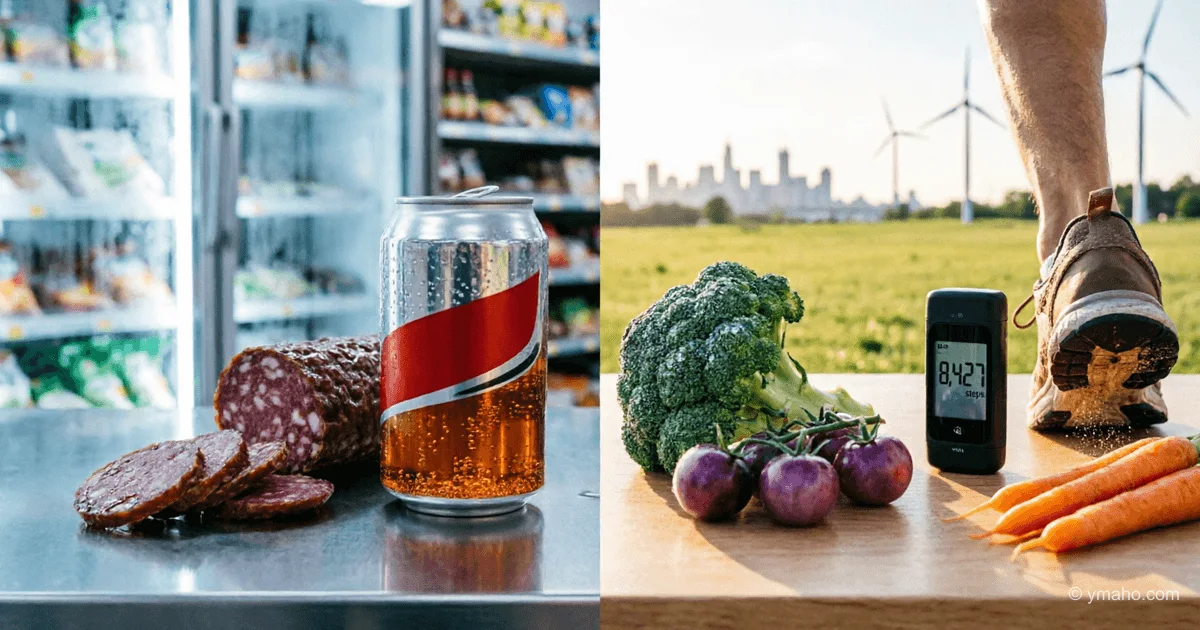
Russian Government Approves New Strict Healthy Lifestyle Recommendations for Citizens
The methodological recommendations call for eliminating sausages, processed foods, and sugary drinks from the diet, and also regulate breakfast within an hour of waking, at least 7,000 steps per day, and avoiding gadgets before bed.
The Gist: What's Really Happening
What the media presents as "new strict healthy lifestyle recommendations" is actually a classic example of turning state demographic policy into a consumer regulation. The government isn't just advising citizens to eat right—it is building a regulatory framework that, in the medium term, will transform the structure of retail demand, insurance medicine, and the functional food market.
Behind the phrases "eliminate sausages and sugary drinks" lies not concern for an individual Russian's waistline, but cold macroeconomic calculation. The state is the largest payer for medical care through the compulsory health insurance (CHI) system. The state guarantees program for 2026–2028 already provides for an increase in financial costs per unit of medical care by an average of 6.8% in 2026. Preventing chronic non-communicable diseases becomes a matter of direct savings for the budget.
The recommendations are a soft form of coercion that precedes strict regulation. First, "methodological recommendations," then voluntary certification, then excise taxes and sales restrictions. This is exactly the trajectory followed by the tobacco and alcohol industries. Now it's ultra-processed food's turn.
Timeline and Context: From Scattered Signals to Systemic Pressure
The chain of events forms a logical sequence. June 2025: First Deputy Chairman of the Federation Council Committee Sergei Mitin publicly states that Russians' diets are unbalanced—vegetable intake is 26% below the norm, fruit 23%, meat and poultry 20%. This is an official recognition of a systemic problem at the legislative level.
December 2025: The state guarantees program for 2026–2028 is approved, with increased standards for preventive measures. The budget allocates billions of rubles to prevent what can be prevented through diet and lifestyle. Simultaneously, the 2026 federal budget distributes subsidies for cardiovascular disease prevention—the leading cause of death, directly linked to diet.
February 2026: Nearly 80% of Russians in surveys cite healthy eating as the foundation of a healthy lifestyle, and demand for healthy lifestyle products in federal chains grows by 15–30% over two years. The market itself signals readiness for change.
May 2026: Methodological recommendations appear with extremely specific prescriptions—breakfast within an hour of waking, 7,000 steps, avoiding gadgets before bed. This is no longer an abstract "eat right" but a detailed regulation of daily behavior.
Who Wins and Who Loses
Winners:
Producers of functional foods and clean-label products. The functional food market in Russia is growing explosively: according to Roskachestvo, there are already over a hundred certified items from nine companies. Sales of the protein line of the Green Line brand grew 51% year-on-year in Q1 2026. Government recommendations effectively subsidize demand for these categories.
Retailers who have invested in healthy lifestyle assortments. Perekrestok reports that the Green Line brand's share reached 9.1% of all supermarket purchases—almost every tenth receipt. This is no longer a niche but mainstream.
Producers of dietary supplements and sports nutrition. In winter 2025–2026, segment turnover grew 2.5 times, and the number of purchases nearly doubled. The methodological recommendations will only strengthen this trend.
Losers:
Producers of sausages, processed foods, and sugary drinks. This is a direct hit on the "eliminate from diet" list. The ultra-processed food industry finds itself in the position of tobacco companies in the 2000s: first recommendations, then labeling, then excise taxes.
Small food retailers in regions where healthy lifestyle assortments are poorly developed. Consumers following recommendations will migrate to federal chains with their healthy lifestyle shelves, leaving local players without traffic.
Low-income consumers. Healthy lifestyle products and functional foods cost on average 30–50% more than regular alternatives. Recommendations not backed by subsidies for healthy eating create a two-tier system: those who can afford a healthy lifestyle and those forced to eat "unhealthily."
What the Media Leaves Out
The main non-obvious insight: This story intersects the interests of three powerful lobbying groups, and the state acts not as an initiator but as an arbiter between them.
The first group is functional food producers. The Association of Functional Food Producers, created a couple of years ago, now includes 42 companies. This is a full-fledged lobbying force interested in the state officially recognizing ultra-processed food as harmful and functional food as recommended. The emergence of methodological recommendations with direct instructions to eliminate sausages is a victory for their lobby.
The second group is insurance companies and the Ministry of Health as the operator of the CHI system. Every ruble spent on prevention saves CHI system costs for treating cardiovascular and oncological diseases. The state guarantees program has already increased preventive care standards for 2026. Healthy lifestyle recommendations are a tool to reduce the burden on the CHI budget over a 5–10 year horizon.
The third group is federal retailers. They benefit from consumers switching to more expensive healthy lifestyle categories because it increases the average check and margins. Deputy Head of Roskachestvo Yulia Mikhaleva directly comments: the average check in the healthy lifestyle segment is growing not only due to price increases but also due to the expanding share of such products in the basket.
Second blind spot: 7,000 steps and avoiding gadgets before bed are not purely medical recommendations but tools of behavioral economics. The state is trying to shift the habits of millions using nudge theory methods because administrative methods cannot achieve this. The goal is to create a new social norm, not to punish non-compliance.
Third point: this is a purely Russian story of "recommendations without funding." Unlike Western models where preventive programs are accompanied by subsidies or tax deductions, here citizens are given instructions without providing resources to follow them. This shifts responsibility for health onto the individual while maintaining all systemic barriers—from prices for quality products to lack of infrastructure for walking activity in small towns.
Forecast: The Next 30 and 90 Days
30 days (until June 20, 2026):
The recommendations will trigger a wave of sarcastic reactions on social media and messengers—this is the standard first phase of perception of any state directives on personal behavior. Simultaneously, federal retail chains will start using the recommendations as a marketing tool: shelves labeled "Recommended by the Ministry of Health" and stickers on products will appear. Sausage producers will issue counter-statements about "unjustified demonization"—this is already happening in professional associations, but the media has not yet picked it up.
Sales of dietary supplements and functional foods will jump another 15–20% on the wave of information noise. According to YuKassa, segment turnover already grew 2.5 times in winter—the summer season traditionally strengthens the "health and body" trend.
90 days (until August 20, 2026):
By autumn, a draft amendment to food labeling legislation will appear. The recommendations are a test balloon: the state will assess market and consumer reactions and move to mandatory requirements. Sugary drinks will be the first to be hit—there is already international experience with excise taxes on them.
Retailers will begin to reconfigure shelf space in favor of healthy lifestyle categories. The share of functional products in federal chains' assortments will grow from the current 9–10% to 12–15% by year-end. This will create additional pressure on traditional product producers—they will have to either reformulate recipes or lose shelf space.
The main long-term effect: by the end of 2026, we will see the formation of two parallel consumer cultures. The first is urbanized, with above-average income, following recommendations and buying functional foods. The second is everyone else, for whom the recommendations remain an unattainable instruction. The divide will only deepen, and sooner or later the state will have to choose between subsidizing healthy eating and moral pressure on those who cannot follow it. For now, the choice is made in favor of pressure—but this is an unstable structure that will require revision as early as 2027.
— Editorial Team









