Your Living Room Could Be a Cell Tower: How Helium Builds Wireless Networks With Everyday People
Ever been frustrated when your phone loses signal in a remote area, or your smart home devices keep disconnecting? Traditional cell towers are expensive to build and slow to deploy, leaving gaps in coverage that big telecom companies struggle to fill. But what if ordinary people could team up to create a wireless network, one living room at a time? That's the simple yet revolutionary idea behind Helium.
Right now, building wireless networks is a job for giants. Telecom companies spend millions per cell tower and take years to get them operational. This makes it nearly impossible to quickly cover rural areas or adapt to new demands, like the explosion of smart devices (think fitness trackers, smart thermostats, and city sensors) that need constant internet access. As a result, coverage gaps are everywhere, and innovation crawls. It's like trying to water a garden with a single, expensive sprinkler system—when what you really need is a thousand tiny watering cans spread across the yard.
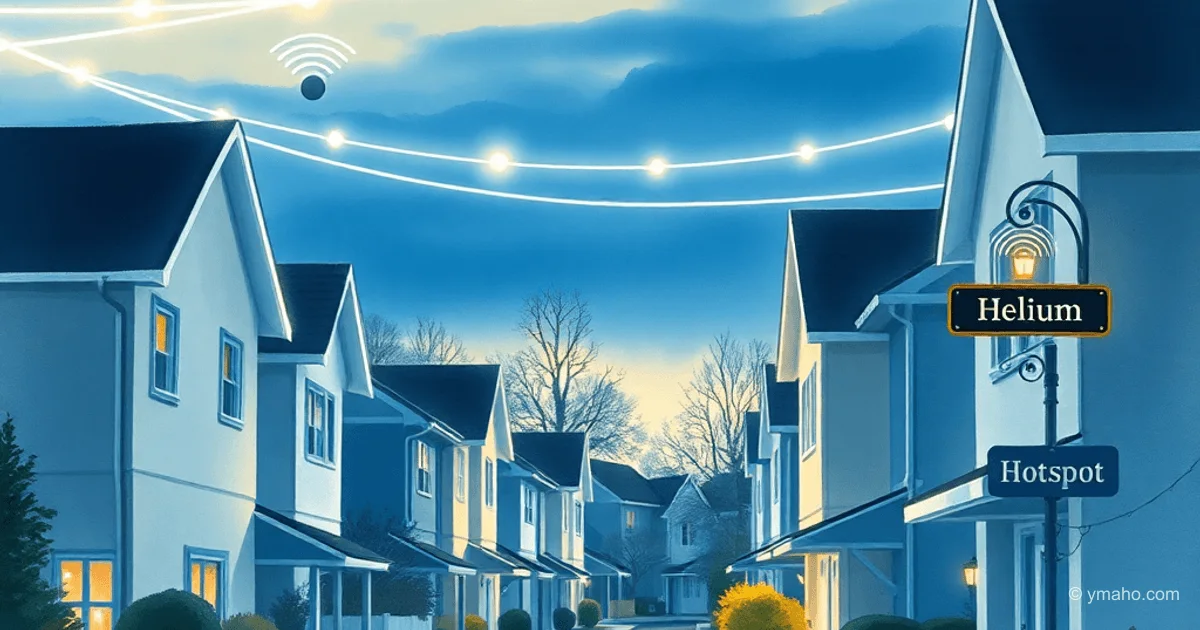
Helium flips this model on its head. Instead of relying on giant towers, it uses small, affordable devices called Hotspots that anyone can set up at home or work. Think of it like turning your living room into a mini cell tower: you plug in a Hotspot, and it starts providing wireless coverage for nearby low-power devices. The more people who join, the wider the network grows—like neighbors sharing spare power strips to keep the block party lights on. And because it's decentralized (run by the community, not a single company), it can expand faster and cheaper.
How Helium's Network Actually Works
A Helium Hotspot is a physical device, about the size of a Wi-Fi router, that you buy and plug into your home internet. Once connected, it broadcasts a wireless signal designed specifically for low-power, long-range devices—like sensors tracking air quality, lost pets, or even vending machines. This type of network is called IoT (Internet of Things), and it's booming as more everyday objects get "smart."
But here's where it gets interesting: Helium runs on blockchain technology. Blockchain is a digital ledger that records transactions securely and transparently—imagine a public notebook that everyone can see but no one can secretly alter. This lets the network operate without a central company controlling everything. Instead, the community of Hotspot owners collectively maintains the network, earning tokens for their contributions.
The Clever "Proof-of-Coverage" Check
How does Helium know a Hotspot is actually providing real coverage? It uses a system called Proof-of-Coverage. Picture this: the network randomly asks one Hotspot to send out a wireless "beacon" signal. Nearby Hotspots listen for this signal and report back if they heard it. It's like a neighborhood watch for internet signals—your Hotspot neighbor might glance out the window to confirm you're doing your job. If they don't detect your signal, you don't get paid.
This simple check prevents cheating. If someone tries to fake coverage (say, by hiding a Hotspot in a closet), other devices won't pick up its signal, and it won't earn rewards. Only Hotspots that genuinely extend the network's reach get compensated. It's a brilliant way to ensure the network grows where it's actually needed.
Earning Rewards: Not Magic, Just Math
Hotspot owners earn HNT tokens (Helium's cryptocurrency) in two main ways:
- Coverage rewards: For proving they provide real, useful coverage via Proof-of-Coverage.
- Data transfer rewards: For moving data across the network when devices use their signal.
But don't imagine this as passive income. Earnings depend entirely on your Hotspot's performance. If it's in a busy area with few competitors (like a quiet suburb), you'll earn more. If it's in a crowded spot (like downtown), earnings drop. It's like running a lemonade stand: prime locations get more customers, but you still have to show up and serve. Also, rewards decrease over time as the network matures—this is by design to encourage early participation.
Importantly, Helium isn't a get-rich-quick scheme. The tokens are a tool to bootstrap the network, not a promise of wealth. Think of it like a community paying you in local currency for helping maintain the park—you're supporting something useful, not speculating.
Key Takeaways
Here's what really matters about Helium for everyday folks:
- Community power: Anyone can help build wireless infrastructure by setting up a Hotspot, no tech degree required.
- Honesty built-in: Proof-of-Coverage ensures only real coverage gets rewarded, keeping the network reliable.
- Rewards follow real work: Earnings depend on your Hotspot's location and performance—there are no free lunches.
- Solving real problems: It offers a faster, cheaper way to connect the billions of new IoT devices flooding our world.
What This Means for Regular People
For you, Helium could mean better coverage for your smart home gadgets or city sensors that monitor air quality and traffic. It also demonstrates how communities can tackle infrastructure problems together—without waiting for big corporations. But remember: this is still an experiment. The network is growing, but it won't replace your phone's cell service tomorrow. If you're curious, you could try a Hotspot, but go in with eyes open: earnings vary by location, and the real win is supporting a more resilient, community-owned internet.
— Editorial Team









