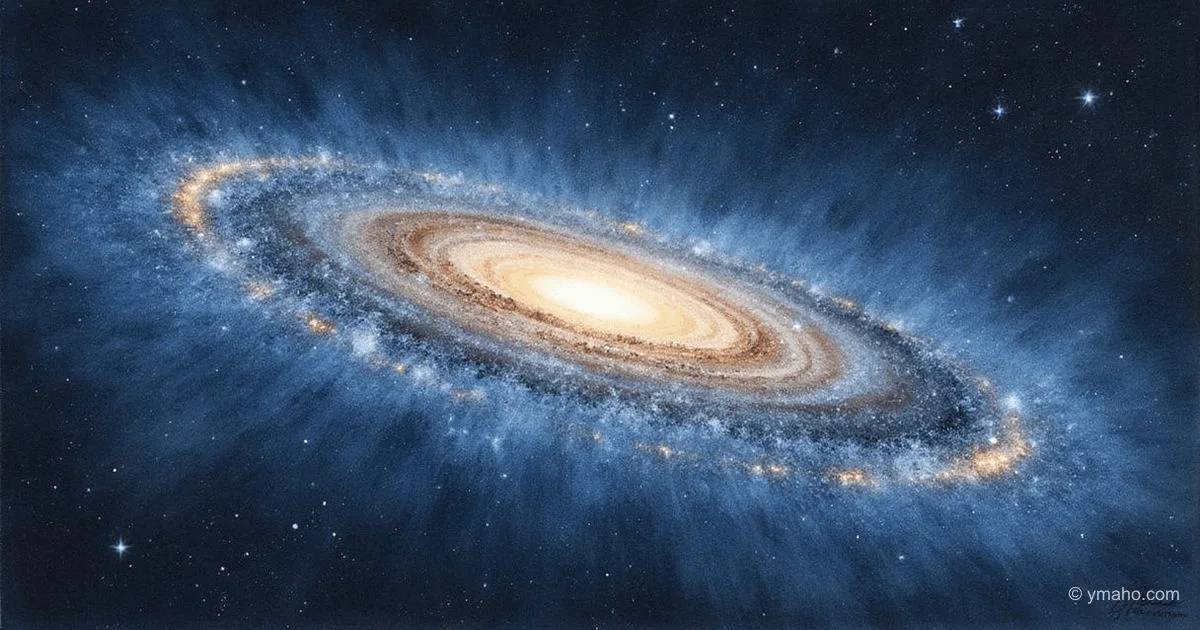
Astronomers Uncover Dozens of Hidden Star Trails Around Our Galaxy
Imagine our Milky Way galaxy as a giant cosmic whirlpool, slowly pulling in smaller star groups over billions of years. As these groups get stretched and torn apart, they leave behind faint trails of stars—like breadcrumbs scattered across space. Scientists have just found dozens of these hidden trails, giving us new clues about how our galaxy grew and where its invisible dark matter might be hiding.
What Are Stellar Streams?
Stellar streams are long, thin ribbons of stars that form when tight clusters or small galaxies orbit the Milky Way and get pulled apart by its gravity. Think of it like riding a bicycle with a leaky bag of sand: as you pedal forward, grains fall out one by one, tracing your path behind you. In space, those “grains” are stars, and their trail reveals the route their parent cluster took around the galaxy.
These streams are incredibly faint—often drowned out by the glow of billions of other stars—so spotting them is like trying to see a single thread in a tangled sweater from across a football field.
A New Algorithm Reveals Hidden Patterns
Until recently, astronomers had confirmed fewer than 20 stellar streams. But a team led by Yingtian “Bill” Chen at the University of Michigan developed a smart new tool called StarStream. Instead of just looking for obvious patterns in telescope data, this algorithm uses physics to predict what a real stream should look like based on how gravity works.
When they ran it on data from ESA’s Gaia mission—which has tracked the positions and movements of over a billion stars since 2014—the algorithm flagged 87 likely stellar streams linked to ancient, dense star clusters known as globular clusters.
Many of these newly found streams don’t match old expectations. Some are short and wide; others curve in unexpected directions. That suggests earlier searches missed them because scientists were only looking for neat, narrow lines.
Why This Matters for Dark Matter
Here’s why ordinary people should care: these star trails act like cosmic speedometers and compasses. By studying how the stars move within a stream, scientists can map the invisible gravitational forces tugging on them—including those from dark matter.
Dark matter is a mysterious substance that doesn’t emit light but seems to make up about 85% of all matter in the universe. It’s thought to form a huge, invisible “halo” around the Milky Way, holding everything together like an unseen scaffold. But we’ve never directly detected it.
Stellar streams are one of the best tools we have to feel out that scaffold. If a stream bends oddly or speeds up unexpectedly, it could mean it passed near a clump of dark matter.
What Does This Mean for Regular People?
- These discoveries help us understand how our galaxy formed—not in one big bang, but by slowly eating smaller neighbors over billions of years.
- Better maps of dark matter could one day reshape our understanding of physics itself.
- The new method shows how clever software can uncover hidden truths in existing data, proving that sometimes the biggest breakthroughs come not from bigger telescopes, but smarter thinking.
Key Takeaways
- Astronomers discovered 87 candidate stellar streams using a new physics-based algorithm called StarStream.
- Stellar streams are remnants of star clusters torn apart by the Milky Way’s gravity, leaving faint trails of stars.
- These streams help map the galaxy’s mass—including its invisible dark matter halo.
- Many newly found streams are irregular, meaning past searches were too narrow in focus.
- Upcoming telescopes like the Vera C. Rubin Observatory will help confirm which streams are real.
— Editorial Team









