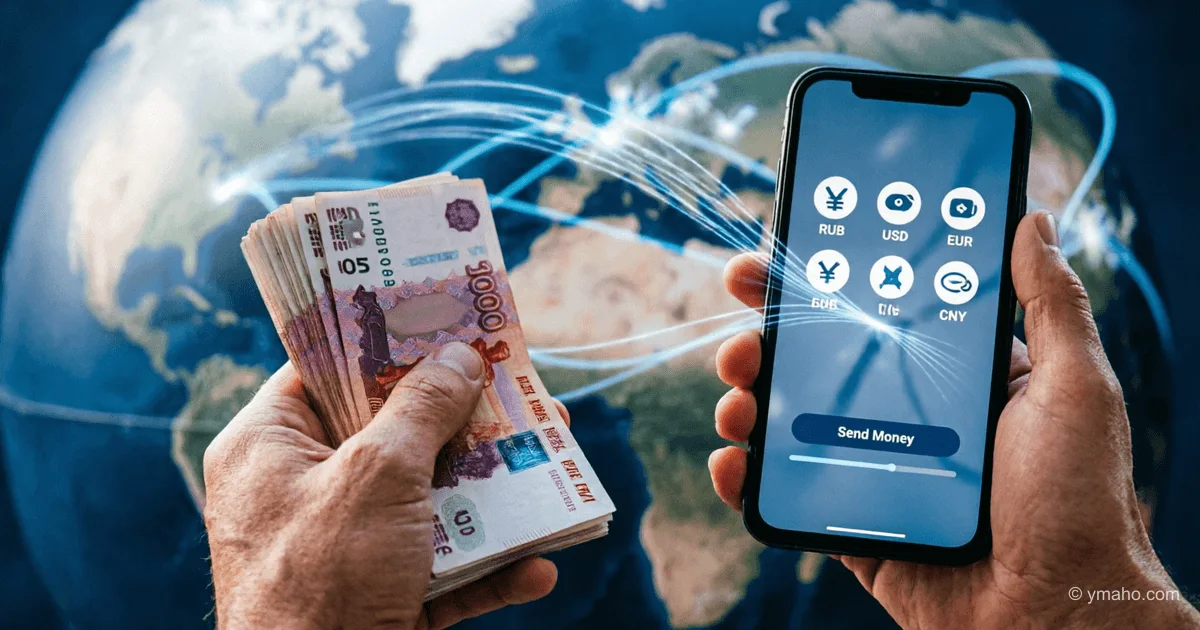
How to Transfer Money Abroad Now: Working Methods
Niche: News & Current Events Content Type: Comparison of Options Why It Matters: A critical financial issue due to sanctions; solutions quickly become outdated, so fresh analysis is needed.
The Gist: What You Need to Know First
Transferring money abroad from Russia in 2025 is not about choosing a convenient service but about bypassing sanctions restrictions. Most familiar channels are blocked: SWIFT transfers from Russian banks in USD and EUR do not work, Visa and Mastercard cards issued in Russia are not accepted abroad, and Western Union and MoneyGram have left the market.
The reality is this: you can physically send money, but each method has its own cost, speed, and risk. Fees reach 5-7% of the amount, exchange rates are predatory, and funds can get stuck in intermediary accounts indefinitely. The main rule: do not try to transfer more than $10,000 in a single transaction — this automatically attracts compliance attention and increases the likelihood of a freeze.
Important: since 2024, the Central Bank has tightened control over cross-border transfers. The limit for individuals is $1,000,000 per month, but banks can set their own restrictions, usually much lower, around $50,000-$100,000 per month. Beyond that, proof of source of funds is required.
Comparison of Working Transfer Methods
Method 1. SWIFT Transfer in Rubles with Conversion on the Recipient's Side
Despite many major banks being disconnected from SWIFT, some still have access. As of May 2025, the following banks are operational: Raiffeisenbank, Gazprombank (CNY and RUB), Tinkoff (limited), BKS Bank, and several regional banks. They send rubles, and the correspondent bank or the recipient's bank converts them into the desired currency.
Fee: 1% to 3% of the transfer amount + conversion with a loss of 2-4% on the recipient's side. Total loss up to 7%. Time: 2 to 5 business days.
Example: sending $1,000 to Germany via Raiffeisenbank. You deposit rubles, the bank sends them through a correspondent account at Raiffeisen Bank International in Vienna. The German bank receives rubles, converts them to euros at its own rate, and credits the account. Out of $1,000, the recipient sees about $930. The rest is eaten up by fees and spreads.
Method 2. Zolotaya Korona Money Transfer System
One of the few remaining services operating in 30+ countries, including Turkey, Serbia, UAE, Armenia, Georgia, and Israel. Transfers are possible only in USD and EUR, as well as Turkish lira for Turkey.
Process: you go to a partner bank branch (Sberbank, VTB) with your passport, provide the recipient's full name and country. The recipient picks up cash at a Zolotaya Korona payout point in their country using their passport. No bank account needed.
Fee: 1-2% of the amount. Limits: up to $5,000 per transfer, up to $50,000 per month. Time: 15-30 minutes.
Catch: the exchange rate is set by the system and is noticeably worse than the market rate. When transferring $1,000 to be received in Turkish lira, you lose $40-60 just on the exchange rate. Additionally, EU countries are not directly included: to send money to Germany or France, the recipient must physically travel to a payout point in a neighboring country where the system works.
Method 3. Cryptocurrency via P2P Platforms
The fastest and cheapest method, but requires technical literacy. It works like this: you buy USDT (a stablecoin pegged to the dollar) on a P2P exchange for rubles, transfer it to the recipient's wallet, and they sell USDT for local currency on their end.
Popular platforms: Binance, Bybit, HTX. Important: Binance has imposed restrictions on users from Russia, but P2P trading in rubles is still available.
Fee: 0-1% on the P2P platform + blockchain fee for the transfer between wallets (usually $1-2 on the TRC20 network). Total loss: 1-3%, the lowest among all methods. Time: 10 minutes to an hour. No limits — you can transfer even $500,000, but large amounts will raise questions about the source of funds on the recipient's side.
Risk: banks monitor P2P transactions. Regular large transfers to crypto exchanges can lead to bank account blocking under Federal Law No. 115-FZ. Use multiple banks, avoid round amounts, and label transfers as "transfer to a friend."
Method 4. Foreign Bank Cards Topped Up from Russia
This scheme works if you or the recipient has a bank card from Kazakhstan, Armenia, Kyrgyzstan, Uzbekistan, or Turkey. You top up this card from Russia via a fast transfer system or P2P, and then use it for payments or further SWIFT transfers.
Fee: 0-2% for top-up + possible loss on conversion. Time: card-to-card transfers — minutes; SWIFT from a foreign bank — 1-3 days.
In practice: a card from Kazakhstan's Kaspi Bank or Armenia's Ameriabank can be topped up from Russia instantly using the card number. Then, from this card, you can send a SWIFT transfer to Europe without sanctions restrictions because the sending bank is not Russian.
Method 5. Brokerage Account and Withdrawal to a Foreign Bank
An exotic but legal method. You open a brokerage account with a Russian broker that has access to foreign exchanges (restrictions apply, but some instruments are available), buy securities traded abroad, then transfer them to a foreign broker's account and sell them, crediting the currency to a foreign bank account. This method is complex, requires qualified investor status, and is not suitable for urgent transfers.
Practical Tips and Important Nuances
- Split amounts. Never transfer the entire sum in one transaction. Break $10,000 into five transfers of $2,000 each, spaced a few days apart. This reduces the risk of freezing and compliance questions.
- Verify the final recipient. The correspondent bank may reject the transfer if the recipient's bank is under sanctions. Before sending, ask the recipient for the full bank name and SWIFT code, then check against EU and US sanctions lists.
- Alternative currencies. USD and EUR are the most problematic currencies. Transfers in CNY, UAE dirhams, or Turkish lira go through faster and with lower fees. If the recipient can accept CNY, send CNY, and they can convert to dollars on their end.
- Intermediary services work until the first check. Companies offering transfers through their accounts appear: you transfer rubles to them, they send dollars to the recipient. Fee 5-10%. This is a gray area: today the company works, tomorrow its account is frozen, and your money is stuck. Only use trusted financial institutions.
- Opening an account in the destination country. If you plan regular transfers, consider opening an account in a bank in the recipient's country. For example, Russian citizens can open accounts in some banks in Turkey or Serbia remotely or during a short visit. Scheme: you transfer rubles to your foreign account via Zolotaya Korona or cryptocurrency, then make a local transfer to the recipient from that account — this avoids international fees.
Common Mistakes and How to Avoid Them
Mistake: specifying "for services" or "for goods" as the payment purpose.
Any commercial purpose is a red flag. The bank will request a contract, invoice, and work completion certificates. If you cannot provide them, the transfer will be stuck. For individuals, only use "personal transfer" or "family support."
Mistake: attempting to transfer through a sanctioned bank.
Sberbank, VTB, Alfa-Bank, Otkritie — all are under sanctions. SWIFT transfers in USD or EUR through them will not go through at all. You will waste time and pay a return fee. Before sending, check which banks actually process payments in the required currency — call the hotline and ask the operator directly.
Mistake: ignoring currency control.
For transfers over $1,000, the bank has the right to request supporting documents. If you send money regularly, prepare income statements, 2-NDFL certificates, property sale contracts — anything that explains the source of funds. Without documents, the transaction may be rejected a week after the application is accepted, when you already think everything is fine.
Mistake: working with only one bank.
Open 2-3 accounts at different banks. If one bank blocks a suspicious transaction, you will have alternative channels. All eggs in one basket means risking losing access to funds indefinitely while investigations are ongoing.
Summary: Brief Conclusion and Next Step
Working methods for transferring money abroad in 2025 exist, but they all come with fees and inconvenience. For amounts up to $5,000, the best options are Zolotaya Korona or P2P cryptocurrency transfer — fast and relatively cheap. For regular large transfers over $10,000 per month, the optimal choice is to open an account in a foreign bank (Kazakhstan, Armenia, Turkey) and use it as a transit account.
Right now, check whether the recipient can receive a transfer via Zolotaya Korona in their country. If yes, that is the simplest first step. If not, contact them and discuss opening a TRC20 wallet to receive USDT. In any case, start with a test transfer of $200-300 to ensure the channel works, and only then send the main amount. Remember: a 3-5% fee is a normal price for a working transfer under sanctions. Free and instant methods no longer exist.
— Editorial Team









