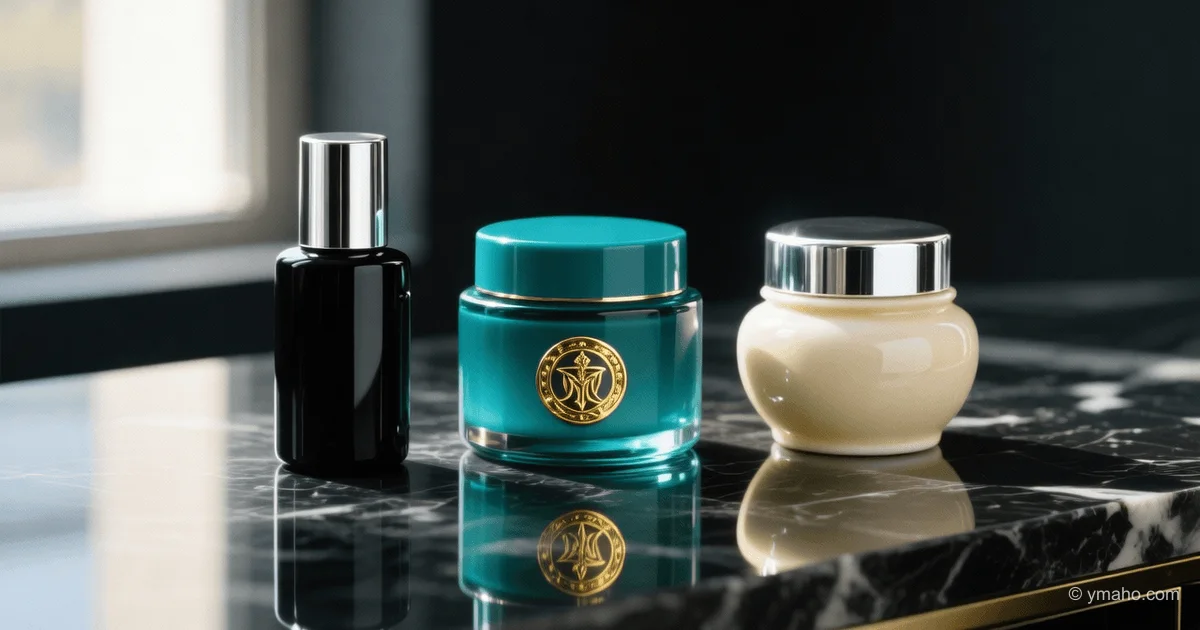
Next-Gen Hyaluronic Masks and BB Cleansing Set the Tone in Skincare
In expert Melanie Grant's personal top picks are the Victoria Beckham Beauty cleansing protocol, Augustinus Bader regenerative serums, and Valmont hydrating masks. It is the combination of clinical methods with luxury hyaluronic masks and enzyme peels that shapes the trend for 'customized' premium skincare.
The Gist: Premium Skincare as an Exclusive Loyalty Club
When an expert like Melanie Grant combines the Victoria Beckham Beauty cleansing protocol, Augustinus Bader regenerative serums, and Valmont masks in one list, the uninitiated observer sees merely expensive skincare. An industry insider sees something else: the formation of an exclusive cross-brand cartel that monopolizes not the shelf, but the mindset of the solvent consumer. This is not 'customized skincare.' It is a carefully managed ecosystem where three brands with fundamentally different DNA—a celebrity startup, a biotech sensation, and Swiss old money—merge into a single narrative of 'unquestionable quality.'
What is happening is what I call 'expert field collapse.' An independent aesthetician with 25 years of experience becomes a node through which legitimacy is distributed among brands willing to play by premium segment rules: price no lower than $70 per unit, minimalist packaging, no aggressive discounting, and having a 'scientist behind them'—Professor Bader at Augustinus Bader, the team of chemists at Victoria Beckham Beauty, and the Valmont research center on the shores of Lake Geneva.
Timeline and Context: How the Puzzle Came Together
Victoria Beckham Beauty entered the market in 2019 with a 'clean luxury' positioning and immediately faced the problem of legitimization in the professional sphere. A celebrity name on a brand always raises suspicions of frivolity. By 2024, the brand made a strategic pivot: it invested in Professor Augustinus Bader as a formulation consultant and began incorporating his patented TFC8 complex into its serums, including the Cell Rejuvenating Power Serum at $210. This was the first bridge between a celebrity brand and the biotech gold standard.
Augustinus Bader, in turn, by 2025 had outgrown its status as a 'one-product brand' (The Cream at $280) and began aggressive expansion into masks and serums. But they lacked ritual—TFC8 explained regeneration at the cellular level but did not provide an 'experience.' Valmont filled that gap. The Swiss brand, since 1985, has built its identity on ritual: their Prime Renewing Pack mask at $230 is applied with a special brush, requires 20 minutes, and is rinsed off with signature water. It is not a product; it is a ceremony.
When Melanie Grant in May 2026 combines these three brands into a 'personal top picks,' she completes a three-year process of their mutual integration into expert discourse. This is not her personal choice. It is the culmination of a strategy that each of the three brands pursued independently: to find an authoritative arbiter who would unite them into a seamless protocol.
Who Wins and Who Loses
The three named brands win; they now share one client without competition. A consumer who trusts Grant will buy the VB Beauty cleanser ($65), the Augustinus Bader serum ($395), and the Valmont mask ($230). Total spend: $690 for three products. Meanwhile, each brand gains access to the other two's audiences without cross-promotion costs. This is an ideal model: competitors become complementary elements of a ritual.
Clearly losing is La Mer. Historically, the brand occupied the niche that Valmont now challenges: the hydrating mask as the culmination of a luxury ritual. But La Mer has lost support from the expert community. Their Crème de la Mer at $200 has long been called 'vaseline with algae' by the critical community, and aestheticians of Grant's level no longer include the brand in their lists. This is a quiet boycott by the professional skincare community, which is reorienting toward brands with more compelling scientific narratives.
Also losing are Asian luxury brands—Sulwhasoo, Amorepacific, History of Whoo. They offer ritual (the Korean multi-step system) but cannot provide a recognizable 'scientist-ambassador' of the Western type. For a Western aesthetician, ritual without personified science is just folklore. Grant, without saying it, drew a line: luxury without an evidence base in 2026 is no longer luxury.
What the Media Isn't Saying
Non-obvious insight: The protocol that Grant presents as customized actually creates dependence on three brands that are technologically incompatible outside the marketing narrative. TFC8 (Bader's patented complex of amino acids and vitamins) loses stability in an alkaline environment. The Victoria Beckham Beauty cleansing protocol uses a low-pH foam that is incompatible with the Valmont enzyme peel, which requires a neutral pH for enzyme activation. The consumer applies one over the other, not achieving the claimed synergy, but blames themselves ('I applied it wrong') rather than the chemical incompatibility of the formulas.
Second omission: the distribution war among these brands. Valmont is exclusively available at Nordstrom and its own spas. Augustinus Bader is at Violet Grey and Net-a-Porter. Victoria Beckham Beauty is in its own DTC system. The consumer physically cannot buy all three products in one place. This creates artificial scarcity and forces hunting for products, which only fuels interest. Behind this is a deliberate strategy: the absence of a single distributor protects the brands from direct price competition and maintains margins at 75-80%.
Forecast: Next 30 Days and 90 Days
In the next 30 days, expect the emergence of an 'official Grant protocol'—a structured PDF guide or even a micro-landing page where the three brands will be openly cross-linked for the first time. This will likely be implemented through her personal website or a partnership with Net-a-Porter, which already works with Bader and could add Valmont. This will turn an informal recommendation into a commercial product—'The Grant Method,' sold as a set.
Within 90 days, we will see a response from outsiders. Second-tier biotech brands—Biologique Recherche, MBR, Cellcosmet—will aggressively seek their own 'arbiters' to create alternative protocols. They will offer aestheticians exclusive terms: a percentage of set sales, joint masterclasses, access to private research. This will trigger an arms race among professional beauty authorities: who has the most convincing pairing of 'my expert + my brands.'
Simultaneously, consolidation will begin. Major players like Estée Lauder Companies will realize that their portfolio (which includes La Mer) is losing precisely because of the lack of cross-brand narrative within their own house. La Mer, Bobbi Brown, and Aveda will need to learn to speak the same expert language. If this does not happen, Lauder will continue to lose premium clients who are flowing to independent luxury.
Conclusion: What looks like a harmless list of favorite products is a map of the future. Premium skincare is no longer a competition of brands but a competition of alliances, where the winner is not the best formula but the most convincing ecosystem of 'expert—ritual—exclusivity.' The entry price for the consumer into this ecosystem is $690 for three jars and complete trust in the arbiter. The price for a brand not on the list is invisibility.
— Editorial Team









