Future Surgery in St. Petersburg: Hybrid Operating Rooms and Artificial Intelligence Transform Medical Practice
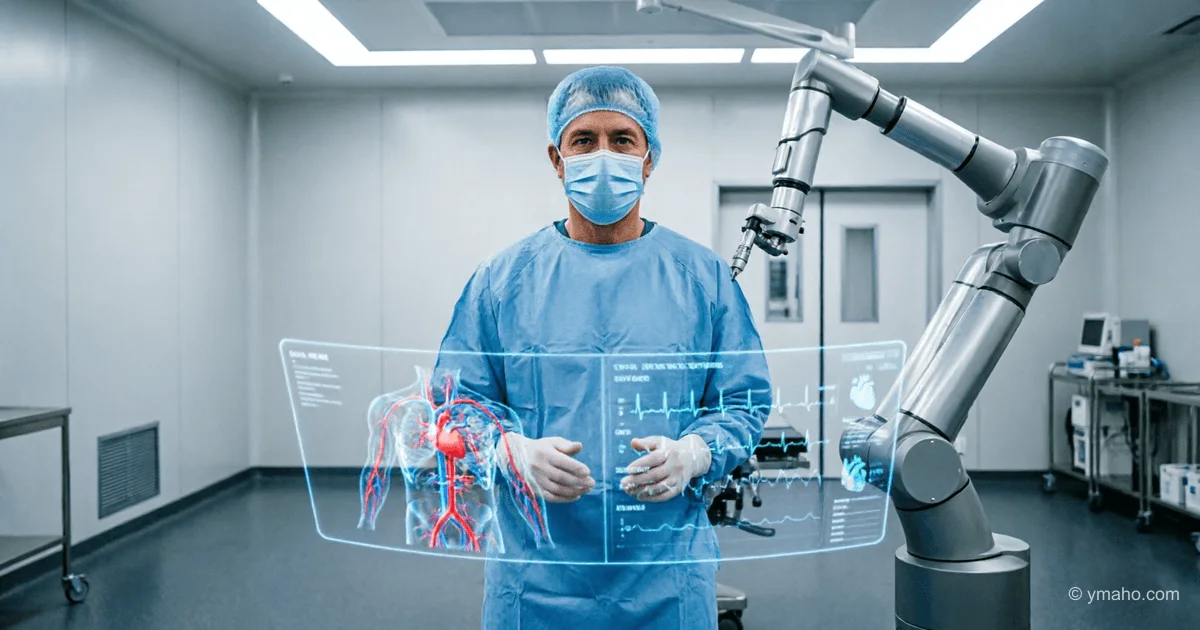
At the Almazov National Medical Research Centre, the operation of hybrid operating rooms combining surgery with digital diagnostics and the implementation of AI systems to assist clinical decision-making were showcased. These technologies are moving from experimental to everyday clinical practice at the centre.
Future Surgery in St. Petersburg: Hybrid Operating Rooms and Artificial Intelligence Transform Medical Practice
Introduction
In early May 2026, St. Petersburg hosted a demonstration of technologies that until recently seemed like science fiction: hybrid operating rooms where surgery is combined with digital diagnostics, and artificial intelligence systems that help doctors make clinical decisions. The event took place as part of the district forum "Healthy Family" with the participation of top state officials—Deputy Chairman of the Security Council Dmitry Medvedev, Minister of Health Mikhail Murashko, Deputy Prime Minister Tatyana Golikova, and Governor Alexander Beglov. The Almazov Centre, already considered a flagship of high-tech medicine, showed that technologies valued at $1.33 billion globally with annual growth above 12% are no longer experimental in Russia but are becoming routine clinical practice.
Event Details and Timeline
The high-level delegation visited the Almazov National Medical Research Centre on May 1, 2026. The centre's Director General, Evgeny Shlyakhto, personally guided the guests through key points, demonstrating three levels of transformation in surgical practice.
First level—hybrid operating rooms. These are spaces where traditional surgery capabilities are combined with digital solutions—intraoperative imaging, angiographic systems, and 3D navigation tools. Such operating rooms host the most complex interventions, including surgeries for aortic pathology and peripheral arteries. During an operation, the surgeon does not rely solely on their own eyes and hands: digital diagnostics provide a real-time view of the pathology. This is especially critical in vascular surgery, where an error of a fraction of a millimeter can cost a patient's life.
Second level—a situation centre based on a telemedicine system. Here, care is coordinated for the most complex clinical cases, and specialists from the regions can receive consultations from Almazov Centre experts with demonstrations of AI-based systems. This is not just video communication: it is an analytical platform that accumulates patient data and helps develop optimal treatment strategies.
Third level—artificial intelligence in everyday medical practice. Centre staff demonstrated how AI algorithms assist in diagnosis and treatment selection. A telling phrase from one report: "Doctors note that the use of AI has already become part of everyday practice, not just an experiment." This transition of technology from laboratory to operational mode is the main news.
The timeline for this leap spans three months. In February 2026, the Almazov Centre launched the Centre for Artificial Intelligence in Medicine and the "School 21" campus—a joint project with the city government and Sberbank. By May, the accumulated experience allowed presenting results at the federal level. Dmitry Medvedev called the Almazov Centre a flagship of translational medicine—a place where scientific developments quickly transition into real medical practice.
Impact and Significance
The St. Petersburg demonstration fits into the global trend of transforming the operating room from a static physical space into an adaptive information ecosystem. According to analysts, the global market for AI in operating rooms was valued at $1.18 billion in 2025, will reach $1.33 billion in 2026, and $2.67 billion by 2032, with a compound annual growth rate of 12.29%. Russia, through the Almazov Centre, is not just observing this trend but becoming a participant in its deployment.
First—technological sovereignty. The Almazov hybrid operating room is not a copy of Western solutions but a proprietary configuration combining surgery, digital imaging, and AI analytics in a single loop. This is fundamental given the restricted access to advanced foreign medical technologies due to sanctions.
Second—change in clinical algorithms. When AI ceases to be an experimental tool and enters everyday practice, the very logic of medical decision-making changes. A surgeon receiving real-time prompts from a machine vision system is a different specialist from one operating solely on their own experience and static preoperative images. Global reviews in 2026 confirm that smart operating rooms reduce cognitive load on surgical teams, identify clinically significant signals from streaming data, and improve outcome consistency across cases.
Third—accessibility of high-tech care. The situation centre with telemedicine functions allows connecting Almazov's expertise to complex cases in the regions. For a country with a vast territory and uneven distribution of medical competencies, this is not just a convenient option but the only way to ensure comparable quality of care in the capital and remote district centres.
Fourth—training a new generation of professionals. The "School 21" campus, opened in February 2026, aims to train specialists who can automate document handling, use algorithms to interpret test results, and plan treatment with risk prediction based on the data obtained. As Governor Beglov emphasized: "Practical medicine, specialized science, and the training of unique specialists will be united by a modern digital environment." This addresses a key challenge of any technological modernization: it is not enough to install hardware—you need people capable of working with it.
Reactions of Key Players
The reaction to the Almazov demonstration was multifaceted, reflecting the different interests of the participants.
Federal authorities used the event to reaffirm the priority of digital transformation in healthcare. Dmitry Medvedev called Almazov a "flagship of translational medicine," and Minister of Health Mikhail Murashko personally inspected the departments and the situation centre. Notably, the visit was part of the party forum "Healthy Family"—evidence that high-tech medicine is becoming part of the political agenda, not just a narrow departmental matter.
St. Petersburg city authorities, represented by Governor Alexander Beglov, emphasized the systemic nature of the changes. His statement that "over six years we have transformed the city's healthcare system" is not just rhetoric: it is backed by specific projects, including the opening of the Centre for AI in Medicine and the "School 21" campus, implemented with co-financing from the city and Sberbank.
The professional community reacted cautiously but constructively. Centre doctors noted the transition of AI from experimental to everyday practice—a formulation that both acknowledges the achievement and sets a high bar for further development. A global review of operating room trends for 2026 emphasizes that the key safety condition is not replacing clinical judgment with technology but training doctors, designing workflows, and ensuring robust clinical governance.
The financial sector, represented by Sberbank, acts not just as a sponsor but as a technology partner. The largest bank's involvement in creating the AI Centre and IT campus is a long-term bet on the medical technology market, which globally is measured in billions of dollars.
Forecast and Conclusions
The demonstration of hybrid operating rooms and AI systems at the Almazov National Medical Research Centre sets several development vectors for Russian high-tech medicine in the coming years.
First—infrastructure consolidation. Creating an AI Centre in Medicine at the largest national medical centre while simultaneously launching an educational campus is a model that will be replicated. Within 3–5 years, similar clusters can be expected in other federal districts.
Second—deepening data integration. Today, the hybrid operating room combines surgery with imaging. Global trends in 2026 go further: digital twins of patients based on preoperative images, VR and AR rehearsals of complex interventions, predictive analytics for operating room scheduling. Almazov is likely to become a pilot site for implementing these technologies in Russia.
Third—workforce transition. "School 21" is just the first step. Within 5–10 years, medical education must adapt to a new reality where doctors work in constant contact with AI assistants. This will require revising curricula, creating new specialties at the intersection of IT and medicine, and developing certification standards for medical AI specialists.
Fourth—regulatory evolution. Global analysts note that integrating AI into operating rooms requires robust clinical safety management systems, clear interoperability standards, and scalable training programs. So far, Russia is focusing on hardware infrastructure, but as clinical data accumulates, regulatory issues will arise: who is responsible for a decision suggested by an algorithm? How to certify evolving AI models? These questions remain unresolved worldwide, and Almazov has a chance to become a platform for finding answers.
There are also limitations that cannot be ignored. Global reviews warn that adoption remains uneven due to differences in resources, regulation, training, and system integration. Not all Russian medical facilities will be able to afford a hybrid operating room costing hundreds of thousands of dollars in the foreseeable future. The gap between flagship centres and ordinary hospitals may even widen in the initial phase of digital transformation.
In essence, the May demonstration at the Almazov Centre is not a one-time show for high-ranking guests but evidence that Russian high-tech medicine has moved from AI experiments to routine application. When a deputy prime minister, a minister, and a deputy chairman of the Security Council visit an operating room and see not a presentation but a working system that assists doctors—that is a marker of technology maturity. Hybrid operating rooms, AI assistants, and telemedicine command centres are no longer "medicine of the future"—they are medicine of the present, which in the next five years will determine how accessible and high-quality high-tech care will be in Russia. Analysts predict a doubling of the global AI-in-operating-room market by 2032—and the Almazov Centre, it seems, intends to occupy a prominent place in that market.
— Editorial Team









