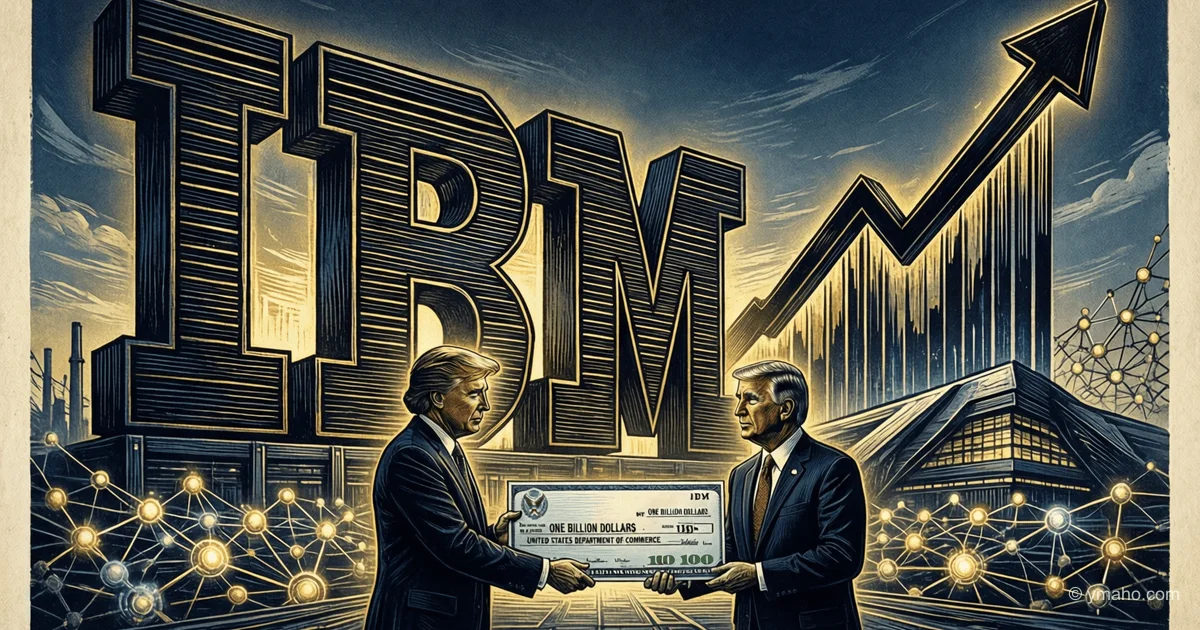
IBM shares surge 12.4% after receiving $1 billion from US government
Shares of the tech giant soared after it was revealed that the company would receive half of the $2 billion in government subsidies allocated to support quantum computing development. This made IBM the top gainer among Dow Jones components.
Quantum Billion for IBM: A Government Bet That Changes Everything
The US government has just picked a winner in the race for the quantum future. IBM got a billion dollars, but gave up something far more valuable in return—a stake in its new subsidiary. This isn't just a subsidy. It's a nationalization of strategic technology disguised as government support.
[The Gist]: What's Really Happening
On May 21, 2026, the US Department of Commerce announced $2.013 billion in awards to nine companies under the CHIPS and Science Act. IBM got exactly half—$1 billion.
IBM shares surged 12.4% in a single day. Market capitalization increased by $27 billion—roughly the entire value of Adidas. Rigetti Computing and D-Wave jumped over 30%.
But the headlines lie. This isn't a "gift" from the government.
Here's the inside scoop: in exchange for the billion, the government received minority stakes in each recipient company. The exact size of the stakes hasn't been disclosed, but this isn't just a grant. It's an investment with a return.
IBM is creating a separate company—Anderon. It's "America's first dedicated quantum foundry" in Albany, New York. IBM is also putting in another $1 billion of its own money. The federal government gets a stake in Anderon. Private investors will also be brought in.
In essence, the US government becomes a co-owner of critical quantum infrastructure. This is a precedent that didn't even happen with Intel.
Timeline and Context
May 21, 2026 — The Department of Commerce signs letters of intent with nine companies. Total commitments: $2.013 billion.
Fund Allocation:
- IBM — $1 billion (plus $1 billion of its own equity) for Anderon
- GlobalFoundries — $375 million for a multi-modal quantum foundry
- Atom Computing, D-Wave, Infleqtion, PsiQuantum, Quantinuum, Rigetti — up to $100 million each
- Diraq — up to $38 million
Deal Terms: The government receives passive minority stakes without control in each company. This isn't charity—it's a new type of public-private partnership.
Why Now?
Quantum computing is a matter of national security. As soon as a cryptographically significant quantum computer emerges (and IBM plans fault-tolerant quantum computing by 2029), all modern encryption goes out the window.
Boston Consulting Group estimates the quantum industry's potential contribution to the global economy by 2040 at $850 billion. McKinsey puts it at $1.3 trillion in just four sectors (automotive, chemicals, financial services, life sciences) by 2035.
The stakes are enormous. The US cannot afford to lose this race to China.
Who Wins and Who Loses
IBM wins—formally. $27 billion in market cap in one day is a win. The company gets government funding for its quantum roadmap.
The US government wins. It gets stakes in strategic tech companies without wasting budget money. This is a smart form of "technological sovereignty."
The ecosystem wins. GlobalFoundries gets $375 million. Small quantum startups get $100 million each. They'll all supply components for IBM and each other.
IBM shareholders lose (in the long run). The government now has a stake in Anderon. That means part of future profits from the quantum business goes to taxpayers, not IBM shareholders.
Competitors not on the list lose. Why didn't Google get money? Or Microsoft? Or IonQ? Because the Trump administration bet on a specific technology architecture.
Paradox: IBM shares surged 12.4% because the market saw "free money." But the reality is that IBM is diluting its shareholders by letting the government into Anderon's capital. The market either didn't get it or decided the strategic win outweighs the dilution.
What the Media Isn't Saying
Non-obvious Insight #1: Anderon isn't just a "foundry." It's a control tool.
IBM is creating a separate company. Why not keep everything inside IBM? Because it's easier for the government to get a stake without entering IBM's parent capital.
What does this mean? Anderon can be sold, taken public, or fully nationalized in a crisis. It's an "option" for the government.
A minority stake today is a controlling stake tomorrow if the rules change.
Non-obvious Insight #2: IBM's roadmap leaves no room for competitors.
Look at who got money: GlobalFoundries (manufacturing), Rigetti, D-Wave, Quantinuum (different architectures). All these companies will supply components for IBM's ecosystem. Or at least depend on the standards IBM sets.
Atom Computing builds neutral-atom systems. Quantinuum uses ion traps. PsiQuantum makes photonic chips. These are different quantum computing modalities. But they'll all integrate through software interfaces controlled by IBM (Qiskit, IBM's open platform).
IBM is becoming the "Microsoft Windows" of the quantum world. Not necessarily the best technology, but the de facto standard.
Non-obvious Insight #3: The $1 billion from the government is less than NVIDIA's AI boom, but strategically more important.
NVIDIA got $0 from the government for its AI boom. Its market cap grew by $2 trillion in two years without government support.
IBM got $1 billion—and its shares rose 12%. The scale difference is huge. But the strategic importance of quantum computing for defense and encryption is incomparable to AI.
Quantum is a weapon. AI is a tool. The government invests in weapons.
Forecast: Next 30 Days and 90 Days
Next 30 days (until June 24, 2026): IBM shares will consolidate around $250-260 (from current ~$230). The euphoria from the news will fade. Investors will start asking tough questions: what's the size of the government's stake? When will Anderon start generating revenue?
Retail investors who bought at the May 23 peak may start taking profits. If the S&P 500 corrects (and the Dow is at record highs, which is always risky), IBM could pull back to $235-240.
Key date: FOMC meeting June 16-17. If Warsh gives a hawkish signal, tech stocks (including IBM) could lose 3-5%.
Next 90 days (until August 24, 2026): The quantum sector overall will continue to grow, but differentiation will increase. Rigetti and D-Wave are high-risk speculative stories (their stocks rose 30%+, but their business models are unproven). IBM is a more stable bet.
But there's a catch: if Democrats regain control of Congress after the elections, the Anderon deal could be revisited. Government stakes in private companies are always political. The Trump administration is making these deals now, but who knows what will happen in a year.
My forecast: IBM will trade in the $230-270 range over the next three months. The ceiling—$270—will be reached if news breaks about Anderon's first contracts with the Department of Defense. The floor—$230—if the broader market falls due to geopolitics or rates.
The main long-term risk: quantum supremacy may not arrive as quickly as IBM promises. IBM's roadmap is ambitious: fault-tolerant computing by 2029. But tech history shows such forecasts often slip. If IBM announces a delay in 2027, shares could lose 30-40% of the current quantum premium.
Editorial Forecast
- Asset: IBM shares (NYSE: IBM) / Direction: Sideways with a slight pullback in the next 48-72 hours.
- Key Levels: Current price ~$242-245. Nearest support—$235 (May 22 close). Resistance—$255-260 (psychological level after the 12% jump). We expect consolidation in the $235-250 range as the market digests the news and awaits details on the government's stake in Anderon.
- Confidence Level: Medium.
- Main Risk to Forecast: If the Department of Commerce reveals that the government's stake in Anderon exceeds 20%, it could trigger a new wave of growth (investors see "government backing as validation")—up to $270. Conversely, if the stake turns out to be symbolic (less than 5%), the market may be disappointed, and IBM could correct to $220-225, as "the billion wasn't that big after all." Also, any news of a quantum breakthrough by competitors (Google, IonQ) could shift market attention.
— Editorial Team









