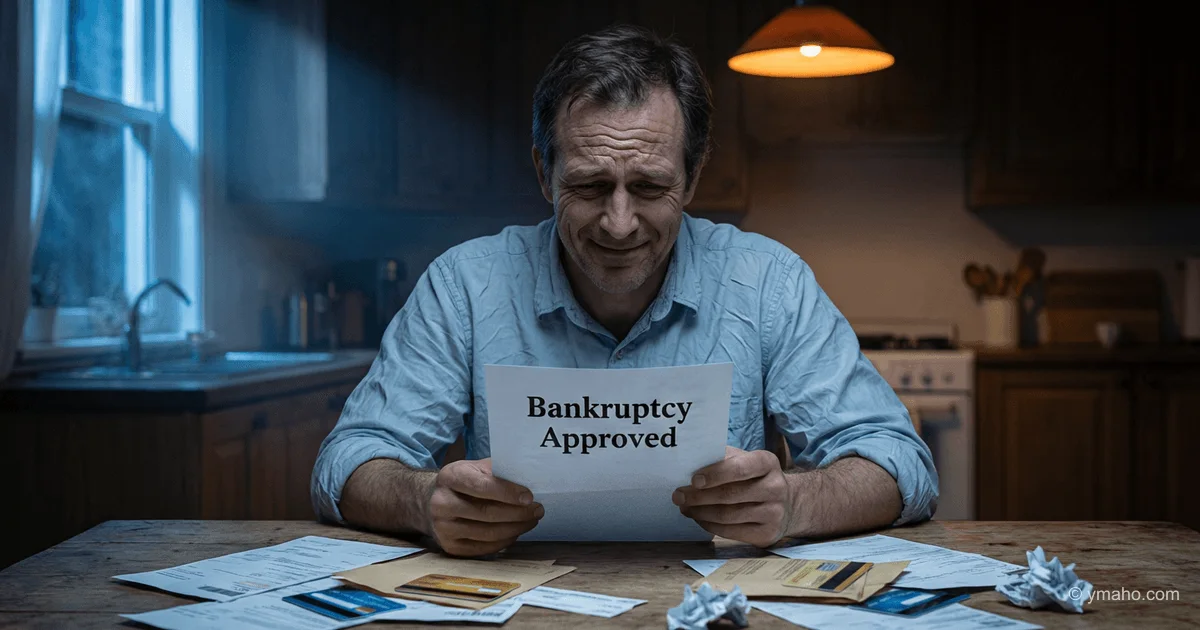
How to Write Off Debts Through Personal Bankruptcy: Cost
Niche: Finance & Earning Money Content Type: Problem Solving Why It Matters: The keyword 'price' indicates readiness to act — the user is looking for concrete costs and conditions, not theory.
How to Write Off Debts Through Personal Bankruptcy in 2026: Complete Guide and Prices
The word "bankruptcy" sounds scary — it immediately brings to mind asset seizure, reputation loss, and huge legal costs. But for an ordinary person with credit and microfinance debts, this procedure is often the only legal way to start with a clean slate.
In this article, I'll break down the specific numbers: how much personal bankruptcy costs in 2026, what expenses are mandatory, when you can write off debts for free, and when you'll have to pay lawyers. No scaremongering, but no sugarcoating either.
The Essence: What You Need to Know First
Personal bankruptcy is a court procedure after which your debts are declared uncollectible and written off. Forever. Debt collectors disappear, banks stop calling, bailiffs close enforcement proceedings.
But it's not free and not simple. In 2026, Russia has two bankruptcy methods:
- Out-of-court (via MFC) — free, but suitable for a very limited group of people.
- Judicial (via arbitration court) — paid, but any debts are written off.
The main question "how much does it cost" depends on which path you choose. The price ranges from 0 to 270,000 rubles (about 0 to 3,000 USD). Let's break down both options with specific numbers.
Step-by-Step Solution: Two Ways to Write Off Debts
Method 1. Out-of-Court Bankruptcy via MFC — Free, but for the Few
Since 2020, Russia has allowed debt write-offs without court — through any Multifunctional Center (MFC) office. In 2026, this option remains and has even been expanded.
Conditions for out-of-court bankruptcy:
| Condition | Requirement |
|-----------|-------------|
| Debt amount | from 25,000 to 1,000,000 rubles |
| Assets | no assets that can be sold |
| Official income | absent or below the subsistence minimum |
| Enforcement proceedings | all closed due to inability to collect |
Who can file in 2026 (expanded list):
- Citizens whose enforcement proceedings have been terminated (bailiffs returned documents due to lack of assets and income).
- Pensioners receiving a pension.
- Recipients of social benefits.
- Participants of the special military operation.
- Citizens whose claims under a writ of execution have not been satisfied for more than 7 years.
What you need to do:
- Gather your passport, SNILS, TIN, and a list of creditors.
- Go to any MFC office at your place of registration.
- Write an application.
What happens next: The procedure lasts 6 months. If during this time none of the creditors contest the bankruptcy and no assets or income are found, the debts are written off.
Cost: 0 rubles. Absolutely free.
Key limitations they don't tell you about:
- Out-of-court bankruptcy is only suitable for those who have no assets at all (not even an old car or garage) and no official income. If you have anything, the procedure will be terminated.
- Creditors can easily contest the write-off if they find even one asset.
- According to lawyers, most MFC applications are either not accepted or the procedure fails.
Verdict on MFC: This is an ideal option for a person with no job, no assets, and small debts. For everyone else, it's a dead end.
Method 2. Judicial Bankruptcy — Paid but Reliable
Judicial bankruptcy is the classic procedure through an arbitration court with a financial manager. It suits almost everyone: with debts of any amount, with assets and income, with any number of creditors.
Who it suits:
- Debt amount from 25,000 USD (2 million rubles) — though in practice you can file for bankruptcy with a smaller amount.
- You have assets (car, dacha, non-primary residence) — they will be sold to cover debts.
- You have official income — part of it will go to creditors.
How much does judicial bankruptcy cost in 2026 — full price breakdown:
The cost consists of two parts: mandatory expenses (which you will pay in any case) and legal services (if you hire a specialist).
Mandatory Expenses (even if you do everything yourself)
| Expense Item | Amount in Rubles | Approx. in USD* |
|--------------|------------------|-----------------|
| Financial manager's fee (deposit) | 35,000 ₽ | ~390 USD |
| Publication in the Kommersant newspaper | ~12,000 ₽ | ~130 USD |
| Notices in the Unified Federal Register of Bankruptcy Information (EFRSB) | 3,000 — 5,000 ₽ | ~35 — 55 USD |
| Postal notifications to creditors | 2,000 — 4,000 ₽ | ~22 — 45 USD |
| TOTAL mandatory expenses | ~52,000 — 56,000 ₽ | ~580 — 620 USD |
Source: calculation by financial manager Yu.A. Borokhov as of January 2026
Additionally, there is a state fee for filing the court application — 4,500 rubles (~50 USD). Sometimes it's already included in the total, but it's better to check separately.
Important: You must deposit this money before filing the court application. Without the deposit in the court's account, the procedure will not start.
Cost of Legal Support ("Turnkey Bankruptcy")
If you don't want to deal with court intricacies yourself (and it's really difficult: preparing dozens of documents, communicating with creditors, monitoring the financial manager), it makes sense to hire a legal company.
How much does turnkey bankruptcy cost in 2026:
- Minimum price for a comprehensive service: from 95,000 to 100,000 rubles (~1,050 — 1,100 USD)
- Average price: 120,000 — 180,000 rubles (~1,330 — 2,000 USD)
- Maximum (complex cases with assets, mortgages, individual entrepreneur status): up to 250,000 — 270,000 rubles (~2,800 — 3,000 USD)
What's included in the "turnkey" service:
- Initial consultation and analysis of your situation.
- Full collection and preparation of documents for court.
- Drafting and filing the application with the arbitration court.
- Finding a self-regulatory organization and appointing a financial manager.
- Representation at all court hearings (you may not need to attend court).
- Interaction with creditors on your behalf.
- Monitoring the entire procedure until full debt write-off.
Important nuance: Many legal companies offer installment payments over the entire procedure period (6-8 months). So you don't pay 100,000 rubles at once, but, for example, 12,000 — 15,000 rubles per month.
Final Table: How Much Does Judicial Bankruptcy Cost in 2026
| Option | Mandatory Expenses | Legal Services | TOTAL |
|--------|-------------------|----------------|------------|
| Self-filing (without lawyer) | ~52,000 — 56,000 ₽ | 0 ₽ | ~52,000 — 56,000 ₽ (~580 — 620 USD) |
| Turnkey bankruptcy (minimum price) | ~52,000 — 56,000 ₽ | from 95,000 ₽ | ~147,000 — 151,000 ₽ (~1,630 — 1,680 USD) |
| Turnkey bankruptcy (average price) | ~52,000 — 56,000 ₽ | 120,000 — 180,000 ₽ | ~172,000 — 236,000 ₽ (~1,900 — 2,600 USD) |
| Turnkey bankruptcy (complex case) | ~52,000 — 56,000 ₽ | 200,000 — 250,000 ₽ | ~252,000 — 306,000 ₽ (~2,800 — 3,400 USD) |
Practical Tips and Important Nuances
What Is NOT Included in the Bankruptcy Cost (Additional Expenses)
If you have assets that are subject to sale (car, dacha, second home, garage, valuables), add to the estimate:
- Asset appraisal — from 5,000 to 20,000 rubles (~55 — 220 USD) depending on the number of assets.
- Organizing auctions — electronic platform commission (usually 2-5% of the sale amount).
- Asset storage — if the car needs to be parked somewhere during the procedure.
- Notarized powers of attorney — if you need to delegate authority.
If you have a mortgaged home (not your primary residence) — it will also be sold. Exception: military mortgage.
What Happens to Your Primary Residence
Nothing. Your primary residence (even if it's a 100 sq. m apartment) is not sold in bankruptcy. It is a protected category of property.
But there is a nuance: if the apartment is mortgaged and you stop paying, the bank can take it. That's a separate story, unrelated to bankruptcy.
What Is Not Written Off Even After Bankruptcy
Some debts will stay with you forever:
- Alimony.
- Debts for compensation of harm to life and health.
- Debts for compensation of harm caused by the death of the breadwinner.
- Current utility payments (those incurred after the start of the procedure).
What Consequences of Bankruptcy You Should Consider
- Credit history. The bankruptcy record remains for 10 years. Getting a new loan or mortgage in the coming years will be extremely difficult.
- Ban on bankruptcy. If you have already gone bankrupt, the next procedure can only be initiated after 5 years.
- Restrictions on positions. For 3 years, you cannot hold managerial positions or be an individual entrepreneur.
Typical Mistakes and How to Avoid Them
| Mistake | Consequence | Solution |
|---------|-------------|----------|
| Attempting out-of-court bankruptcy while having assets | Procedure terminated, debts not written off | Honestly assess your assets; if you have property, only judicial bankruptcy |
| Hiding assets from the financial manager | Court refuses to write off debts, transactions declared invalid | Full transparency is the best policy |
| Choosing lawyers based on the cheapest ad | Fly-by-night company disappears with your money | Check the company: read reviews, check ratings, ask about installment plans |
| Naivety: not paying loans and hoping to "wait it out" | Debt grows due to fines, bank goes to court | If you can't pay, start bankruptcy, don't wait |
| Paying "debt relief" companies for free MFC service | Loss of money | Out-of-court bankruptcy via MFC is free. Don't pay for it |
Summary: Brief Conclusion and Next Step
Writing off debts through bankruptcy in 2026 is possible. Here's the choice before you:
| Your Situation | Which Path | How Much It Costs |
|----------------|------------|-------------------|
| Debt up to 1 million rubles, no assets, no official income | Out-of-court bankruptcy via MFC | 0 rubles |
| Debt of any amount, have assets or income | Judicial bankruptcy (self-filing) | ~52,000 — 56,000 rubles (only mandatory expenses) |
| Debt of any amount, no time or desire to deal with court | Turnkey judicial bankruptcy | ~150,000 — 250,000 rubles (installments over 6-8 months) |
Your next step — right now:
- Calculate your debts. If the total is less than 25,000 USD (2 million rubles) and you have no assets, go to the MFC. It's free.
- If debts are larger or you have assets — get a free consultation from a bankruptcy lawyer. Many companies offer the first consultation for free and then propose installment plans.
- Do not take out new loans or microfinance loans to "cover old ones." That's a debt spiral from which bankruptcy is the only way out.
- Don't believe those who say "we'll write off your debts in 2 days." Bankruptcy lasts at least 6 months — that's the law.
Remember the main thing: bankruptcy is not a disgrace. It is a civilized mechanism that exists in all developed countries. If debts become unbearable, it's better to spend 50,000 rubles on a legal write-off than to hide from collectors for years and accumulate fines. Choose your path — and start a new financial chapter today.
— Editorial Team