Interstellar Comet Sprays Olympic Pools of Water Daily—Here’s Why That Matters
An alien comet from beyond our solar system is blasting enough water into space every day to fill 70 Olympic swimming pools. This isn’t science fiction—it’s real data from a European spacecraft, and it gives us a rare chance to study ingredients from another star system that formed billions of years ago.
Unlike most comets born in our own cosmic backyard, this visitor—named 3I/ATLAS—is an interstellar traveler, meaning it originated around a different star entirely. Watching it up close is like getting a care package from across the galaxy, sealed since before Earth existed.
A Cosmic Garden Hose in Deep Space
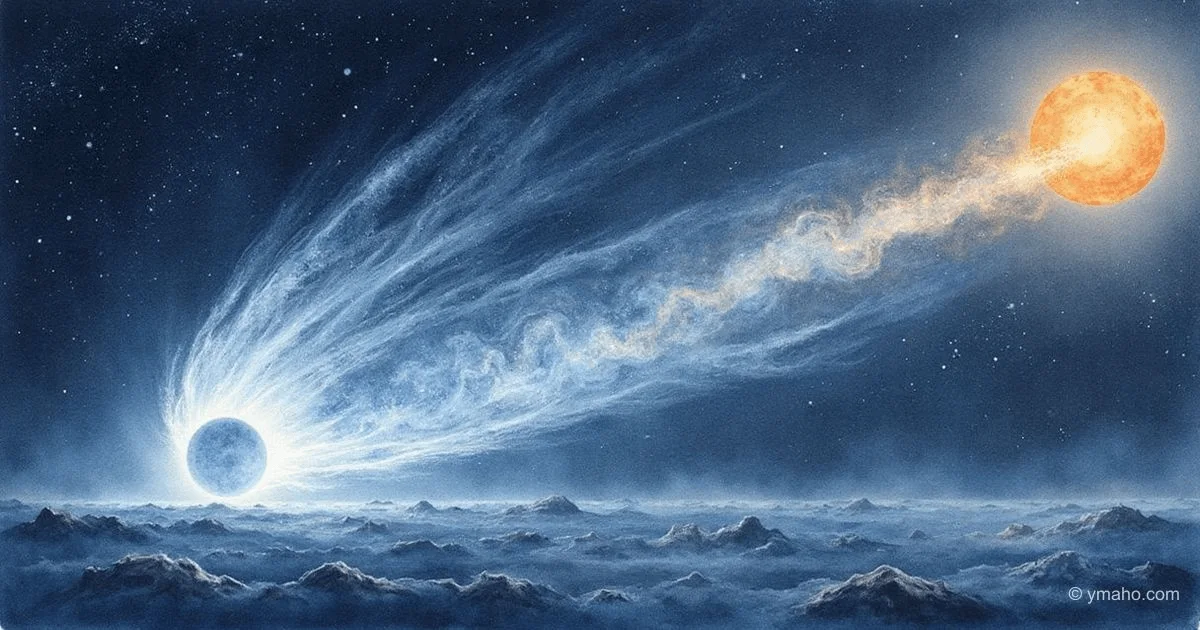
When 3I/ATLAS swung close to the Sun in late 2025, heat caused its frozen core to erupt. Solid ice didn’t melt into liquid first—it turned straight into vapor, a process called sublimation (think dry ice fog at a concert). This explosive release created a glowing cloud around the comet—its coma—and a long tail stretching millions of miles.
But 3I/ATLAS didn’t just fizz gently. It erupted with surprising force, spraying about two tons of water per second. To picture that: imagine filling an Olympic pool—which holds roughly 2,500 tons of water—in under 20 minutes, nonstop, all day long.
The Jupiter-bound JUICE spacecraft, built by the European Space Agency, caught this spectacle using two special cameras: MAJIS and JANUS. Though JUICE’s main mission is to study Jupiter’s icy moons, scientists quickly reoriented it to glimpse the fleeting comet. The timing was tight, and the signal took months to reach Earth—but the payoff was huge.
What’s Inside an Alien Iceball?
MAJIS detected infrared light signatures from water vapor and carbon dioxide—what scientists call “volatiles” because they easily turn from solid to gas when warmed. These molecules are key building blocks for planets and possibly life.
Because 3I/ATLAS formed around another star, its chemical makeup might differ from comets in our solar system. Comparing them helps answer big questions: Are planetary ingredients universal? Or does each star system cook up its own unique recipe?
So far, 3I/ATLAS seems rich in water—more active than expected for an object so far from home. That suggests its ice may be more exposed or structured differently than local comets. Scientists are now analyzing jets, rays, and filaments in its tail to understand how material escapes its surface.
Key clues include:
- Brightening far beyond typical comets after perihelion (closest approach to the Sun)
- Complex structures in its coma, hinting at uneven outgassing
- Strong, sustained water vapor emissions even as it moved away from the Sun
Why Should Earthlings Care?
Studying interstellar objects like 3I/ATLAS isn’t just about distant stars—it’s about our origins too. Comets in our solar system likely delivered water and organic molecules to early Earth. If alien comets carry similar ingredients, it raises the possibility that the seeds of life could travel between star systems.
Plus, each interstellar visitor is a time capsule. 3I/ATLAS may be over 4 billion years old, preserving conditions from its birthplace long before humans existed. By decoding its chemistry, we’re reading a message from the deep past of another corner of the Milky Way.
What does this mean for regular people? First, it reminds us that our solar system isn’t isolated—we’re part of a dynamic galaxy where objects wander between stars. Second, understanding how common water-rich bodies are elsewhere helps us gauge how rare—or common—planets like Earth might be. And finally, missions like JUICE, designed for one job, can deliver unexpected breakthroughs when they stay flexible.
Key takeaways
- 3I/ATLAS is only the third confirmed interstellar object ever observed passing through our solar system.
- It ejects about two tons of water vapor per second—equivalent to 70 Olympic pools daily.
- The JUICE spacecraft captured unplanned but critical data using its MAJIS and JANUS instruments.
- Its composition offers clues about planet formation around other stars.
- Interstellar comets may help explain how water and organic materials spread across the galaxy.
— Editorial Team









