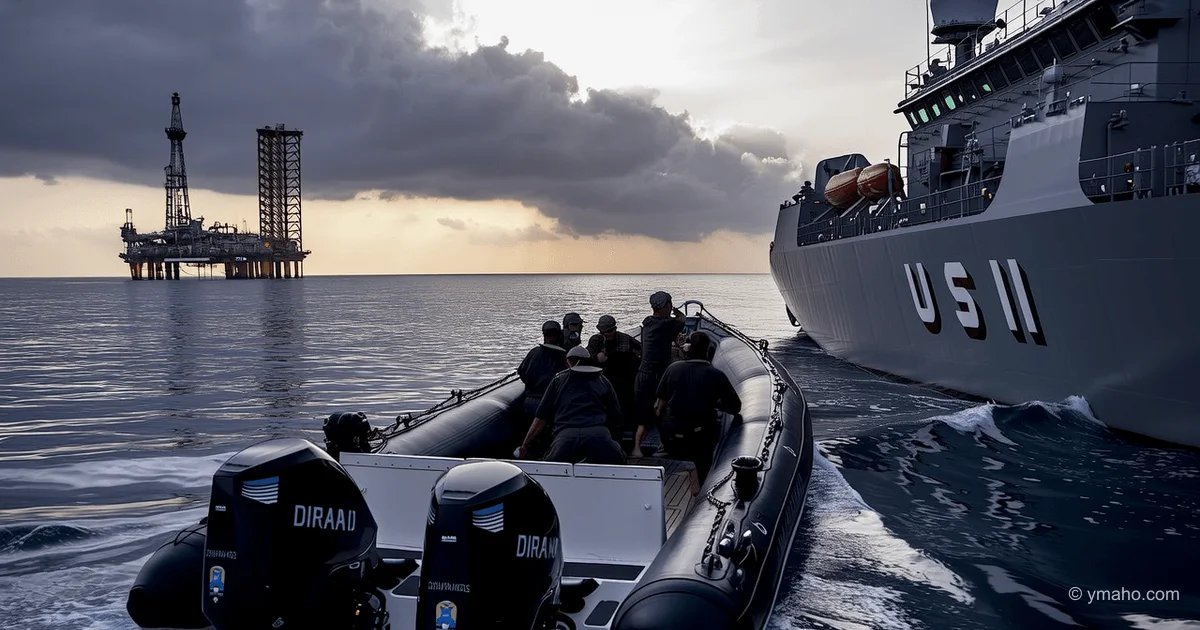
Iran Accuses Kuwait of Illegally Attacking a Boat and Detaining Citizens, Threatens Retaliation
Iran's Foreign Minister Araghchi stated that Kuwaiti forces attacked an Iranian vessel and detained four individuals linked to the IRGC. The incident occurred near an island that Iran claims is used by the US to strike the Islamic Republic.
The Essence: What's Really Happening
The incident involving the detention of Iranian citizens near a Kuwaiti island is not a border incident or a coincidence. It is a link in a chain of operations I would call the "creeping internationalization" of the Iran-US confrontation. Tehran is deliberately provoking the small Gulf states, testing whether the US security umbrella will work for allies when American military resources are stretched between the Strait of Hormuz, the Red Sea, and bases in Iraq. The four detainees, linked to the IRGC, were on a boat near an island that Iran describes as "used by the US to strike the Islamic Republic" — a hub for intelligence operations, and Kuwait, willingly or not, has found itself in the role of a forward bastion. The real question is not what that boat was doing, but why the Iranian side immediately publicized the incident through Foreign Minister Araghchi, bypassing quiet diplomatic channels. The answer: escalation is the goal, not a side effect.
Timeline and Context
Kuwait has balanced between Iran and the US for decades, but since February 2026, that balance has collapsed. That was when Kuwaiti intelligence services, coordinating with CENTCOM, stepped up monitoring of the northern Persian Gulf. The island Araghchi refers to is most likely Bubiyan or one of the small islands near the Iraq-Kuwait border, where forward posts are located to track IRGC movements. The Iranians have long known about these facilities, but until May 2026, they refrained from direct accusations. The turning point came after May 3-5, when the US Navy intercepted two Iranian vessels carrying ballistic missile components to Yemen. The detention of four individuals on May 12-13 is an act of asymmetric retaliation, framed by the Kuwaiti side as "preventing illegal entry."
Context is critical here: Tehran is escalating not on the main front but on a secondary theater where the US has fewer resources to respond. While the USS Abraham Lincoln carrier strike group is bottled up in the Gulf of Oman and the USS Harry Truman maneuvers in the Red Sea, the western shore of the Persian Gulf remains the responsibility of patrol boats and allied coast guards. Iran is striking into this gap, testing Article 5 of the Gulf Cooperation Council's defense pact — will it hold if not Riyadh or Abu Dhabi is attacked, but "only" Kuwait?
Who Wins and Who Loses
The main beneficiary is the Islamic Revolutionary Guard Corps in its domestic political struggle against the so-called moderates. Each such incident radicalizes the agenda, marginalizes negotiation supporters, and justifies inflating the military budget, which the IRGC controls through shell companies. Chinese and Russian diplomats indirectly benefit: every conflict between Arabs and Iran strengthens their position as "indispensable mediators," whose services come at the cost of geopolitical concessions.
Kuwait loses outright. Its stock market, the Premier Market Index, lost 4.2% in the week following the incident — a direct reaction to the realization that the country has turned from a neutral ground into a front line. Yields on Kuwaiti sovereign bonds maturing in 2031 jumped by 80 basis points, reflecting a risk premium. The US also loses tactically: it has to spread its already stretched naval forces, sending destroyers to Kuwait's shores, which weakens pressure in the Strait of Hormuz — exactly what Tehran aims for. Saudi Arabia loses initiative: Crown Prince Mohammed bin Salman expected the conflict with the Houthis to be frozen, only to find his northern neighbor being drawn into a confrontation that could spill over into Saudi waters.
What the Media Isn't Saying
First: the boat detained by the Kuwaitis was not just "linked to the IRGC" — it carried equipment for hydrographic seabed surveying. This is standard procedure before mining a water area. The Iranians were mapping approaches to Kuwait's oil terminals at Mina al-Ahmadi and Mina Abdullah, through which 2.1 million barrels per day are exported. If this information is confirmed, we are looking not at reconnaissance but at preparation for sabotage capable of disabling 6% of global oil exports. The Kuwaiti side deliberately downplays this fact to avoid panic and the flight of foreign specialists from oil facilities.
Second: of the four detainees, one, according to operational data, is an officer of the Quds Force with the rank of Sarhang (equivalent to colonel), who previously coordinated operations against Israeli targets in Cyprus and Greece. His presence on a fishing boat is nonsense unless the mission had strategic significance. Kuwaiti investigators are now trying to determine whether an attack on the joint US-Kuwaiti Camp Arifjan was planned, but these interrogations are behind closed doors, and the results will not be made public.
Forecast: Next 30 Days and 90 Days
Within 30 days, Iran will ramp up rhetorical pressure. Araghchi has already announced a protest note to the UN Security Council, but the main tool is not diplomatic but proxy activity: pro-Iranian militias in Iraq, especially Kata'ib Hezbollah, may carry out a demonstrative attack on Kuwaiti facilities or diplomatic personnel. Kuwait will respond by tightening its regime in its part of the Persian Gulf, possibly involving British minehunters based in Bahrain. Oil markets will add $3-5 per barrel as a "Kuwait risk premium," pushing Brent above $110.
Within 90 days, we will see two parallel processes. First, the transformation of the Gulf Cooperation Council from a discussion platform into a military alliance. Kuwait will initiate a request for a permanent US contingent on its territory — something the country has refused since the 2003 war. Second, Iran will try to split this alliance by offering Oman and Qatar separate security guarantees in exchange for renouncing US military presence. This scenario would split the GCC into "hawks" (Saudi Arabia, Bahrain, Kuwait) and "waverers" (Oman, partially Qatar). In any case, the era of neutrality for the small Gulf states is over — they are becoming a battlefield, whether they like it or not.
— Editorial Team









