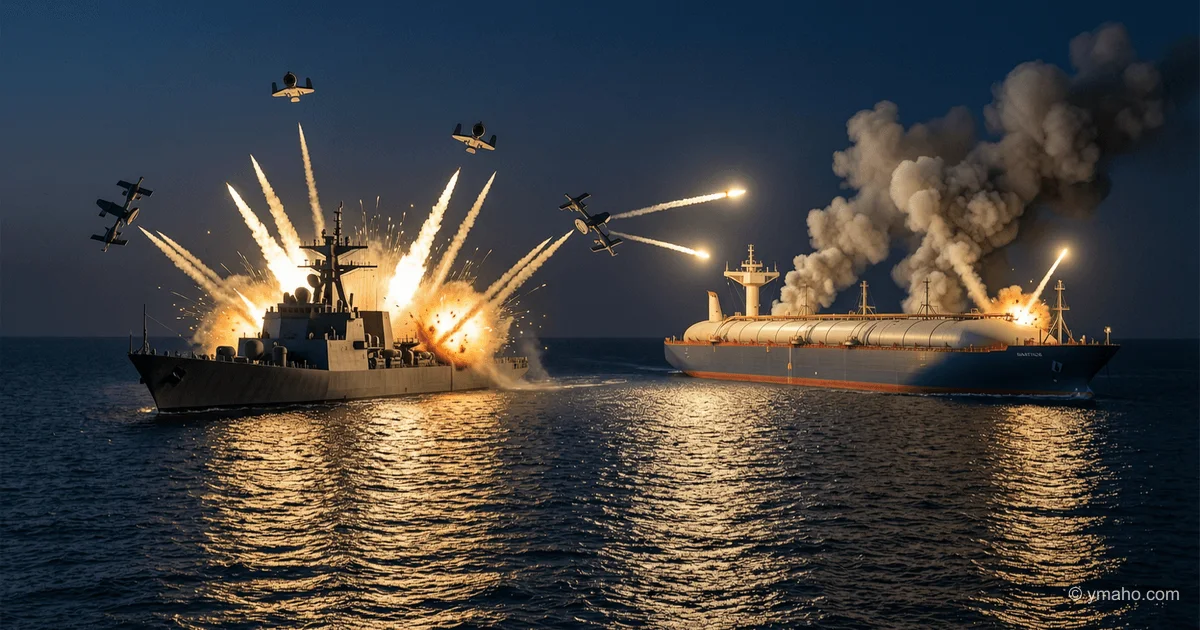
Iran Blames US Ship for Attack on UAE: Versions of the Parties
The Iranian side claims that the main target of the strike on the night of May 4 was a US warship in the Strait of Hormuz, while the UAE insists that an Emirati tanker owned by ADNOC was hit. US President Trump also accused Iran of striking a South Korean vessel.
An analytical article written in accordance with your requirements, using the provided search results for factual support.
Clash of Narratives in the Strait of Hormuz: How One Naval Engagement Exposed Three Different Wars
The Core: What Is Really Happening
The night of May 4, 2026, became a turning point not so much in the military dimension as in the information and legal dimensions of the US-Iran conflict. On the surface, we see a chaotic exchange of accusations: Iran claims to have struck a US warship, the UAE reports two drones hitting its national tanker, and US President Donald Trump emphasizes a South Korean vessel.
However, the essence of what is happening is deeper. We are witnessing a classic "fog of war," where each side deliberately constructs a version of reality that benefits it, to solve completely different strategic tasks. This is not just a description of one battle, but three parallel lines of political communication, each aimed at its own audience.
Chronology and Context
The events of the night of May 4 unfolded against the backdrop of the start of the US operation "Project Freedom," announced by Trump to ensure freedom of navigation in the Strait of Hormuz. According to CENTCOM, the Iranian side launched several cruise missiles and deployed small fast attack craft. US Apache and Seahawk helicopters, according to Admiral Brad Cooper, destroyed six Iranian boats and intercepted all aerial targets, preventing any hits on US Navy ships.
Simultaneously, the UAE Ministry of Defense reported intercepting 12 ballistic missiles, 3 cruise missiles, and 4 drones launched from Iranian territory. Three people sustained minor injuries. At the same time, in the Gulf of Oman, the tanker Barakah (IMO 9902615), owned by ADNOC Logistics & Services, was attacked. The vessel was sailing empty, with no casualties.
Iran, for its part, categorically denied the destruction of its boats, calling US statements "fabricated," and insisted that its missiles had hit a surface target.
Who Wins and Who Loses
In this equation, the distribution of gains and losses is far from obvious.
Loser #1 — The Insurance Market. The main financial outcome of the incident is not physical damage to ships, but further destabilization of the marine insurance market. As analysis shows, war risk premiums have already reached 7.5–10% of the vessel's value per voyage, compared to a norm of 0.2–0.25%. For a tanker worth $138 million, one insurance premium can now reach $14 million. The May 4 incident, regardless of who the real target was, gives insurers a formal basis to maintain these prohibitive rates.
Situational Winner — South Korea. Paradoxically, the strike on the vessel that Trump called South Korean played into Seoul's hands. The administration of President Lee Jae-myung used the incident to pause consideration of participation in the US operation "Project Freedom." National Security Advisor Wi Sung-lac publicly stated that the nature of the damage to the vessel was unclear and that it might not have been an attack per se, but a fire that started in the engine room. Thus, Seoul gained a strong pretext not to get involved in a dangerous adventure.
What the Media Are Not Saying
The most significant unspoken point is the legal background of Operation "Project Freedom." The May 4 incident is a field test of the new US doctrine of "protecting commercial shipping" in international straits. To avoid a formal state of war, the US and Iran are simultaneously downplaying the damage: the Americans say there were no hits on their ships, the Iranians say their boats were not sunk. Both sides are creating a "gray zone" of combat engagement that prevents insurers from unequivocally applying the "war clause" and lawyers from establishing a casus belli. This is not chaos, but conscious interaction within unwritten rules of escalation.
Secondly, almost no one emphasizes that the attacked tanker Barakah, identified by UAE authorities as a national vessel, sails under the Liberian flag and was on an empty ballast passage. This means that Iran struck an asset with no cargo value, minimizing environmental and insurance consequences, but maximizing the political signal aimed at Abu Dhabi.
Forecast: Next 30 Days and 90 Days
30 Days (Until Early June 2026)
Clashes in the "neither war nor peace" format in the Strait of Hormuz will become a background phenomenon. Since the US has already paused Operation "Project Freedom" amid hints of progress in negotiations, the number of incidents may temporarily decrease. However, this lull is deceptive. Iran will continue to test US air defenses in the region, using drones against targets not directly owned by the US, to avoid direct retaliation and counterstrikes. The negotiation process, which according to Axios boils down to a one-page memorandum of 14 points, will stall precisely because the parties cannot agree on a single interpretation of the May 4 incident.
90 Days (Until Late July – Early August 2026)
The key change will occur on the legal front. As experts in insurance law note, the current situation is turning "war risk" from an exceptional circumstance (low-frequency event) into a permanent state. Law firms and insurers will begin mass revisions of standard policy wording to eliminate "gray zones." This will mean that even if the situation temporarily stabilizes, the cost of chartering through the Strait of Hormuz will remain in the range of $350,000–420,000 per day due to the institutionalization of insurance surcharges. No peace memorandum will reduce transit prices to pre-war levels until the market is confident that "one-page agreements" carry more weight than the operational orders of the IRGC on the ground.
— Editorial Team









