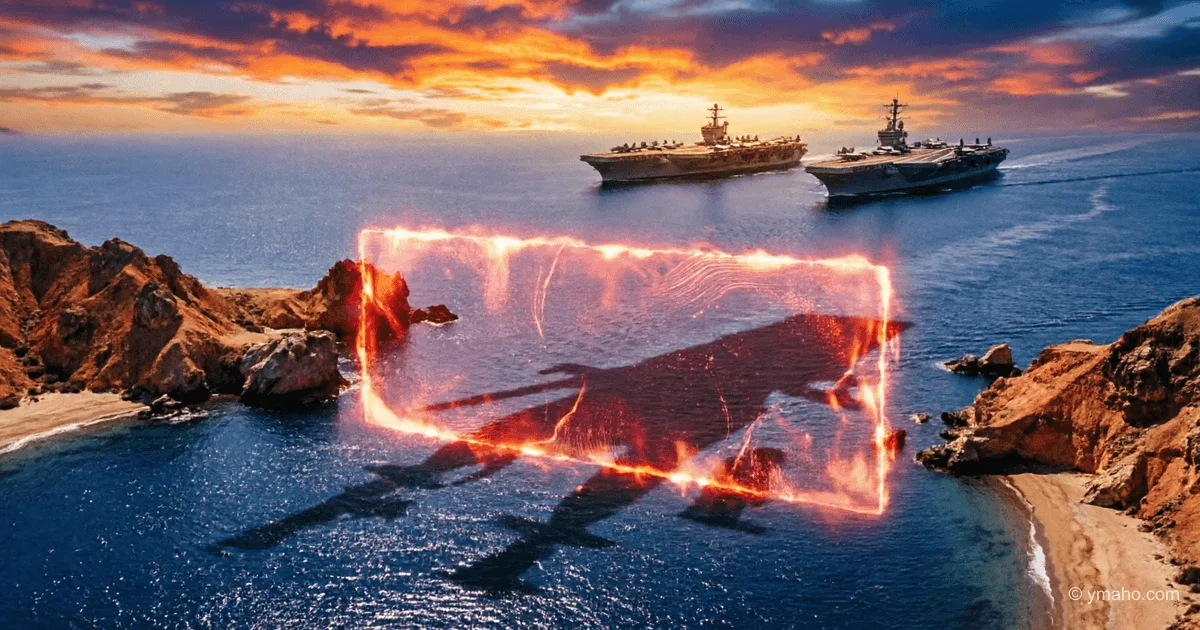
Iran Blocks the Strait of Hormuz, Two US Carrier Strike Groups Deploy Near the Persian Gulf
Tehran announced the blockade of the Strait of Hormuz until the complete lifting of the US naval blockade, through which about 20% of the world's oil passes. In response, the Pentagon completed the deployment of the aircraft carrier 'George H.W. Bush' to the region, and now two strike groups led by the aircraft carriers 'Abraham Lincoln' and 'George H.W. Bush' are stationed off the coast of Iran.
Analytical Article: 'The Closed Strait' — The World Loses Control Over the Main Oil Artery for the First Time in Half a Century
On April 22, 2026, the world witnessed an event unseen since the Iran-Iraq War of the 1980s. Iran officially announced the blockade of the Strait of Hormuz, stating it would remain closed 'until the complete lifting of the US naval blockade.' The Pentagon's response was swift: the second carrier strike group, led by USS George H.W. Bush, completed its deployment to the region. Now, off the coast of Iran — in the Gulf of Oman and the Arabian Sea — two US aircraft carriers are deployed: USS Abraham Lincoln and USS George H.W. Bush. This is the largest buildup of US naval power in the region since 2003. The world has entered a phase of 'blockade confrontation,' the consequences of which for the global economy could be catastrophic.
Event Details and Timeline
On the evening of April 21, 2026, an official representative of the Islamic Revolutionary Guard Corps (IRGC) made a brief but devastating statement: 'The Strait of Hormuz is closed to all vessels sailing under the flags of countries supporting the naval blockade of Iran. The strait will remain closed until US warships stop intercepting Iranian tankers in international waters.'
This statement was not spontaneous. Two weeks earlier, the US Navy intercepted three Iranian supertankers heading to Venezuela, accusing them of violating the sanctions regime. Tehran regarded these actions as a de facto naval blockade of its economy. Over the following 48 hours, Iranian speedboats and minelayers began a large-scale operation to mine the strait's fairway at its narrowest point — just 33 kilometers between Oman and Iran, where shipping lanes narrow to three kilometers in each direction.
US intelligence confirmed the deployment of over 100 contact and magnetic naval mines. In response, the Pentagon, which had been on high alert since the beginning of the month, ordered the USS George H.W. Bush carrier group, then in the Mediterranean Sea, to urgently proceed to the Persian Gulf via the Suez Canal. On a forced march, accompanied by a cruiser and three destroyers, the carrier reached the Gulf of Oman by the morning of April 23, joining the USS Abraham Lincoln already there.
Impact and Significance
The scale of this event's impact is comparable only to the 1973 oil embargo or the closure of the Suez Canal in 1956–1957 and 1967–1975. But there is a key difference: the Strait of Hormuz is not just a canal; it is the only maritime artery for the Gulf states.
For the global economy: Approximately 17–20 million barrels of crude oil pass through the strait daily, accounting for about 20% of all global seaborne oil trade. This includes oil from Saudi Arabia, the UAE, Kuwait, Iraq, and Qatar. Additionally, about a third of the world's liquefied natural gas (LNG), primarily from Qatar, transits the strait. The only alternative — a pipeline through Saudi Arabia to the Red Sea — has a capacity of less than 5 million barrels per day. Thus, nearly 15 million barrels per day are removed from the global supply chain. According to the International Energy Agency (IEA), global strategic reserves (about 4 billion barrels) can compensate for the shortfall for only 8–9 months, after which supply collapse will occur.
For energy prices: The day after the blockade announcement, Brent crude exceeded $106 per barrel, and WTI approached $97. However, Goldman Sachs analysts warn this is just the beginning. With a full and sustained blockade lasting more than two months, Brent could reach $150–200 per barrel, and in the event of a military clash, $250–300, which would mean an immediate global recession reminiscent of the 1979–1980 scenario.
For society: The world faces a real threat of fuel riots and gasoline rationing in developed countries. In Europe, where gas reserves were already depleted after the 2022–2023 crisis and electricity prices are tied to gas costs, household heating bills could rise 3–4 times. In the US, the administration is already considering temporary restrictions on fuel sales at gas stations — for the first time since the 1970s.
Reactions of Key Players
United States: The White House, through the National Security Advisor, stated that the blockade of the strait is an 'act of war.' However, the Pentagon is not rushing into an immediate military response, as clearing the strait is technically complex and dangerous. According to experts, demining would take 4 to 6 weeks, during which minesweepers would be vulnerable targets for Iranian missiles and drones.
China and India: The largest importers of Gulf oil find themselves hostage. China, which receives about 45% of its oil imports (roughly 7 million barrels per day) through the Strait of Hormuz, has already put its strategic petroleum reserve on emergency release. Beijing called for restraint from both sides without naming Iran as an aggressor, reflecting its dependence on discounted Iranian oil.
Europe: The European Union, already suffering from high inflation, faces a choice: support the US in a military operation to unblock the strait or attempt to mediate. But mediation is unlikely, as Iran demands a complete lifting of sanctions — a condition the US cannot meet in an election year.
Russia: Moscow, capitalizing on the situation, has increased oil supplies to China and India via its eastern ports and intensified negotiations on the construction of the 'Power of Siberia 3' gas pipeline, which would serve as an alternative to LNG maritime transport.
Forecast and Conclusions
The situation with two aircraft carriers off the coast of Iran and a closed strait is a perfect storm. Neither side can back down without losing face, but a full-scale military conflict is deadly dangerous for both.
The most likely scenario is as follows: the strait will remain closed for the next 2–4 weeks. The US will build up minesweeper forces and prepare a demining operation under air cover from the two carriers. Iran, aware of its coastline's vulnerability, will limit itself to demonstrative launches of anti-ship missiles and drone attacks. Oil prices will rise, reaching $130–150 per barrel within a month. This will force the Fed not only to abandon rate cuts but possibly to raise rates to curb inflation expectations.
Conclusion: For the first time since the Cold War, humanity finds itself in a situation where a critically important maritime artery is blocked by military force, and the only way to open it risks direct military confrontation between a nuclear power (even a threshold one like Iran) and a superpower. The world will never be the same. We are entering an era of the 'geopolitical price of oil,' where supply security becomes more important than the price itself, and strategic reserves transform from a technical tool into a weapon of national survival.
— Editorial Team









