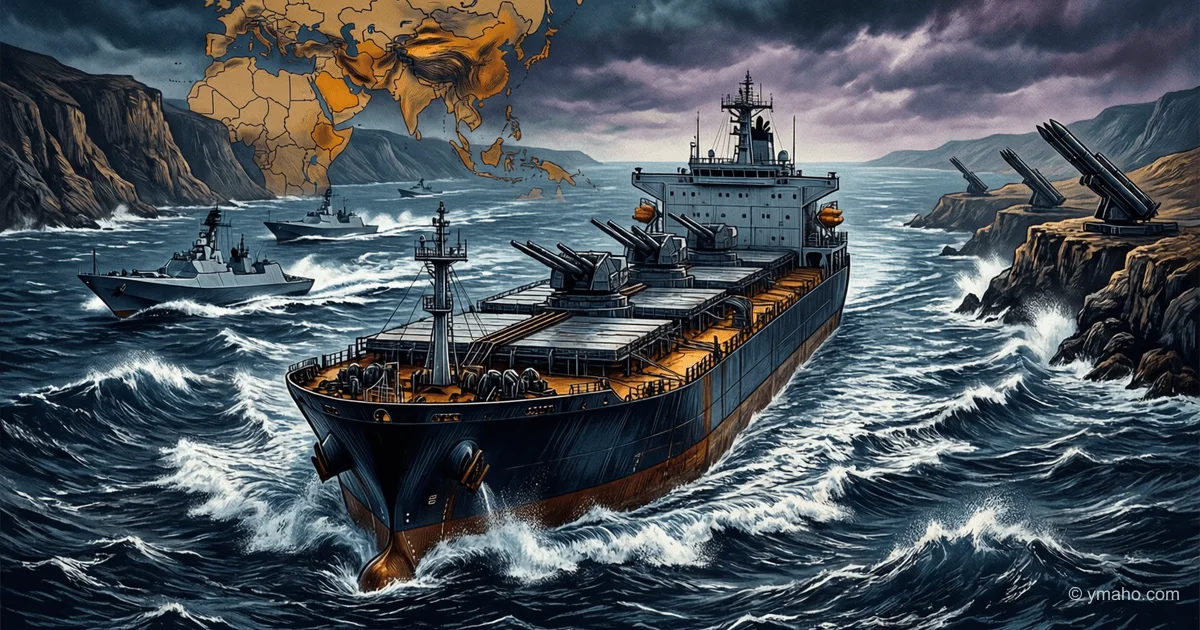
Iran Establishes Persian Gulf Authority to Control Shipping in the Strait of Hormuz
Iran's Supreme National Security Council has officially established the Persian Gulf Authority, introducing new transit permit requirements and mandatory safety fees for vessels passing through the Strait of Hormuz. The UAE has joined other Gulf states facing a collapse in cruise tourism and cancellations of luxury sea voyages due to the new crisis in the strait.
Persian Gulf Authority: Iran Turns the Strait into a Toll Parking Lot
[The Gist]: What's Really Happening
Iran's Supreme National Security Council has established the Persian Gulf Authority (PGSA) — a body that formalizes control over shipping through the Strait of Hormuz. In practice, this means introducing a system of transit permits and mandatory safety fees. Iran has officially moved from chaotic blockades to orderly rent extraction.
Note: Iran has not declared a blockade in the classical sense. It has created a bureaucratic mechanism that makes passage without its permission impossible. Ships can go through — but only after paying and receiving approval. This fundamentally changes the nature of the conflict: instead of military escalation, Tehran chooses economic legitimization of its control.
Why does this matter for financial markets? Because markets can tolerate war, but they cannot tolerate uncertainty. Iran's new system creates predictability — pay up and pass through. This predictability is already being priced in.
Timeline and Context
— May 16, 2026: Head of Iran's parliamentary national security committee, Ebrahim Azizi, announces that details of the new shipping regulation mechanism in the Strait of Hormuz will be revealed soon.
— May 20: Al Jazeera publishes the math behind the new fee — up to $2 million per vessel, payable in Chinese yuan. Authorization is issued via email at [email protected] after providing data on the owner, insurance, crew, and cargo.
— May 22: The UAE officially joins the list of countries affected by the collapse of cruise tourism. MSC Cruises, Costa Cruises, and TUI Cruises cancel winter itineraries in the Persian Gulf.
— May 23: Official confirmation of the PGSA launch. Iran also announces enhanced operational control along 2,000 kilometers of its southern coastline — from the Persian Gulf to the Gulf of Oman.
— Behind the scenes: According to Hellenic Shipping News, vessels linked to Israel are under a complete ban. Vessels linked to the US or "hostile countries" face severe restrictions or denial of passage. Others can pass for a fee.
Who Wins and Who Loses
Winners:
— Iran. According to Al Jazeera estimates, before the war, 120-140 vessels passed through the strait daily, carrying about 20 million barrels of oil. Even if Iran can process 20-30 vessels per day at $1 million per passage (a conservative estimate below the peak of $2 million), that's $20-30 million in daily revenue. Over a year, that's $7-11 billion — more than Iran earned from legal oil exports before sanctions.
— Ship owners who agree to pay. The cost of idling a tanker is about $50,000-100,000 per day in operating expenses alone, not counting lost revenue. Paying $1-2 million and passing through in 24 hours is cheaper than waiting a month.
— China. Fees are paid in yuan. This strengthens the Chinese currency's position in international settlements and creates demand for yuan from shipowners worldwide. A subtle but powerful blow to the dollar as the sole settlement currency in maritime trade.
Losers:
— The Gulf cruise industry. Six major liners (MSC Euribia, Celestyal Journey, Celestyal Discovery, Mein Schiff 4, Mein Schiff 5, Aroya Manara) are stranded in the ports of Dubai, Abu Dhabi, and Doha. About 17,000 passenger berths are idle. MSC Euribia, designed for 6,300 passengers, was supposed to head to Europe — instead, it sits at Port Rashid in Dubai. Losses for cruise operators are estimated in the tens of millions of dollars for May alone.
— UAE, Qatar, Bahrain. These countries have invested billions in cruise infrastructure. Dubai and Abu Dhabi built modern cruise terminals, banking on the winter tourist season. Now all of it sits idle. According to Travel and Tour World, cancellations have already affected the 2026-2027 winter season — operators simply won't commit.
— Insurance companies covering war risks. Additional war risk premiums (AWRP) have surged from 0.15-0.25% to 1-5% of the vessel's value per passage. For a $100 million tanker, that's $1-5 million per transit. Some quotes reached 5-10% at peak moments. Insurers earn premiums but face catastrophic risks — if several vessels are damaged in a single incident, payouts could exceed $1.75 billion, as Jefferies analysts estimated in March.
What the Media Isn't Saying
Non-obvious insight: The PGSA is not an Iranian initiative. It is a response to the American blockade, and Washington fully understands that creating such an authority is an admission that the Pentagon cannot force the strait open.
The US has declared a blockade of Iranian ports. But what good is a blockade if Iran controls the strait? American ships cannot enter the strait without provoking a direct confrontation. And without entering the strait, how do you plan to open it? Patrolling from a safe distance doesn't work when control is exercised from shore batteries and IRGC speedboats.
Iran understands this and creates the PGSA as the de facto legitimate operator of the strait. This mirrors the Turkish model in the Bosporus: Turkey cannot prohibit passage, but it can charge fees for navigation services, pilotage, and salvage readiness. Iran does the same, with one difference — its control is based on the threat of force, not international conventions.
A second hidden detail: OFAC (the US Office of Foreign Assets Control) issued guidance on May 1, 2026, warning that payments to Iran for safe passage may be deemed prohibited transactions, exposing non-US companies to secondary sanctions risk. This means that even if a shipowner pays Iran, they may lose access to dollar settlements and US banks.
In practice, this creates a schizophrenic situation: European and Asian vessels pay Iran in yuan through shell companies to pass, then report to the Americans that they "paid nothing." The system works, but any glitch — and the chain collapses.
Forecast: Next 30 Days and 90 Days
30 days (by end of June 2026)
— The PGSA system stabilizes. Iran will publish an official tariff — expected to be $500,000 to $1.5 million per vessel depending on type and cargo. Oil tankers will pay more, container ships less.
— Transit numbers will rise from the current 26 vessels per day (per Iran's data) to 50-60. That's still half the peacetime level of 120-140, but better than a complete halt.
— Cruise companies will finally abandon the Persian Gulf for the 2026-2027 season. This is already confirmed by MSC, Costa, TUI. Losses for the region: $1.5-2 billion from tourism alone.
— Insurance rates stabilize at 1-2% of vessel value instead of the peak 5%. Enough for ships to move, but not enough to restore pre-crisis volumes.
90 days (by end of August 2026)
— Optimistic scenario: The international community (via IMO or UN) is forced to recognize the PGSA as a de facto regulator. Iran gains legitimacy for a fee — a kind of "license to control." In this case, vessel flow recovers to 80-100 per day, Brent oil corrects to $85-90.
— Pessimistic scenario: The US imposes secondary sanctions on 5-10 major shipowners who paid Iran. This creates a domino effect — no one wants to be next. Transit collapses back to 10-15 vessels per day. Brent surges to $115-120.
— Base scenario (70% probability): Status quo with gradual transit growth. Iran collects $300-500 million per month. The US pretends not to notice yuan payments. Markets get used to the "new normal" — the strait is open, but expensive. Brent in the $95-105 range.
Editorial Forecast
Asset: Brent crude. Direction: Moderate decline over the next 48-72 hours to $98-101 per barrel — markets are pricing in stabilization of the PGSA system as a factor reducing the risk of a full blockade. Key levels: Resistance — $105.5 (weekly high), support — $95 (zone where buying from China and India kicks in). Confidence level: Medium (60%). Main risk: If OFAC announces the first sanctions against a shipowner who paid Iran, Brent will break $110 within 6-8 hours — the market will realize there is no legal way to pass the strait, and panic will return.
The editorial opinion is analytical in nature and does not constitute individual investment advice.
— Editorial Team









