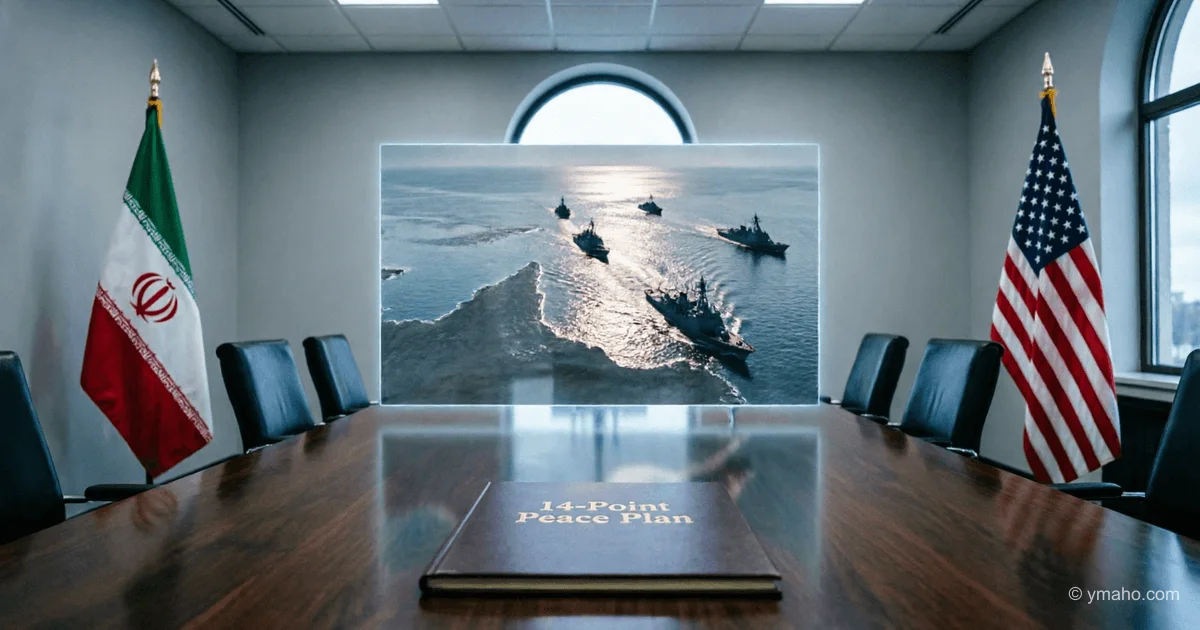
Iran presents US with 14-point peace plan, demanding reparations and troop withdrawal
Tehran insists on lifting sanctions, unfreezing assets, and creating a new management mechanism for the Strait of Hormuz, but Washington may reject these proposals.
Ultimatum from Tehran: reparations, the strait, and troop withdrawal — what Iran demanded from the US
Introduction
While the world watched the escalation in the Persian Gulf, Tehran made an unexpected diplomatic move. On the night of May 3, 2026, Iranian news agencies Fars and Tasnim reported that Iranian authorities had handed Washington a 14-point peace plan. The document was a response to the American ceasefire proposal — a tough ultimatum including reparations, troop withdrawal, and a change in the status of the Strait of Hormuz.
President Donald Trump, upon receiving the document, expressed deep skepticism. "I can't imagine it will be acceptable, since they haven't yet paid a high enough price for what they've done to humanity and the world over the last 47 years," he wrote on Truth Social. The conflict, which began on February 28 with US-Israeli strikes, has reached a stalemate. The only round of negotiations on April 11 in Pakistan failed. Now the parties are locked in confrontation: Iran blocks the Strait of Hormuz, the US blocks Iranian ports. Amid this "war of attrition," Tehran has put forward conditions that change the very logic of negotiations.
Event details and timeline
The initiative came from Washington. The US proposed a two-month ceasefire under a 9-point plan. However, Iran responded that "the focus should be not on extending the ceasefire, but on ending the war," and insists on resolving all issues within 30 days.
The plan includes the following key demands:
- Security guarantees — assurances that attacks on Iran will not be repeated in the future.
- Withdrawal of US troops from "border regions" and from "Iran's periphery."
- Lifting of the naval blockade imposed by the US around Iranian ports.
- Unfreezing of Iranian assets abroad.
- Payment of reparations for damage caused during the conflict.
- Cancellation of all sanctions against the Islamic Republic.
- Cessation of hostilities on all fronts, including Israeli attacks on Lebanon.
- Establishment of a "new mechanism for the functioning of the Strait of Hormuz."
According to media reports, the plan provides for phased implementation. First — a ceasefire and security guarantees for Iran and Lebanon. Then — discussion of a new management regime for the strait. And only after reaching consensus on these issues — negotiations on the nuclear program.
Iran's Supreme Leader Mojtaba Khamenei had previously stated his position: "By the will and power of God, the bright future of the Persian Gulf region will be without America," and Iran intends to introduce "new legal mechanisms and a management system" for the strait.
Impact and significance (for the world / industry / society)
This plan is not just a negotiating position. It represents an attempt by Iran to radically reshape the balance of power in the region and lock in military gains through diplomacy.
For the Middle East, the key point is the demand for a new regime in the Strait of Hormuz. Iran is essentially seeking international legal recognition of its control over the strategic artery through which about 20% of the world's oil supplies pass in peacetime. This would mean not just a return to the status quo, but a change in the rules of the game in Tehran's favor, with the possibility of levying fees on passing ships.
For the US, the demands for troop withdrawal and reparations are politically toxic. The Trump administration officially declared the war over on May 1, notifying Congress, but maintained a military presence and blockade. Agreeing to reparations would mean acknowledging aggression — a step unthinkable for the White House. Lifting sanctions would deprive Washington of a key lever of pressure.
For the global economy, prolonging the crisis means maintaining high energy prices. Analysts warn: the longer the strait remains blocked, the higher the inflationary pressure worldwide. Bloomberg has already reported that Iran has begun cutting oil production due to storage tanks filling up.
Reactions of key players
The US takes a hard line. Trump openly doubts the acceptability of Iran's conditions. According to WSJ sources, the administration is preparing for a prolonged naval blockade of Iran, aiming to "strangle its economy by limiting oil exports."
However, the military is preparing an alternative scenario. According to FOX News, US commanders believe they can deliver a "final blow" to Iran using Dark Eagle hypersonic missiles if negotiations reach a complete dead end.
Iran maintains a combative stance. Military adviser to the Supreme Leader Mohsen Rezaei threatened to "send American ships and troops to the graveyard." Foreign Minister Abbas Araghchi expressed readiness for diplomacy but warned: the US must avoid "excessive demands, threatening rhetoric, and provocative actions."
Mediators — Pakistan, through which the plan was transmitted — remain in the shadows. Arab Gulf states, including Oman, have previously opposed Iranian initiatives to levy fees on ships.
Forecast and conclusions
The coming days will be decisive. Washington must give an official response to Tehran's 14 points. Several scenarios are possible:
Optimistic: The US softens its position, offering a compromise on the strait (e.g., joint management or international control) in exchange for dropping demands for reparations and immediate troop withdrawal. However, Trump has already made it clear that he considers the Iranians have not paid a "sufficient price."
Realistic: Negotiations drag on. The conflict enters a phase of "neither war nor peace" — blockades remain, the strait stays closed, and the parties exchange threats and limited strikes. Iran's economy gradually suffocates, but global oil prices remain high.
Pessimistic: Washington rejects the plan, announces new strikes (a "final blow" on nuclear facilities or infrastructure). Iran responds with full-scale escalation in the strait and attacks on US bases in the region. The scenario everyone fears becomes reality.
The conclusion is clear: Tehran's initiative is not a path to peace, but a tug-of-war at maximum stakes. Each side hopes the other will blink first. But in this game, the loser could be the entire world — through gasoline prices, inflation, and the risk of a major war.
— Editorial Team









