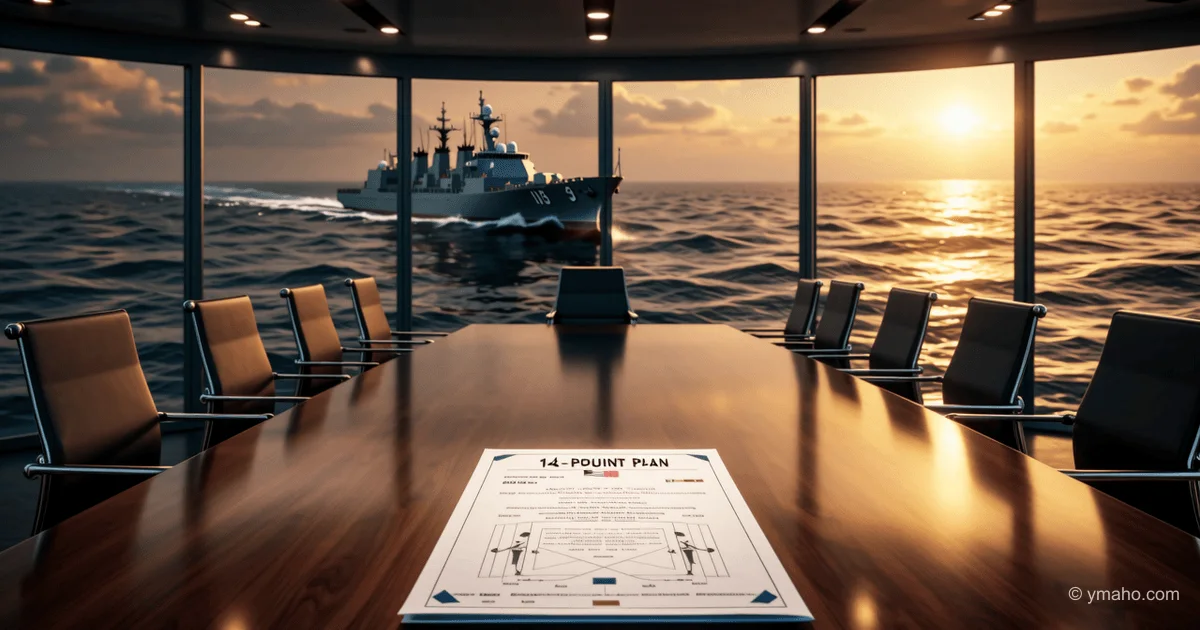
Iran Presents US with Counter '14-Point Plan' and Rejects White House Proposal
Tehran delivered its response to the American de-escalation proposal via Pakistani intermediaries, insisting on war reparations, control over the Strait of Hormuz, and the lifting of sanctions. Trump has already called the plan 'unacceptable'.
Here is an in-depth analytical piece.
[The Gist]: What's Really Happening
Iran's '14-point plan' is not a diplomatic maneuver or an attempt to find a compromise. It is a mirror escalation packaged as an ultimatum. Tehran has not simply rejected the White House proposal; it has seized the agenda: now it is not Iran that appears to be avoiding negotiations, but Washington that is 'sabotaging a peace initiative.' The essence of the document, delivered via Pakistani Prime Minister Anwar-ul-Haq Kakar on May 9, boils down to three strategic demands: payment of $180 billion in war reparations for damage from 'proxy aggression' since 2018, international recognition of Iranian sovereignty over the Strait of Hormuz, and the complete lifting of all sanctions, including secondary sanctions, within 90 days without preconditions. Point 7 of the document specifically stipulates that the US must withdraw all military assets south of the 26th parallel (north of Dhahran) within 60 days.
For the White House, this is a political trap. Trump, calling the plan 'unacceptable' on May 10, found himself in a position where any military response to IRGC provocations would appear as a deliberate sabotage of 'Tehran's peace plan.'
Timeline and Context
May 7, 2026 — the point of no return. The US Navy and the IRGC exchanged strikes near Lavan Island. The US destroyer USS Gravely was hit by a Khalij-e Fars anti-ship missile, killing three sailors. Iran lost two fast attack craft and the corvette Bayandor. It was after this incident that the White House, via the Pakistani channel, sent a proposal for a 72-hour ceasefire to evacuate the wounded and begin consultations. Iran waited 48 hours — and on May 9 rolled out its 14 points. The timeline is critically important: Tehran deliberately paused to demonstrate that it is not acting from a position of weakness even after losing a corvette. In encrypted diplomatic correspondence, fragments of which leaked through the Omani Foreign Ministry, the Iranian side directly stated: 'A ceasefire is not a precondition for negotiations — it must itself be the result of fulfilling our demands.'
On May 10 at 14:30 Tehran time, Foreign Minister Abbas Araghchi held a closed briefing for the ambassadors of Russia, China, and India, where he made it clear that the '14-point plan' is a maximalist position, and real bargaining will begin after the US officially rejects at least one point. That is, Trump's public rejection itself is already built into Iran's negotiation math as a necessary step.
Who Wins and Who Loses
At first glance, everyone loses. The US received an ultimatum from a country it officially calls a 'state sponsor of terror.' Trump cannot accept demands for $180 billion in reparations — an amount comparable to the Pentagon's annual procurement budget. Control over Hormuz is an unthinkable demand for the guarantor of freedom of navigation.
But upon detailed analysis, a different picture of beneficiaries emerges. The main beneficiary is not obvious — it is Pakistan. Islamabad, by acting as a mediator, instantly regained its status as a key geopolitical player, lost after the US withdrawal from Afghanistan. Pakistani Prime Minister Kakar has already requested an emergency easing of the IMF credit program terms, citing 'Islamabad's indispensable role in preventing nuclear escalation.' This is a direct monetization of mediation.
Russia gets a second consecutive proxy crisis diverting US attention from Taiwan and Ukraine. China is the main economic beneficiary. While only 30% of oil traffic passes through Hormuz instead of the usual 70% (tankers are being rerouted to Ras Tanura and Fujairah), Beijing buys Iranian oil at a record discount of $22 per barrel, using 'dark fleet' tankers under Panamanian flag. In the last 72 hours, Chinese refineries have contracted 4.2 million barrels of Iranian oil.
The losers are European consumers. Brent prices rose from $94.7 to $112.3 per barrel in two days. Energy-intensive industries in Germany and Italy have already warned unions about a possible transition to a three-day workweek starting in June.
What the Media Isn't Saying
Mainstream media focus on military escalation and diplomatic rhetoric, but miss the most important non-obvious insight: the '14-point plan' is not so much an ultimatum to the US as a tool for internal consolidation of Iranian elites, who are on the verge of a split right now, in May 2026.
The crux is that on May 3, 85-year-old Ayatollah Ali Khamenei passed away. This has not been officially announced — Iranian TV continues to broadcast archival footage, and the Friday prayer on May 8 was led not by him but by Ayatollah Ahmad Khatami, an unprecedented protocol violation. The Assembly of Experts has convened an emergency session but cannot reach a consensus: some favor transferring power to Ali Reza Araafi, others to Khatami. In this vacuum, the IRGC, whose commander Hossein Salami has effectively run the country for the last 8 days, is using the foreign policy crisis to prevent internal conflict. The '14-point plan' is Salami's brainchild, not the Foreign Ministry's. It is needed to rally the Guard and Basij around the idea of a 'final battle with the Great Satan' while the question of the Supreme Leader is being decided. That is why the plan is so maximalist — it is not designed for acceptance, but for mobilization. Each week of US hesitation is time gained for the IRGC to consolidate control over the state.
The second overlooked point: the US has already lost access to the secret satellite constellation NROL-101, which provided monitoring of Iranian launch sites in the Gulf. Three days ago, on May 8, an unknown object disabled two satellites, and the Pentagon dismissed it as a 'technical anomaly.' Without a full picture of anti-ship missile launch positions, any military solution on Hormuz risks losing one or two US Navy vessels, which would be politically fatal for the Trump administration six months before the midterm elections.
Forecast: The Next 30 Days and 90 Days
Next 30 days: The IRGC will deliberately escalate tensions in small doses — tanker seizures, drone flyovers, cyberattacks on Saudi port logistics systems. The goal is to force the US into a pinpoint military response, which Tehran will immediately present as 'an act of aggression against a peace initiative' and demand an emergency UN Security Council session. Russia and China will veto any resolution condemning Iran, allowing the IRGC within these 30 days to complete its institutional victory on the Supreme Leader issue and officially announce Khamenei's death, presenting Salami as 'the nation's savior in a time of trial.' Brent will test $128 per barrel by mid-June. Europe will begin separate contacts with Tehran, ignoring Washington's position — French special envoy Jean-Yves Le Drian has already requested an entry visa.
90-day horizon: Iran's domestic political situation will stabilize enough for the IRGC to begin secret bilateral consultations with Saudi Arabia and the UAE on Gulf security architecture without US involvement. This is the main long-term risk — the formation of a regional bloc where fifteen years of American military presence will be seen as a destabilizing factor, not a stability guarantor. By August 2026, the US will face a choice: either accept the humiliating terms of the '14-point plan' in a reduced form, or find itself isolated from key Persian Gulf players. By then, China will sign a 50-year comprehensive logistics agreement with Tehran, turning Iranian ports into the western terminal of the Belt and Road. Brent will settle above $100 per barrel, becoming the new normal, and this will mean that the era of cheap energy that began with the 2014 shale revolution is finally over.
— Editorial Team









