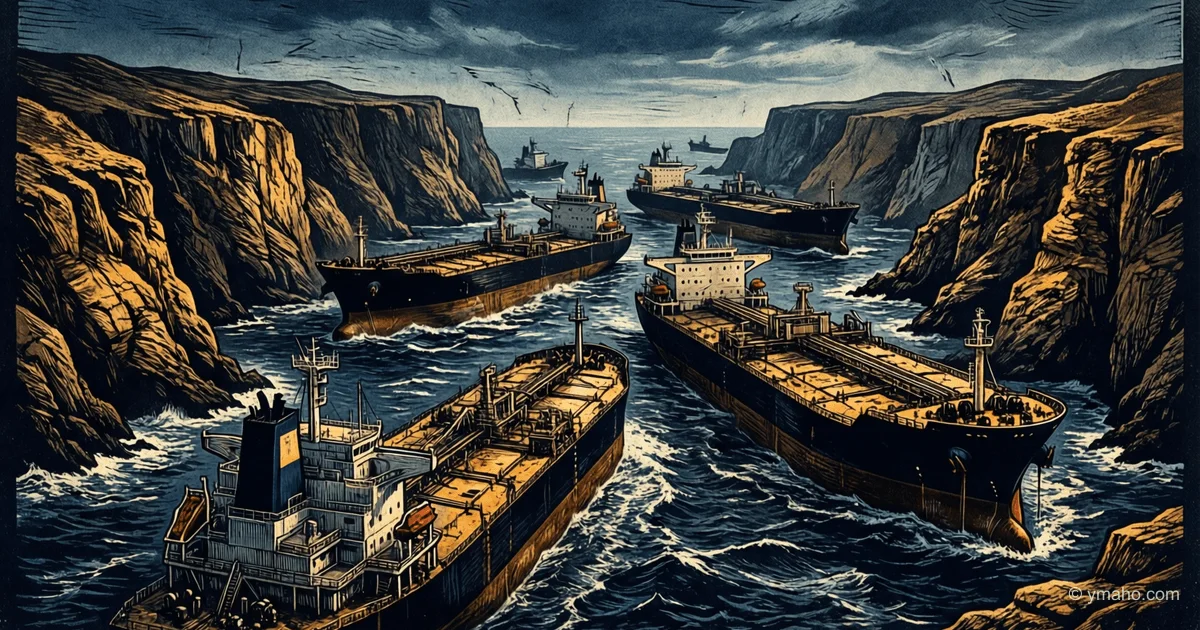
Iran's Losses from the Strait of Hormuz Blockade Reach $435 Million Per Day
Due to the US blockade, Iran loses about $435 million in trade revenue daily, with nearly two-thirds of that amount coming from crude oil exports. According to experts, Iran's public finances have already suffered losses of about $17 billion since the start of the blockade, while the country's annual inflation has exceeded 54%.
The Blockade as a Mirror: Why $435 Million Per Day Is Not Iran's Main Problem
[The Gist]: What Is Really Happening
The figure of $435 million in daily losses cited by analysts has become a meme in financial markets. But behind it lies a much more dangerous dynamic. Iran is not just losing money. It is losing the ability to return to the market even after the blockade is lifted.
Let's break down the math. $435 million per day is the sum of two components: $276 million in lost exports (oil, petrochemicals, non-commodity goods) and $159 million in blocked imports. But these figures are based on pre-crisis volumes. Actual losses today are higher because Iran can no longer export even the volumes it had in March 2026.
The main thing markets are missing: Iran is 10-14 days away from irreversible damage to its oil industry. Free onshore storage is about 80-85% full out of a total capacity of 50-55 million barrels. About 20 million barrels are free. At current production (which Iran cannot fully stop without losing wells), these storage facilities will be filled in 13-15 days.
Then comes the moment of truth: old wells will have to be shut in. The water coning effect will lead to an irreversible loss of 300,000-500,000 barrels per day of production capacity. That's $9-15 billion in lost future revenue annually, forever. Iran knows this. The US knows this. It's a war of attrition, and the timer is ticking.
Timeline and Context
- April 13, 2026: CENTCOM announced a full naval blockade of Iranian ports. The operation took less than 36 hours, involving over 10,000 military personnel, a dozen ships, and more than 100 aircraft.
- April 15: Initial loss estimates—$435 million per day. Analysts at FDD (Foundation for Defense of Democracies) publish a detailed calculation, including the critical storage factor.
- April 25 – May 10: Satellite data shows that only a few tankers carrying Iranian oil have left the Gulf of Oman. Exports fell by 80% compared to March (from 23.4 million barrels per month to about 4 million for the same period).
- May 12-13: Euronews and other media report that Iran's inflation has risen to 54%, with food inflation above 115%. The rial falls to 1.9 million per dollar.
- May 21: Kpler analysts note that cumulative oil losses in the Middle East reached 782 million barrels by May 8, and are expected to hit 1 billion by the end of May.
- May 23: Data is published on Iran's accumulated public finance losses—about $17 billion since the start of the blockade. Inflation officially exceeds 54%.
Who Wins and Who Loses
Winners:
- China. Yes, it sounds paradoxical given the loss of supplies. But Beijing gets Iranian oil via a "shadow fleet" with transponders turned off at a discount of $20-25 per barrel to Brent. Iran's losses are China's savings. Moreover, the yuan is becoming the settlement currency for circumvention schemes, strengthening its international position.
- Physical oil traders with access to alternative sources (Russia, Venezuela). The spread between Brent and Urals has widened to $18-20, creating arbitrage opportunities.
- Manufacturers of enhanced oil recovery (EOR) equipment. After Iran loses some capacity due to water coning, recovery will require their services—orders worth $2-3 billion over the next 2-3 years.
Losers:
- Ordinary Iranians. This is obvious, but the scale of the disaster is underestimated. Annual food inflation is 115%. Chicken and lamb have risen 45% since February, rice 31%, eggs 60%, tea and milk over 50%. Cash withdrawal limit is $18-30 per day. A 10 million rial note is worth about $7.
- Turkey and Pakistan. They received Iranian gas under long-term contracts at a discount. Now supplies are threatened, and they have to turn to the spot LNG market, where prices are 30-40% higher.
- Shipowners who failed to pull their tankers out of the blockade zone. According to Kpler, about 66 million barrels are stored on vessels in the Persian Gulf. That's dead cargo—cannot be sold or unloaded.
What the Media Isn't Saying
Non-obvious insight: Iran is deliberately not stopping production, even knowing that storage is overflowing. Why? Because shutting down wells is political suicide for the regime.
Hundreds of thousands of people work in Iran's oil industry. Closing wells means mass layoffs in the provinces of Khuzestan and Bushehr—traditional strongholds of regime support. Unemployment is already sky-high (officially about 15%, actually 25-30%). Add to that 54% inflation and 115% on food. The regime survives because people believe: "we are temporarily enduring, but we will get everything back later." If the wells are closed forever, that belief will vanish.
Second hidden detail: The IMF forecasts Iran's economy to shrink by 6 percentage points next year. That's the official figure. But behind the scenes, the fund discusses a scenario of a 12-15% drop if the blockade lasts another 60 days. Iran can no longer import equipment for its refineries. After 90 days without spare parts, refinery utilization will fall from 70% to 30-40%, and recovery will take years.
Third: In the Kpler report of May 21, there is a phrase that no one noticed: "the global crude oil balance in March and April showed a deficit of about 2 million barrels per day." That is, the blockade of Iran has already created a global deficit. But Brent prices are still below $110—because China and India have cut purchases due to weak demand. If demand recovers and the blockade remains, $120-130 is inevitable.
Forecast: Next 30 Days and 90 Days
30 days (by end of June 2026)
- Critical point—June 5-7. By then, Iran's free storage will be completely full. The regime will be forced to either sharply reduce production (with capacity loss) or start emergency flaring of oil in the field (environmentally catastrophic and technically difficult).
- According to Kpler estimates, cumulative losses will reach 1-1.1 billion barrels. This is a volume the global market cannot quickly replenish—OECD stocks will fall to historic lows.
- The rial will break through 2.2 million per dollar (currently 1.9 million). The black market will be closer to 2.5-2.7 million. Inflation will accelerate to 60-65% annually.
90 days (by end of August 2026)
- Optimistic scenario (30% probability): Diplomatic breakthrough via Qatar. The blockade is lifted in exchange for nuclear concessions. But Iran returns to the market with damaged capacity—the lost 300,000-500,000 barrels per day cannot be restored. Brent stabilizes at $80-85.
- Base scenario (50% probability): The blockade continues, Iran begins shutting in wells. By August, production falls from 1.5 million barrels per day to 800,000-900,000. Public finances collapse, the regime introduces bread rationing. Brent at $105-115.
- Pessimistic scenario (20% probability): Iran attempts to break the blockade by military means. Direct US-Iran conflict. The Strait of Hormuz is completely closed for 2-4 weeks. Brent at $140-160. Global recession.
Editorial Forecast
Asset: Brent crude oil. Direction: Sideways with increased volatility over the next 24-72 hours in the range of $98-105 per barrel—the market is pricing in a continuation of the blockade but does not believe in a complete collapse of Iranian production in the coming days. Key levels: Support—$95 (buy zone from China), resistance—$108 (level where short sellers' automatic stop-losses are triggered). Confidence level: Medium (55%). Main risk: If satellite confirmation of well shut-ins in Iran (e.g., at the Ahvaz or Marun fields) appears within 72 hours, Brent will break $110 in 12-24 hours—the market will realize that capacity losses are becoming irreversible and will start pricing in long-term premiums.
The editorial opinion is analytical in nature and does not constitute individual investment advice.
— Editorial Team









