Iran's Special Forces Seize Tankers in the Strait of Hormuz in Response to US Naval Blockade
Iran's special forces have seized two foreign vessels attempting to transit the Strait of Hormuz without Tehran's permission. This was a response to the interception of Iranian tankers by US military worldwide and a demonstration of the Islamic Republic's control over the strategic strait.
Analytical Article: "Boarding as a Political Statement" — Why the Seizure of Tankers Changed the Balance in the Strait of Hormuz
When it comes to naval confrontation, one usually imagines destroyers, aircraft carriers, and cruise missiles. But Iran rewrote the rules of the game by returning to tactics that seemed anachronistic in the era of precision weapons. The special forces of the Islamic Revolutionary Guard Corps (IRGC) seized two foreign container ships attempting to pass through the Strait of Hormuz without Tehran's permission. This operation was a direct response to the interception of Iranian tankers by US military worldwide and, more importantly, a demonstration that the Islamic Republic maintains real control over the planet's main oil artery, despite the presence of two US carrier strike groups.
Event Details and Timeline
It all began when the US intercepted the Iranian supertanker Tuska in the Gulf of Oman, seizing it with Marines. Tehran immediately regarded this as an act of maritime piracy and threatened a symmetrical response. The answer was not long in coming.
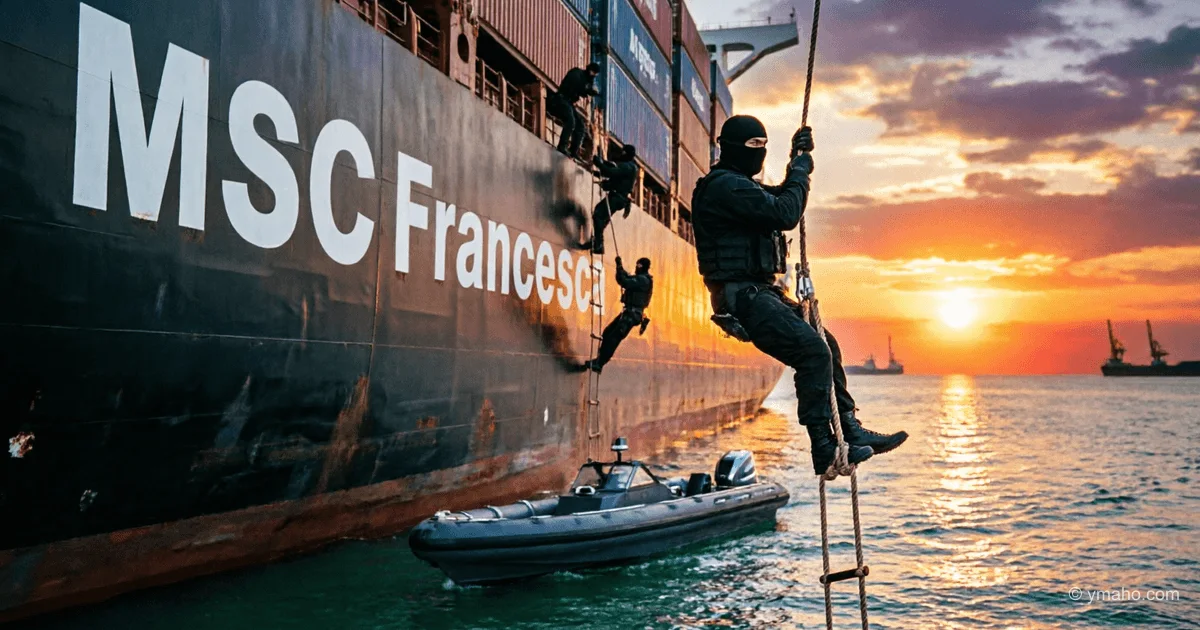
On the morning of April 22, 2026, IRGC special forces on fast boats attacked two container ships in the Strait of Hormuz:
- MSC Francesca — a vessel under the Panamanian flag, operated by a Swiss company
- Epaminondas — a vessel under the Liberian flag, owned by Greek shipowners
Iranian state television released video of the operation, which quickly spread through global media. The footage shows masked fighters on a gray fast boat approaching the container ship, climbing rope ladders aboard, and clearing rooms with Kalashnikov rifles without encountering resistance. The video's style resembled a movie trailer — with upbeat music and dynamic editing — indicating its propaganda purpose.
Iranian authorities stated that the vessels attempted to transit the strait without permission and without paying the fee established by Tehran. The seizure occurred almost simultaneously with US President Donald Trump's announcement of an indefinite extension of the ceasefire with Iran — the deadline was set for April 22. Formally, the pause in hostilities remained, but at sea, the confrontation only intensified.
On the same day, US forces conducted their own operation: US Marines boarded the supertanker Majestic in the Indian Ocean, which, according to the Pentagon, was carrying about 2 million barrels of Iranian oil. Thus, the parties exchanged "symmetrical strikes" at sea without formally violating the land ceasefire.
Impact and Significance
The seizure of two container ships is not just another episode in a series of maritime incidents. This event has three fundamental consequences.
1. Demonstration of Asymmetric Superiority. Iran once again showed that even against a military superpower, one can act effectively using unconventional tactics and geographic factors. As noted by the Greek maritime security firm Diaplous, the operation is part of a "multi-layered threat system" that includes "shore-based missiles, drones, mines, and electronic warfare" to "create uncertainty and slow decision-making." Fast boats, of which Iran has hundreds, have become the "backbone" of its maritime strategy, enabling rapid response operations.
2. Failure of US Strategy. Despite Trump's claims that the US has "total control" over the Strait of Hormuz, the reality looks different. As The Guardian acknowledges, while US forces have proven their ability to stop vessels leaving Iranian ports, they "have yet to demonstrate the ability to open the strait" for ships from allied Gulf states. Moreover, according to analytics firm Vortexa, the US "missed" at least 34 tankers and gas carriers linked to Iran that continued to export oil.
3. New Level of Confrontation. Iran's introduction of a fee for transit through the strait is an unprecedented step. According to Iranian authorities, the first revenues have already been directed to the central bank. In effect, Tehran is shifting the conflict into an economic dimension, monetizing its position as the "gatekeeper" of the strait. This changes the nature of the conflict: from purely military-political, it becomes trade-economic, where each side tries to impose its own navigation rules on the other.
Reactions of Key Players
The US found itself in a difficult position. Trump, on one hand, threatens to "destroy" Iranian boats if they approach the US blockade line. On the other hand, he stated he is "in no hurry" to end the conflict, signaling that the current "neither war nor peace" situation suits him. Simultaneously, the White House ordered increased naval operations, including the destruction of Iranian boats laying mines.
Iran shows internal division in its statements. The military command ("Khatam al-Anbiya") speaks of full control over the strait and maintaining the blockade, while the diplomatic ministry (Foreign Ministry) claims "there is no blockade, restrictions are technical in nature." This contradiction may indicate either a struggle between agencies within Iran or a deliberate tactic: the military creates facts on the ground, while diplomats leave a window for negotiations.
The shipping world finds itself hostage. As Daniel Mueller, an analyst at the British maritime security company Ambrey, notes, "the civilian shipping industry is not equipped to prevent the seizure of vessels by Iranian armed forces." This means any commercial ship passing through the strait is potentially vulnerable. Insurance companies have already raised premiums to astronomical levels, and some shipowners prefer to go around Africa — adding weeks to the route and millions to costs.
Europe and Asia are forced to watch from the sidelines. European countries, having lost Russian gas, are even more dependent on Middle Eastern supplies but lack the military capability to intervene. China, the largest importer of Gulf oil, calls for restraint but cannot afford enmity with either side.
Forecast and Conclusions
The seizure of tankers by Iranian special forces is not a spontaneous action but part of a long-term strategy. Iran no longer tries to hide its control over the strait — it demonstrates it openly, almost proudly. This puts the US before a dilemma with no good solutions.
Scenario 1 (50% probability): "Indefinite Blockade." Iran will continue selective seizures of vessels, especially those linked to countries supporting the US naval blockade. Oil prices will remain in the $100–120 range, shipping insurance will become more expensive, but a complete collapse will not occur. Both sides will save face, continuing to exchange strikes through proxies and at sea.
Scenario 2 (30% probability): "Escalation." The US will strike Iranian fast boats and coastal missile installations, forcing Iran to move to larger-scale actions — for example, massive missile attacks on US bases in Qatar and Bahrain. Oil prices will skyrocket to $150–180.
Scenario 3 (20% probability): "Diplomatic Exit." Pakistan's mediation, which lost momentum after the breakdown of talks in Islamabad, will be revived under new terms. A possible compromise: the US stops intercepting Iranian tankers in exchange for guarantees of free passage for ships under allied flags. But as long as Iran demands a complete lifting of the blockade and the US is unwilling to agree, progress is unlikely.
Conclusion: The Iranian seizure of tankers is not just a news item but a marker of a changing era. For decades, the US was the guarantor of freedom of navigation in the Gulf. Now that guarantee is in question. Iran has shown it can control the strait using asymmetric tactics against which aircraft carriers are powerless. A world accustomed to the oceans belonging to the West must get used to a new reality. The Strait of Hormuz is no longer an "American lake" — it has become a battlefield where the rules are written by those willing to go all the way. And while Trump talks about his "lack of haste" and Iran publishes victory videos, ships around the world are frozen in anticipation of whose will proves stronger.
— Editorial Team









