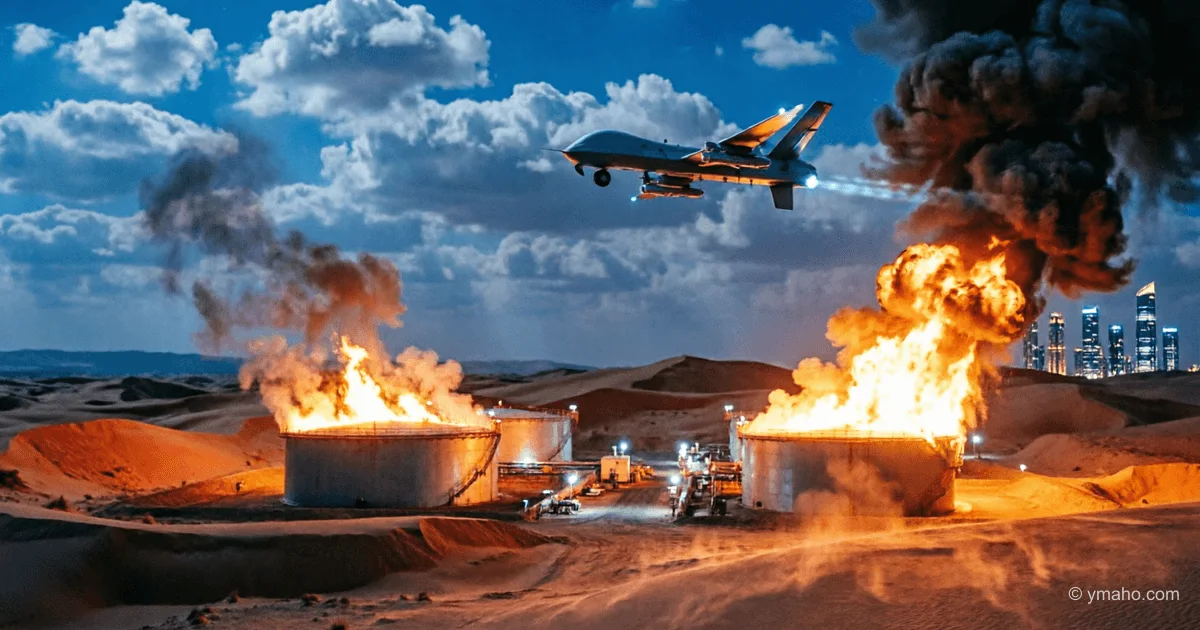
Iran Strikes Asymmetric Blows at Gulf Arab Monarchies' Economies
Iran attacked oil and gas facilities in the UAE, Kuwait, and Qatar, as well as Amazon data centers, causing serious damage to their economies and regional tourism.
Asymmetric Response: How Iran Shifts the War to the Economies of Gulf Arab Monarchies
Introduction
While global media focus on negotiations to unblock the Strait of Hormuz, a different kind of war is unfolding in the territories of the Persian Gulf Arab monarchies—quiet but devastating. Unable to directly confront the US military machine, Iran has bet on asymmetric strikes against the most vulnerable points of the economies of Qatar, Kuwait, Bahrain, and above all, the United Arab Emirates.
Oil and gas facilities, desalination plants, Amazon and Oracle data centers, Dubai's financial zones—all have become targets of Iranian drones and missiles. As New York Times columnist Thomas Friedman noted, this war demonstrates a new reality: relatively weak players, using cheap drones and cyber tools, can inflict colossal economic damage on much stronger adversaries.
Event Details and Timeline
The asymmetric strike campaign began almost immediately after the US-Israeli operation against Iran on February 28, 2026. Tehran warned: if the US continues attacks on Iranian power plants, Iran will respond with strikes on energy infrastructure and telecommunications companies with American shareholders in the region.
The energy sector was among the first to suffer:
- Kuwait: On April 3, 2026, Iranian drones and missiles struck a power plant and desalination facility. Earlier that same day, the Mina al-Ahmadi refinery—one of the largest in the Middle East—was attacked. A fire engulfed "several operational units," and according to local authorities, this was the third strike on that plant.
- UAE: The Emirates bore the brunt of the attack. According to the UAE Ministry of Defense, 91% of threats were intercepted since the start of the war, including 268 ballistic missiles, 15 cruise missiles, and 1,514 drones. However, there were breaches. The Habshan gas complex was hit. The Jebel Ali port in Dubai, also targeted, was closed for repairs.
Technology infrastructure became a new target:
- Amazon Web Services confirmed a direct hit on two of its data centers in the UAE, and a third in Bahrain was damaged by a nearby drone explosion. As Friedman noted, these attacks caused "far greater economic and service disruptions" than the cost of the drones used.
- There were also reports of a strike on an Oracle data center in Dubai, though local authorities called this information a "hoax."
Tourism and business activity have been effectively paralyzed. The famous Burj Al Arab hotel in Dubai was closed for an 18-month "renovation" after being hit by an Iranian projectile. Major international banks evacuated employees from the Dubai International Financial Centre, which also came under attack.
The Ruwais refinery (the largest in the Middle East) was shut down as a precaution after a fire caused by a drone strike.
Qatar halted liquefied natural gas production and declared force majeure.
Impact and Significance (for the world/industry/society)
The destruction caused by Iran is long-term and is reshaping the region's economic landscape.
Industrial infrastructure destroyed for years. As Regnum writes, the specificity of oil refining and gas liquefaction equipment means that replacing it at plants in Europe, the US, or Japan takes 18 to 24 months. With ongoing shelling, no Western contractor will risk sending engineers into the strike zone. Destroyed facilities will be out of commission for years.
Reputational blow to reliability. For centuries, Gulf countries have positioned themselves as absolutely reliable energy suppliers. If supplies are interrupted for months, their Asian clients (China, India, Japan) will be forced to turn to the US, Guyana, Brazil, and even Russia. After the war, the Arab monarchies will have to win back clients with huge discounts.
Threat to the digital future. Gulf countries have invested billions in turning the region into a hub for artificial intelligence and cloud services. However, attacks on Amazon and Oracle data centers cast doubt on the security of such investments. Work on laying new submarine fiber-optic cables in the Persian Gulf has effectively stopped.
Lifeline under threat. Domestic electricity generation and water desalination in Gulf countries are entirely dependent on burning natural gas. A strike on a gas processing plant could leave megacities without air conditioning and drinking water in a desert climate. As already happened in Kuwait, where a desalination plant was hit—this is a direct threat of humanitarian catastrophe.
Reactions of Key Players
The reaction of Gulf countries has been paradoxical: despite outward unity, a rift is growing within the alliance.
The UAE emerged as the most steadfast and hardest-hit party. The Emirates declared readiness to "endure the war for up to nine months" and, according to intelligence, even launched a retaliatory strike deep into Iran, shooting down a drone over Shiraz. The UAE received Israel's Iron Beam laser defense system to counter drone swarms.
Saudi Riyadh takes a more ambiguous stance. On one hand, Foreign Minister Faisal bin Farhan warned that Iran "is mistaken if it thinks Gulf countries lack the ability to respond." However, according to Al-Quds, Iran exploited long-standing differences between Riyadh and Abu Dhabi (including the UAE's exit from OPEC) to try to neutralize Saudi Arabia's position and secure its non-interference.
The US itself, while coordinating defense, according to analysts, "opened Pandora's box" for Arab allies by failing to protect them from Iranian retaliatory strikes. As Gulf International Forum Director Dania Tafer stated, if Iran is allowed to maintain a "veto over the Gulf economy" through control of Hormuz, it will make the position of Arab monarchies extremely vulnerable.
Forecast and Conclusions
The conflict has definitively entered a protracted phase of "war of attrition," and the stakes are unprecedentedly high.
Prolonged crisis. Talks in Pakistan have reached a deadlock. Iran continues to block Hormuz, the US blocks Iranian ports. Without a political solution, the threat of strikes on infrastructure in the UAE, Kuwait, and Qatar will persist.
Global energy transition. The global oil and gas market, deprived of 20% of supplies through the strait, will be forced to restructure. This will accelerate project development in the Western Hemisphere (US, Brazil, Guyana), but energy prices will remain high for the foreseeable future.
Risk of escalation. Iran's new Supreme Leader Mojtaba Khamenei has promised to send American ships "to the bottom of the waters" and asserts Iran's right to "new management of the strait." If the US decides to launch a new massive strike after the truce expires (the authorization under the War Powers Resolution expires on May 1), Iran has promised a "long and painful" response. In that case, the current destruction may seem like just the beginning.
The conclusion is clear: Iran's asymmetric warfare is working. Tehran's goal is to make the presence of the US and its allies in the region so costly and dangerous that they leave on their own. If the United Arab Emirates, whose economy relies on tourism, finance, and technology, cannot withstand this pressure, it will be a strategic victory for the Islamic Republic and a signal to the world of the dawn of an era of "mass chaos," where even small players can dictate terms.
— Editorial Team









