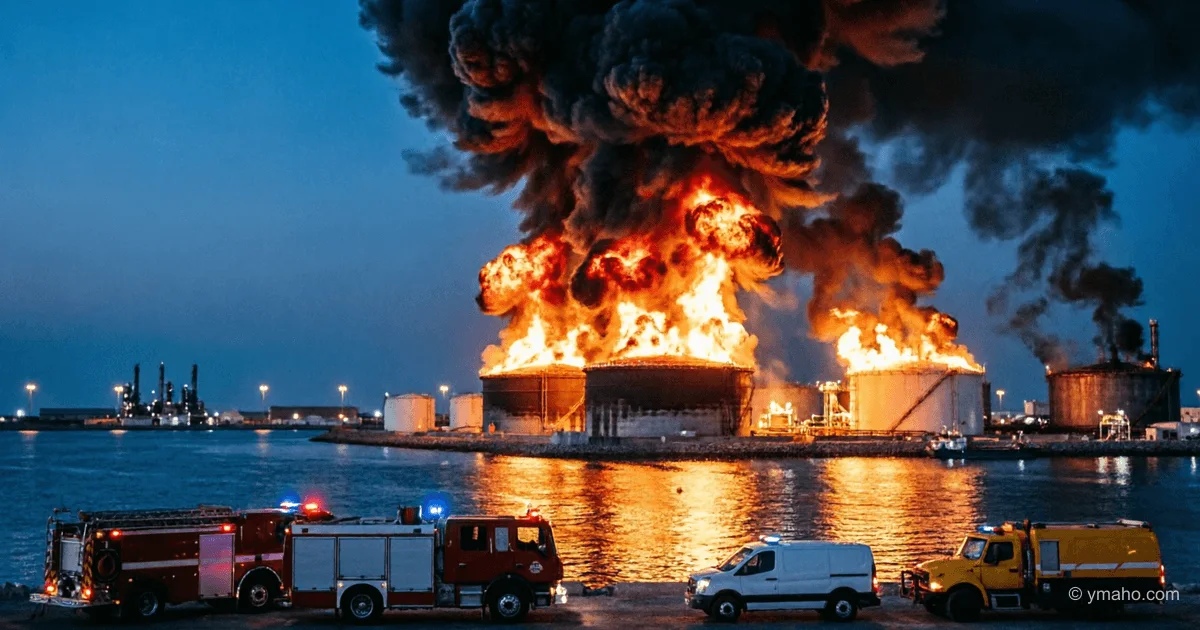
Iran Launches Missile Strike on Oil Port in UAE
On May 4, the port of Fujairah in the UAE, where a US military base is located, was set ablaze by Iranian missiles. An Iranian military official denies the attack was intentional, blaming the American side for provocation.
Strategic Frontier in Flames: Missile Strike on Al-Fujairah
Introduction
May 4, 2026, may go down in history as the point of no return in the protracted military-political crisis between Iran and the United States and its allies. The missile strike on the oil port of Al-Fujairah in the United Arab Emirates not only shattered the fragile ceasefire in effect since April 8 but also attacked a symbol of the economic invulnerability of the Arabian monarchies in the face of the Iranian threat. The fire in Fujairah's petrochemical zone vividly illustrated that in modern Middle Eastern warfare, there are no "safe havens," and economic shock instantly translates into political pressure. This incident requires detailed analysis not only in the context of military chronology but also through the lens of global energy security, which has already reacted with a sharp rise in commodity prices and transport risks.
Event Details and Timeline
The attack occurred on the morning of May 4 and was the first direct assault on UAE territory since the ceasefire was declared. According to a statement from the UAE Ministry of Defense, air defense systems detected and intercepted a total of 19 aerial targets: 12 ballistic missiles, 3 cruise missiles, and 4 unmanned aerial vehicles. Despite the claimed effectiveness of the air defense, damage could not be avoided. One of the drones struck facilities in the Fujairah Oil Industrial Zone (FOIZ), where oil storage facilities and terminals of key global traders, particularly Vitol, are located.
A direct hit caused a massive fire at the site. Fujairah authorities confirmed that three Indian nationals sustained moderate injuries and were promptly hospitalized. Concurrently with the attack on port infrastructure, reports emerged of damage to an ADNOC tanker near the coast, adding tension to the region's shipping situation. Notably, an Iranian military official, in comments to state media, denied that the strike was intentionally aimed at UAE territory, attributing the incident to "provocative behavior by American forces." Nevertheless, Tehran acknowledged the launch of missiles toward Fujairah, calling it a precautionary measure in response to the US operation "Project Freedom" to ensure navigation in the Strait of Hormuz.
Impact and Significance
The strategic importance of Al-Fujairah cannot be overstated. The port is located on the UAE's east coast, directly on the Gulf of Oman, approximately 70 nautical miles from the Strait of Hormuz. This geographical advantage has long made Fujairah a "backup exit" for hydrocarbons in the event of an Iranian blockade of Hormuz. Before the strike, the port exported over 1.7 million barrels of oil and oil products per day, equivalent to about 1.7% of global daily demand. The strategic ADCOP oil pipeline, with a capacity of 1.5–1.8 million barrels per day, connecting Abu Dhabi's fields to terminals on the Indian Ocean coast, also passes through here.
The attack shattered the myth of this economic hub's invulnerability. As news of the hits and fire broke, markets reacted with panic. War risk insurance premiums for voyages in the region soared to 5% of the vessel's value, which for a large tanker could mean additional costs of around $7.5 million per voyage. The reduction in available export routes effectively threatens the UAE with forced cuts in oil production. Globally, Fujairah's vulnerability means that the geopolitical risk premium in the price of a barrel of oil will persist until security guarantees for the Emirates' east coast are established. Symbolically, the UAE had previously invested over $1.2 billion in building the "Al-Mandous" underground storage facilities, capable of withstanding a missile strike, indirectly confirming the seriousness and anticipation of this threat.
Reactions of Key Players
Reactions to the attack were immediate, harsh, but divergent. The UAE Ministry of Foreign Affairs issued a statement calling the attack "treacherous aggression" and stating that the country reserves its "full and legitimate right" to respond in accordance with international law. Arab Gulf states, including Saudi Arabia, Kuwait, Qatar, and Bahrain, formed a united front in condemning Tehran's strikes.
Washington's reaction was central to the narrative. President Donald Trump, commenting on Operation "Project Freedom" and the subsequent strikes, stated that Iranian forces would be "wiped off the face of the earth" if they attempted to attack American ships. However, there is no unity within the US establishment: amid the escalation, Trump criticized polls showing declining support for the war among Americans, calling them "fake." CENTCOM Commander Admiral Bradley Cooper avoided directly answering whether the ceasefire regime was still in effect, indicating legal and military uncertainty at the moment.
Iran, for its part, acted in its usual style of denial and threat. Foreign Minister Abbas Araghchi called the American initiative "Project Dead End" and warned the US against interference. Notably, Tehran continues to exploit the theme of indirect contacts: the Foreign Ministry statement emphasized progress in negotiations mediated by Pakistan, which contrasts with the burning oil terminals but creates a diplomatic loophole for retreat.
Forecast and Conclusions
The strike on Fujairah marks the conflict's transition to a new, far more dangerous stage, where asymmetric attacks destroy not only infrastructure but also the very foundations of global energy logistics. A military response from the US and its allies, whose readiness has already been reported in the press, is highly likely. However, the effect on the global economy is even more significant. The ceasefire regime has effectively been nullified, so in the short term, oil prices may test new local highs due to disrupted supply chains.
From a military standpoint, the attack demonstrated that the "thousand cuts" tactic—drone and missile strikes on the territory of Gulf monarchies—can paralyze the region's economy even without a full-scale ground invasion. If the Arabian monarchies cannot guarantee total airspace protection over all terminals, the global market will face a shortage not so much of oil itself but of insurance and tanker tonnage. The main conclusion is that relying solely on a military solution without simultaneously launching a real negotiation process only expands the geography of the crisis, turning the "safe" eastern coast of the UAE into a hotspot as volatile as the Strait of Hormuz.
— Editorial Team









