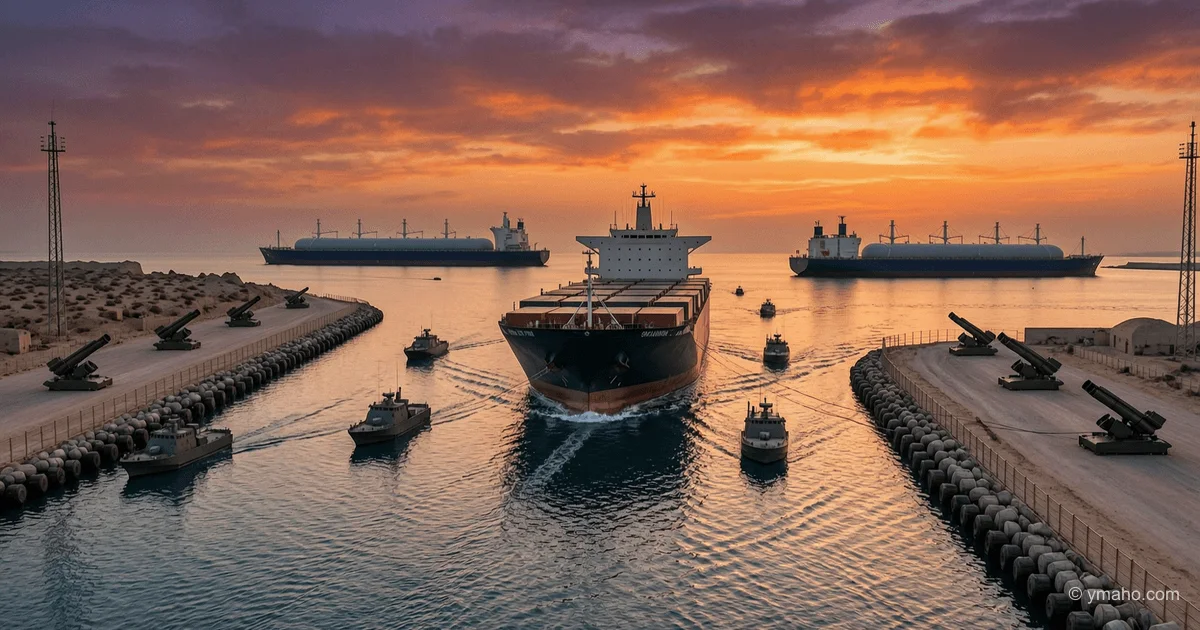
IRGC Demands All Ships Use Only Iranian Corridor in the Strait of Hormuz
The IRGC Navy has called on all vessels to pass through the Strait of Hormuz only via the corridor provided by Tehran. The statement emphasizes that this is the "only safe way," and attempts to use other routes "will face a decisive response."
IRGC Ultimatum: How Iran Is Rewriting Maritime Law at Gunpoint
The Core: What Is Really Happening
On May 5, 2026, the naval forces of the Islamic Revolutionary Guard Corps issued a statement that is a warning in form but a fundamental revision of international maritime law in one of the planet's most critical energy corridors in substance. The IRGC demanded that all ships use only the Iranian corridor when passing through the Strait of Hormuz, calling it the "only safe way," and threatened a "decisive response" to anyone attempting to choose another route.
Most global media headlines boiled down to the formula "another round of tension." But this is not another round. This is the institutionalization of a regime where a state's sovereign right to control a strait that is international under the UN Convention on the Law of the Sea is asserted not through diplomacy but through missile arsenals and drone swarms.
The IRGC statement did not emerge in a vacuum. It was preceded by the publication of a map of a new "control zone" in the Strait of Hormuz, with clearly marked boundaries: the eastern line between Iran's Kuh Mobarak and the UAE's Fujairah, and the western line between Qeshm Island and Umm Al Quwain. This is not just a map. It is a unilateral demarcation replacing the international traffic separation schemes established by the IMO with rules dictated by Tehran.
The key point missed by most commentary: the IRGC statement is a direct consequence of the failure of the US operation "Project Freedom." The US announced it would escort ships through the strait on May 3, escorted two vessels under the US flag on May 4, and by May 5 was forced to suspend the operation after Saudi Arabia refused to allow the use of its bases and airspace. It was precisely in this power vacuum—when the US convoy stopped and the strait was left without alternative force protection—that the IRGC struck with an information attack, presenting its version of "order" to the world.
Timeline and Context
The events of May 2026 cannot be understood without a brief retrospective of three months of conflict.
On February 28, the US and Israel launched Operation Epic Fury against Iranian nuclear and military infrastructure. Iran's response was an immediate and effective blockade of the Strait of Hormuz for vessels linked to the US and Israel. From that moment, traffic through the strait dropped by more than 90%.
By early April, over 200 laden tankers were blocked in the Persian Gulf. War risk insurance premiums soared to 7.5–10% of vessel value, making transit commercially unviable even with military escort.
On April 8, a temporary two-week truce was agreed, contingent on resuming shipping. On April 9, Iran introduced a transit fee of $2 million per vessel. The truce effectively collapsed, and negotiations in Islamabad mediated by Pakistan reached a deadlock.
On April 13, Trump announced a full naval blockade of Iranian ports—the largest operation of its kind since the Korean War. A "double blockade" emerged: Iran controlled passage through the strait, while the US blockaded Iranian ports.
On May 3, Trump announced "Project Freedom," an operation to militarily escort commercial vessels. On May 4, the US escorted two ships under the US flag through the strait—a negligible number compared to the pre-war norm of 130 ships per day. By May 5, the operation was suspended due to Saudi Arabia's refusal to provide bases.
It was at this moment, on May 5, that the IRGC published its statement on the Iranian corridor as the "only safe route." The chronology leaves no doubt: Tehran used the window of opportunity opened by the suspension of the US mission to entrench its control normatively.
Winners and Losers
Iran is the clear tactical winner of the current phase. The IRGC has not only maintained its ability to block the strait but has moved to the next stage of control—regulatory. Now it is not enough simply not to be attacked; every vessel must actively demonstrate loyalty by entering the Iranian corridor and, in effect, acknowledging Tehran's right to permit or deny passage.
Yadollah Javani, deputy political chief of the IRGC, put it bluntly: any vessel must obtain permission from the Iranian armed forces to pass through the strait. This is not a technical safety requirement—it is an assertion of sovereignty over an international strait.
Moreover, on May 6, the IRGC claimed that vessels were already complying with the new transit rules and that this contributed to "regional maritime security." The Iranian narrative is taking hold: we are not blocking the strait; we are ensuring safe passage under our rules.
The US is the biggest loser, and in two dimensions simultaneously. First, militarily: an operation announced as a rescue of shipping, which escorted only two vessels in a day and was then suspended, looks like a strategic miscalculation of unprecedented scale. Second, legally: the Iranian corridor exists in parallel with US statements about freedom of navigation, and while Tehran demonstrates the ability to enforce its rules, Washington does not.
The shipping industry is caught between two forces, each dictating its own terms. Hapag-Lloyd, one of the world's largest container carriers, stated on May 5 that transit through the Strait of Hormuz was "currently impossible" for its vessels, and the company's risk assessment "remains unchanged." Marcus Baker, global head of marine insurance at Marsh Risk, noted fundamental uncertainty: "We just have to see if the Iranians will abide by peace, if the Americans will abide by peace, and what that will mean for shipping."
Behind this cautious statement lies a harsh reality: shipping companies trust neither Iranian safety guarantees nor American capabilities to provide security. Over 1,000 vessels remain stranded in the region.
China and Pakistan are unexpected beneficiaries. As early as late March, reports emerged that Pakistan was using its mediator position to facilitate the passage of "friendly" vessels—primarily Chinese—through the Iranian corridor. The scheme: Pakistan transmits vessel data to the IRGC, and they receive permission to pass without raising the Pakistani flag. Iran allowed two ships per day for 10 days. This model—bilateral arrangements bypassing international law—is becoming a prototype for the future regime of the strait.
What the Media Is Not Saying
Insight one: the Iranian corridor is not just a route; it's a payment system. Media report on the map and coordinates, but almost no one discusses monetization. On April 9, Tehran introduced a $2 million fee per vessel for passage. Now that the corridor is declared the "only safe route," this fee transforms from an emergency measure into a permanent toll. Multiply $2 million by 130 ships per day (pre-war norm), and you get $260 million in daily revenue, or nearly $95 billion per year. This is not a safety fee; it is a rent comparable to Iran's oil revenues.
Insight two: insurance has become a weapon. The war risk insurance market effectively achieves what the IRGC seeks through military means. With rates soaring to 7.5–10% of vessel value, commercial transit becomes pointless regardless of how many US destroyers escort it. For a tanker worth $138 million, a one-time premium reaches $14 million, compared to $345,000 in normal times. Insurers, not the military, decide whether a vessel will go through the strait. And their decision—"no"—serves Iran's strategy, even if the insurers themselves do not intend it.
Insight three: the IRGC's map overlaps with the territorial waters of the UAE and Oman. The eastern boundary of the declared zone connects Iran's Kuh Mobarak with the UAE's Fujairah, and the western boundary connects Qeshm Island with Umm Al Quwain. This means the Iranian "control zone" encroaches on waters that the UAE considers its own. Neither Abu Dhabi nor Muscat has publicly responded to this map—and their silence is deafening. Regional Arab states, it seems, have chosen not to confront Iran directly over maritime boundaries at a time when US security guarantees appear shaky.
Forecast: Next 30 Days and 90 Days
30 days (until early June 2026)
The Iranian corridor will continue to function as a semi-official regime. The IRGC will selectively allow passage to vessels from "friendly countries"—China, India, Pakistan, and possibly some European operators that tacitly accept Iranian terms. Western shipping companies will maintain their refusal to transit. The number of stranded vessels will not significantly decrease.
The key risk in the coming month is a direct military incident. The IRGC has warned that any deviation from the Iranian corridor will face "decisive measures." If a captain of any vessel, for any reason—navigational error, charterer pressure, or ignorance—deviates from the prescribed route, the IRGC may follow through on its threat. This would create a casus belli capable of instantly pushing oil prices above $100 per barrel.
Insurance rates will remain prohibitive. Even if the US attempts to revive "Project Freedom," shipping companies will not return without a "practically verified peace agreement"—and no such agreement is on the horizon.
90 days (until late July–early August 2026)
By August 2026, the Iranian corridor stands a good chance of evolving from a temporary measure into a permanent element of maritime law in the Persian Gulf. The mechanism tested by Pakistan and China—bilateral arrangements for vessel passage through coordination with the IRGC—will expand. China, India, Pakistan, and possibly other Asian countries will conclude informal or semi-formal agreements with Tehran for guaranteed transit. This would mark the end of an era in which freedom of navigation in the Strait of Hormuz was ensured by the US Navy and international law.
For the US, this is a strategic defeat whose consequences will extend far beyond the Middle East. If the Strait of Hormuz is permanently controlled by Iran, US security guarantees at other critical maritime chokepoints—the Taiwan Strait, the South China Sea—will lose credibility. Allies in Asia and Europe will see that Washington could not ensure freedom of navigation in a strait through which one-fifth of the world's oil passes.
Brent crude oil prices will stabilize in the range of $85–100 per barrel—not due to physical shortage, but due to the institutionalization of risk. The market will become accustomed to the idea that passage through Hormuz is not a right but a privilege that must be purchased from Tehran with money or political loyalty.
The main outcome of three months: Iran, which began the conflict as the party under attack, ends it as the holder of the keys to the world's most critical energy checkpoint. The IRGC ultimatum of May 5, 2026, is not just another threat. It is a declaration of a new order in which international law yields to the law of the strong, and freedom of navigation becomes a commodity. And judging by the silence of the international community, this order is already being accepted as a given.
— Editorial Team









