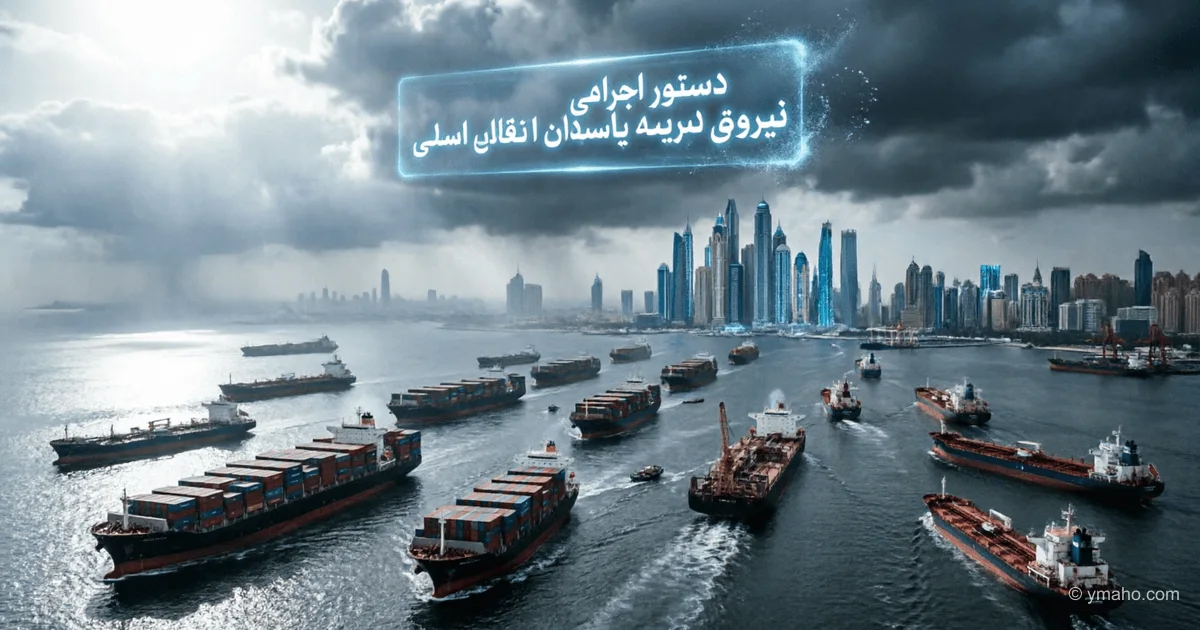
IRGC Orders Civilian Vessels to Leave Persian Gulf Amid US Operation
Iran's Islamic Revolutionary Guard Corps (IRGC) issued radio warnings to commercial vessels demanding they leave anchorages in the Persian Gulf, triggering a "mass exodus" of ships toward Dubai. This came as the United States announced the start of Operation "Project Freedom" to escort vessels.
Here is a detailed analytical article written in accordance with your requirements.
Ultimatum on the Airwaves: How the IRGC's Order to Leave the Gulf Is Changing the Rules of Naval Warfare and the Global Economy
Introduction
The events of May 4, 2026, in the Persian Gulf marked a transition from quantitative to qualitative change. What previously appeared as escalating tensions suddenly took on the features of a systemic breakdown of the familiar world order. Iran's Islamic Revolutionary Guard Corps (IRGC) moved from verbal warnings to direct action, broadcasting over open radio frequencies an order for commercial vessels to immediately leave their anchorages. The ensuing "mass exodus" of ships toward Dubai occurred against the backdrop of the just-announced US Operation "Project Freedom," creating a volatile mix of humanitarian crisis, military confrontation, and economic chaos. This IRGC move signifies not just another round of tension but an attempt by Tehran to de facto establish its own sovereignty over the waterway, challenging not only the US Fifth Fleet but the entire architecture of international maritime law.
Event Details and Timeline
The crisis unfolded with kaleidoscopic speed. After the US administration announced Operation "Project Freedom," which involves military escort for roughly 2,000 merchant vessels stranded in the region with 20,000 sailors on board, the Iranian side acted almost instantly. The IRGC used the standard VHF maritime channel to convey an unequivocal demand to captains: weigh anchor and leave designated areas of the waterway.
Unlike previous incidents, this warning was not a general political statement. It was targeted and operational. Specific coordinates of zones declared "unsafe for non-military navigation" were broadcast. The maritime community's reaction was immediate and bordering on panic. Ship tracking systems recorded a sharp, chaotic movement of hundreds of vessels southward toward the port of Jebel Ali in the United Arab Emirates. Captains, faced with a choice between the risk of military engagement and the threat of being charged with disobeying Iranian authorities, opted to seek refuge in neutral waters. This exodus created an unprecedented navigational situation: congested shipping traffic at the entrance to Dubai sharply increased the risk of collisions among multi-ton giants deprived of their usual safety lanes.
Impact and Significance
The significance of the IRGC's actions extends far beyond tactical confrontation in a specific waterway. We are witnessing the emergence of a new doctrine of asymmetric control over strategic sea lanes. Iran is demonstrating that to block global trade, it is not necessary to sink ships with missiles. It is enough to create a zone of legal and military uncertainty where any civilian operator is forced to choose between obeying informal IRGC orders and the dubious protection of Western navies.
The economic consequences of this tactic are devastating. Even a short-term mass exodus of vessels from the area means supply schedule disruptions measured not in days but weeks. Container carrier MSC has already announced the launch of a land route bypassing the Strait of Hormuz through Saudi Arabia, a forced measure whose cost falls on the end consumer. Estimates of additional logistics costs under this scheme range from $4,500 to $5,500 per container, comparable to the full cost of maritime freight in pre-crisis times. Given that more than 150,000 containers per week passed through Gulf routes under stable conditions, the financial damage to the global economy easily reaches hundreds of millions of USD daily. This shock is already transmitting into macroeconomic indicators: the US Consumer Price Index jumped to 3.3% amid a 21.2% rise in gasoline prices, and core PCE inflation reached 3.2%.
On the social dimension, the situation is aggravated by the humanitarian component. On board the blocked or forced-to-maneuver vessels are about 20,000 sailors. Their food and water supplies are running out, and psychological tension is rising. Their plight is becoming a bargaining chip in the geopolitical game of superpowers, where the announced US rescue operation and the Iranian ultimatum only increase mutual risks rather than solving the problem of people's physical survival.
Reactions of Key Players
The reactions of major actors demonstrate the absence of a unified plan to exit the crisis. The US, announcing Operation "Project Freedom," faced its ambiguity. Formally a humanitarian escort mission, it will inevitably be interpreted by Iran as a military incursion if US Navy ships attempt to physically push back IRGC forces. Washington risks being trapped: any forceful confrontation provoked by Iranian fast boats will call into question the "humanitarian" status of the mission and require a decisive response for which the White House may lack political will ahead of the Fed leadership change.
Iran's position appears cynically calculated. The commander of the Khatam al-Anbiya headquarters, General Ali Abdollahi, accompanied the radio order with a statement that all vessel movements must be coordinated with Iranian military. This effectively introduces a permit-based navigation regime, legitimizing from Tehran's perspective a maritime blockade.
The US Federal Reserve found itself squeezed between inflationary pressure and recession risk. The split in the FOMC vote, with four members opposing the decision to keep the rate at 3.50-3.75%, is an indicator of confusion in the face of geopolitically driven inflation that cannot be cured by monetary tools.
Europe remains silent at the diplomatic level, but European central banks are already preparing for the worst. The ECB signals readiness to raise rates in June, as European inflation reached 3.0%, and any disruptions in energy and goods supplies from Asia via the Persian Gulf will hit the eurozone economy hard.
Forecast and Conclusions
The situation in the Persian Gulf has entered a phase where the logic of escalation is dictated not by the political will of individual leaders but by the inertia of military mechanisms set in motion by both sides. The IRGC's radio order is a clear signal that Iran has moved to implement a doctrine of "active defense" at sea, without waiting for hypothetical sanctions relief or peace agreements.
The forecast for developments can be divided into three scenarios. The first, most likely, is the maintenance of controlled tension. Iranian forces will continue selective detentions and inspections of vessels; the US will limit itself to demonstrative escort of individual convoys; and the bulk of maritime trade will be redirected to land and bypass multimodal routes. Insurance and freight costs will stabilize at levels 2–3 times higher than pre-crisis, becoming the new economic normal. The cost of shipping a container from Shanghai to Rotterdam may settle above $12,000–14,000 for an extended period.
The second scenario is a tactical incident. Amid chaotic movement of hundreds of vessels and the presence of two hostile navies, a random collision, mistaken launch, or provocation is almost inevitable. Such an incident would lead to a short-term but complete paralysis of shipping and a spike in oil prices to levels not seen since the 2022 crisis.
The third, least likely but most destructive scenario is a full-scale military confrontation with a US attempt to forcibly reopen the strait. In this case, the global economy would face a shock comparable in scale to the 1973 oil embargo, but under conditions of much more integrated global supply chains and already elevated inflation.
The main conclusion is that the IRGC ultimatum marks the failure of traditional deterrence mechanisms. The world is entering an era where control over maritime communications will be exercised not only by carrier strike groups but also by the ability to create zones of legal vacuum and information terror. The humanitarian Operation "Project Freedom," conceived as a demonstration of strength and protection, in reality becomes a prologue to a new, much more dangerous phase of asymmetric confrontation, where the main victim will be the global consumer, forced to pay increased logistics costs out of their own pocket.
— Editorial Team









