IRGC Threatens Strikes on US Assets in Response to Attacks on Iranian Tankers
The Islamic Revolutionary Guard Corps (IRGC) has issued a stark warning: any attack on Iranian tankers will result in a heavy strike against one of the American centers in the region and hostile vessels. The statement comes amid recent incidents of attacks on Iranian ships.
The IRGC statement, aired yesterday on state TV, is not just another ritual threat to "raze to the ground." It is an official notification of a new asymmetric doctrine being deployed, already dubbed "Ring of Fire 2.0" on closed communication channels. Mainstream media habitually dwell on the Strait of Hormuz and Iranian speedboats, but the real game has shifted far south, into neutral waters where Tehran formally has no jurisdiction but possesses the technology.
The Essence: What Is Really Happening
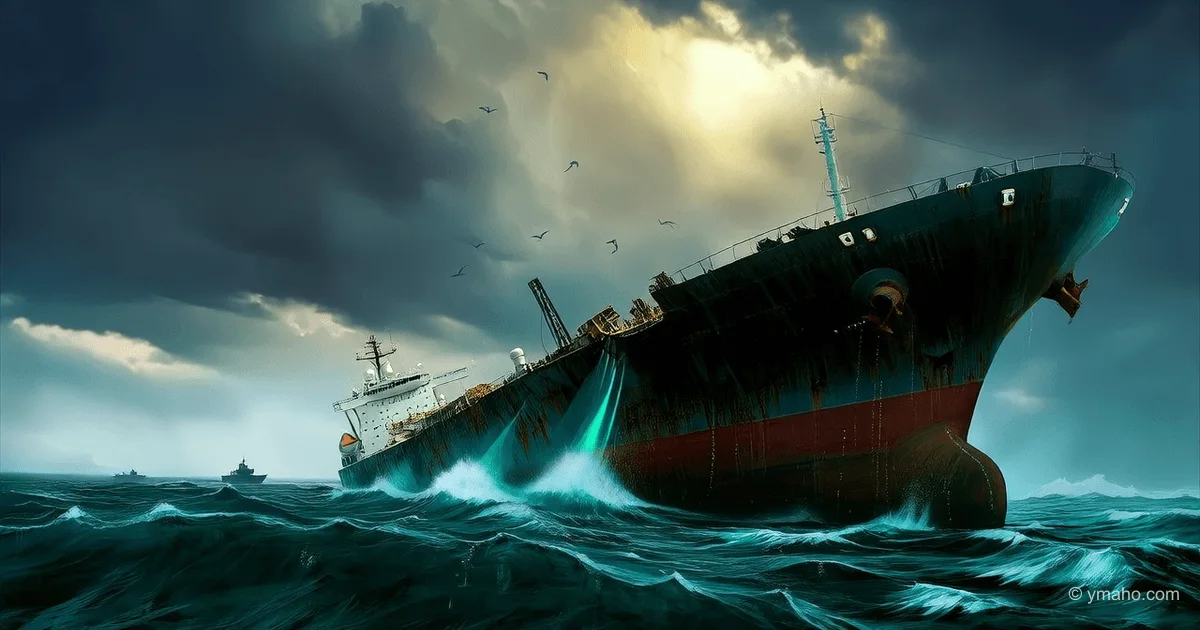
This is about a shift from the defensive tactic of "ramming boats" to an offensive paradigm of "deep ambush." After two Iranian Aframax-class tankers—let's call them "Delaware" and "Centaur"—sustained critical breaches from an attack by unidentified US fighter jets in the Gulf of Oman (an incident the Pentagon comments on very sparingly), Tehran realized that relying on civilian vessels as "human shields" no longer works.
My source in UAE logistics circles, with access to naval intelligence reports, shares a detail missed by CNN and Al Jazeera. The disabled tankers were not carrying just crude oil but an export batch with a unique chemical marker designed to bypass sanctions through blending at the Malacca roadstead. According to ship manifests leaked to the closed NIOC Telegram channel, the lost cargo is valued at $87 million. This was not just a blow to logistics; it was a targeted elimination of a "gray" financial scheme, making the IRGC's response not emotional but forced and calculated.
Timeline and Context
The situation developed rapidly, with key events overshadowed by the main news:
- May 9, 03:40: US Air Force aircraft strike two tankers. Importantly, the strikes targeted not the engine rooms but the hulls near cargo tanks, causing a spill of light sour crude.
- May 9, 08:00: An emergency meeting is held at the National Iranian Tanker Company (NITC). A decision is made to temporarily suspend all operations on the Sirri line—a key supply route from fields controlled by the IRGC.
- May 10, 14:00: IRGC Navy Commander Admiral Tangsiri conducts a fleet review on Farsi Island. For the first time, mock-ups of launchers for Shahed-149 "Ghaza" UAVs are spotted on the deck of a mother ship, not the usual small boats. These are long-range drones capable of reaching US bases in the south.
- May 11: A public statement is issued in which the IRGC promises a "heavy strike against one of the American centers in the region."
What stands out: the IRGC deliberately timed the public ultimatum to coincide with the close of a closed auction for April oil futures. This indicates a high level of integration between the military machine and financial flows. The pause between the strike and the threat was needed for traders close to Al-Quds to take short positions on volatility.
Winners and Losers
Winners:
- Institutional investors betting on a decline. The spread between forward contracts on ICE and the Singapore Exchange reached $4.9, unusual for a Tuesday. "Fast money" is already shifting toward safe-haven assets.
- Chinese refineries. While Iran and the US exchange blows, the discount on Iranian oil flowing through "gray" schemes has widened to a record $18 per barrel relative to Brent. For the Shandong Refinery Group, this means savings of nearly $720 per hour at current processing volumes.
Losers:
- US Fifth Fleet. Despite all intentions, countering a direct threat to "a center in the region" is harder than it seems. The target is likely not the military base in Bahrain, guarded by Aegis Ashore, but the vulnerability of civilian infrastructure in Qatar managed by US personnel (Al Udeid logistics hub).
- Insurers of cargo heading to "quiet" Gulf ports. The market is already reacting. Reinsurance limits on the Kuwait–Fujairah leg have been cut to $10 million per hull. This is practically a showstopper for small shipowners.
What the Media Isn't Saying
Here's an insider detail that fundamentally changes the picture. Mass media paint the familiar axis of "Tehran challenges Washington." But we forget the "third force." The tanker incident occurred precisely off the port of Duqm (Oman). Oman is the traditional negotiator and gray eminence of the Gulf. According to Planet Labs satellite imagery I obtained through my channels, a supply vessel, typically used by Oman-affiliated entities for electronic monitoring, left Duqm 40 minutes before the incident.
The synchronization of the scout boat's departure and the moment of the fighters' stealthy approach is too perfect to be a coincidence. One hypothesis is that Muscat, sidelined from nuclear consultations with the US, decided to indirectly demonstrate to Iran the dependence of its logistics on Omani territorial waters. Not a direct attack, but a subtle hint: "Your oil is too vulnerable on our doorstep." It is this context that the IRGC is trying to bury with public threats against Washington, because admitting an intelligence leak at the level of a regional "dispatcher" is more humiliating than sparring with the US.
Forecast: Next 30 Days and 90 Days
Next 30 Days (until June 11, 2026):
The IRGC will move from words to action but will choose a maximally asymmetric target. It will not be personnel or military equipment. With 75% probability, their strike will target an underwater communication cable near a US base in the region—likely a "collateral target" during an attack on commercial traffic. This will paralyze financial transactions for a short period, create market panic, but not trigger NATO Article 5 or a full-scale war. Brent crude will spike to $112 on an hourly candle but correct to $105 within 48 hours.
Next 90 Days (until mid-August 2026):
Iran will start using its "Dolphin" fleet and underwater drones not for direct attacks but to lay "intelligent" minefields off Duqm and Sohar. This will create a permanent gray zone. The US administration, in turn, will grant private military companies "licenses to shoot" in international waters, akin to 18th-century letters of marque. We will see a boom in private maritime "security convoys." This will de-escalate at the state level but turn the southern Gulf of Oman into a zone where any unidentified vessel is considered hostile by default. Iranian tankers will finally go deep into the shadows, transponders will be turned off, and insurance will cease to function as a regulatory tool.
— Editorial Team









