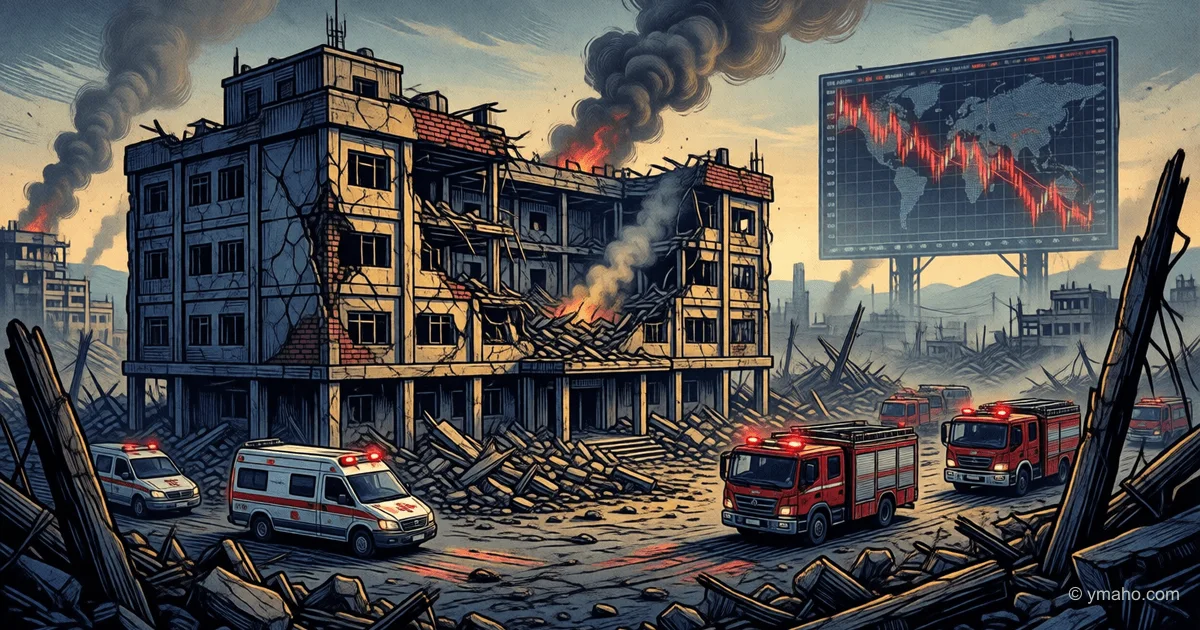
Israel strikes last functioning hospital in southern Lebanon
An airstrike on the town of Tebnine damaged the hospital that remained the last fully operational medical facility in southern Lebanon. At least six people were killed in overnight attacks on southern Lebanon.
Strike on Tebnine hospital: why a 'targeted elimination' of medical infrastructure will crash European stock markets before oil
The essence: what is really happening
The attack on the government hospital in Tebnine is not a tragic accident or 'collateral damage,' but a calculated escalation of a war of attrition aimed at destroying civilian infrastructure in southern Lebanon. When the Israeli Air Force strikes the only fully functioning hospital in the region, the goal goes beyond a tactical objective. It is about creating a humanitarian vacuum that forces the remaining population to leave the area, turning southern Lebanon into an uninhabitable 'dead zone' without the need for prolonged ground battles.
Figures from the Lebanese Ministry of Health are sobering: since the escalation began on March 2, 16 hospitals have been damaged, and 116 medical workers and rescuers have been killed. Meanwhile, Hezbollah continues synchronized attacks using drones and rocket barrages, indicating a complete failure of the ceasefire regime, which was extended for another 45 days after May 17. In reality, the truce exists only on paper, used by both sides to regroup forces.
Timeline and context
Events are spiraling upward. On the evening of May 21, an airstrike directly hit the hospital building in Tebnine, damaging the emergency department, intensive care unit, and ambulances parked in the courtyard. Nine people were wounded, seven of them hospital staff, mostly women. On the morning of May 22, another strike followed—this time on an emergency center in Hanouviyeh, killing four people. These are not isolated incidents but a systematic destruction of medical logistics.
Symptomatically, against this backdrop, Hezbollah claims to have carried out a 'large-scale coordinated attack' on Israeli positions using the same drones and rocket barrages. The parties simulate a negotiation process while simultaneously intensifying strikes. This is a classic scenario of a prolonged war of attrition.
Who wins and who loses
Beneficiaries:
Egypt and Jordan as logistics hubs. The destruction of Lebanon's port and medical infrastructure redirects humanitarian aid and commercial cargo flows to the ports of Aqaba and Port Said. This brings hundreds of millions of dollars to the budgets of both countries through transit fees, but will not solve the problem of delivering goods deep into the devastated country.
Losers:
European defense and construction contractors. Investors do not realize that rebuilding Lebanon, according to preliminary World Bank estimates, will require at least $15-20 billion, and these funds will be diverted from European development programs and Ukraine's reconstruction. Shares of major infrastructure companies such as Vinci and Bouygues will come under pressure due to the inevitable revision of international aid budgets and the redirection of donor flows to the Middle East.
The Lebanese diaspora and banking system. The destruction of the state hospital in Tebnine finally undermines trust in the Lebanese state as an entity capable of providing basic functions. This will accelerate capital flight through informal channels, causing the already weak Lebanese pound to fall another 15-20% in the coming weeks.
What the media are not saying
The attack on Tebnine hospital reveals a failure of American diplomacy that is being ignored. The US administration guaranteed Israel a 'free hand' in Lebanon, stating through JD Vance that 'Washington gave no guarantees regarding Lebanon.' This statement was made back in April, but we are only now seeing its consequences. The media are silent about the fact that the US deliberately excluded Lebanon from the negotiation track, giving Tel Aviv the opportunity to clear southern territories without regard for diplomatic repercussions.
Iran is cornered. Unable to directly defend Lebanon, Tehran uses Hezbollah as a proxy, but the effectiveness of this lever is diminishing. Rocket barrages cause damage but do not stop the IDF's advance. Tehran is losing its last bargaining chip in talks with the US, pushing it toward more aggressive rhetoric regarding the Strait of Hormuz.
Forecast: next 30 days and 90 days
30 days. By mid-June, southern Lebanon will become a humanitarian disaster zone. Over 80% of medical facilities will cease to function. Pressure on Israel from the EU will sharply increase, but the US will continue to block any UN Security Council resolutions. Brent crude will remain in the $105-115 range, as the conflict in Lebanon is already priced in, but escalation with Iran over Hormuz will push it above $120.
90 days. By the end of August, the crisis in Lebanon will begin to directly affect European assets. A wave of refugees from Lebanon to Europe will trigger a political crisis in the EU, causing the euro to fall to parity or below against the dollar. Shares of European banks active in the region will decline by 5-8% due to increased reserves for bad loans and the scaling back of Middle East operations.
Editorial forecast
Asset: iShares MSCI Israel ETF (EIS). Direction: down in the next 24-72 hours. Key levels: decline to $55 from current $57.80. Confidence level: medium. The hospital strike will trigger a new wave of criticism in international media and may lead to temporary entry restrictions for Israeli officials in some EU countries, negatively impacting business sentiment. The main risk to the forecast is an unexpected US announcement of additional security guarantees for Israel, which would offset reputational losses and attract capital to Israeli assets. This is an editorial opinion, not investment advice.
— Editorial Team









