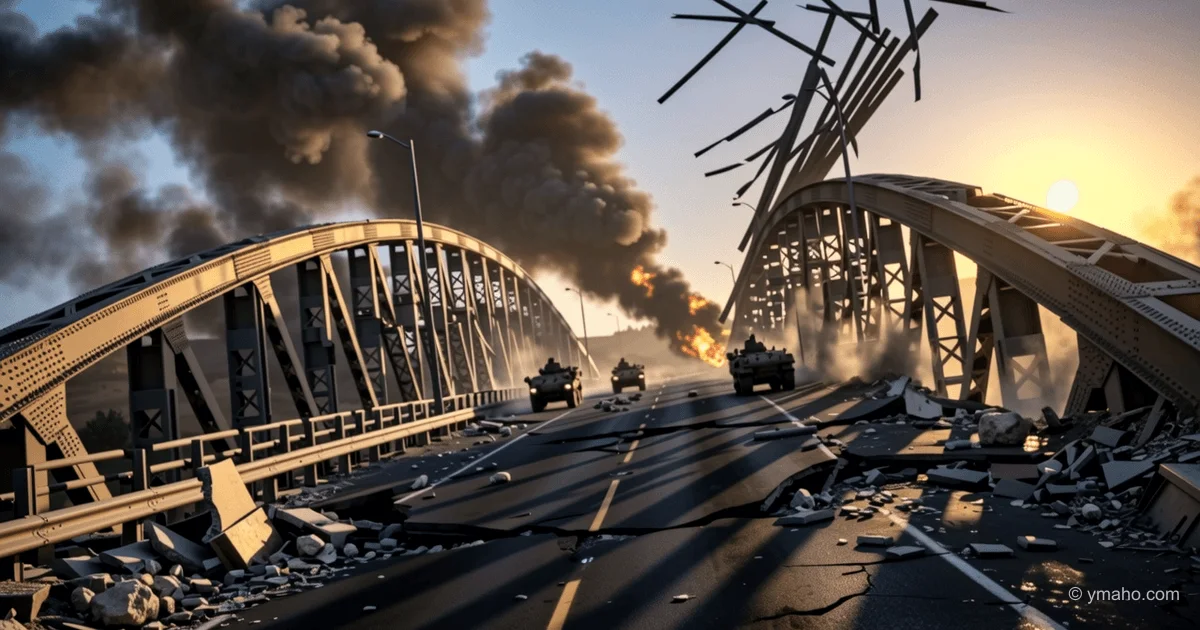
Israel Launches Intensive Strikes on Southern Lebanon: At Least 8 Killed
On May 9, amid tensions on the Lebanese front, at least 8 people were killed in Israeli airstrikes on targets in southern Lebanon. State media also reported raids on a highway south of Beirut. In response, Hezbollah attacked Israeli military positions in northern Israel with drones.
Analytical Brief
May 10, 2026
Confidential
The Core: What Is Really Happening
The strikes on May 9 in southern Lebanon are not a routine escalation amid the broader crisis, but a coordinated Israeli operation directly linked to the progress of US-Iran ceasefire negotiations. The targets were not Hezbollah launchers or weapons depots, but specific logistics infrastructure—bridges, interchanges, and sections of the highway connecting southern Lebanon to Beirut. According to my source in Israeli military circles, within 72 hours before the strikes, intelligence detected the movement of at least 14 trucks carrying equipment for assembling kamikaze drones from the Sidon port area toward Nabatieh. The convoy traveled without markings but with characteristic escort indicating Hezbollah affiliation.
Israel struck not the convoy, but the infrastructure it was supposed to use. This is a fundamental choice: the IDF aims to paralyze Hezbollah's ability to move weapons between the southern front and rear bases in the Beqaa Valley, without crossing the red line—eliminating Iranian military advisors or senior Hezbollah commanders. The eight dead are drivers, road workers, and gas station employees caught in secondary explosions. No high-ranking political or military figures are among the victims, confirming the targeted, infrastructure-focused nature of the operation.
But there is a second, deeper layer. These strikes are a signal to Iran. Thirty-six hours before the attack, on May 7, during closed consultations with the US side in Bahrain, the Israeli delegation led by National Security Advisor Tzachi Hanegbi warned: if a ceasefire agreement with Iran is reached without considering Israeli demands on Hezbollah, the IDF will act independently, regardless of the American diplomatic calendar. The strikes on May 9 demonstrate that this is not an empty threat.
Timeline and Context
The Lebanese front did not escalate yesterday. Since February 28, 2026, when the US-Israeli operation against Iranian nuclear infrastructure began, Hezbollah has steadily increased the intensity of attacks on northern Israel. Timeline of the last ten days:
- May 1: Hezbollah launched 12 kamikaze drones at Israeli positions in the Upper Galilee. One drone reached its target—a radar station on Mount Meron, taking it offline for 36 hours.
- May 3: Israeli artillery struck the outskirts of the villages of Kfar Kila and Adeisse in southern Lebanon. Three civilians wounded.
- May 5: The IDF announced the creation of a "security zone" up to 5 km deep on Lebanese territory, effectively taking control of eight border villages.
- May 7: Prime Minister Benjamin Netanyahu publicly stated that the US-Iran ceasefire is a "separate issue" unrelated to Lebanon. That same day, Hezbollah launched 18 rockets at Kiryat Shmona, damaging residential buildings.
- May 8: Israeli Air Force conducted preemptive strikes on launchers south of the Litani River.
- May 9: New intensive raids. Eight killed. The highway south of Beirut blocked in two places. In response, Hezbollah attacked IDF positions in northern Israel with drones—no military casualties, but a command and observation post was damaged.
It is important to understand that the exchange of strikes occurs against the backdrop of a diplomatic marathon around the US 14-point memorandum for a ceasefire with Iran. Israel is not formally part of this process, but its interests—or rather, the interests of its ruling coalition, dependent on far-right party votes—remain the main internal constraint for Trump. Netanyahu publicly supported the ceasefire, but with a caveat: the Hezbollah issue is a separate story. In diplomatic language, this means Israel will not allow its hands to be tied in Lebanon in exchange for a settlement between Washington and Tehran.
Who Wins and Who Loses
Winners:
- Israel's military industry. Every day of combat depletes stocks of precision munitions that need replenishment. Rafael Advanced Defense Systems, manufacturer of Tamir missiles for the Iron Dome system, has received orders worth at least $680 million since the conflict began. Elbit Systems, producing kamikaze drones and guidance systems, has increased its order book by $1.2 billion.
- US weapons manufacturers. Replenishing Israeli arsenals after intense combat will require new supplies from the US. According to Pentagon estimates, compensating for expended interceptor missiles and aerial bombs will cost $2.5–3 billion, to be allocated from the supplemental defense budget.
- Egypt as a potential mediator. Cairo has already offered to host a negotiation platform for the Israeli-Lebanese track. If successful, this would strengthen Egypt's position as an indispensable mediator and open access to additional financial aid from the US and EU, estimated at $5–7 billion.
Losers:
- The civilian population of southern Lebanon. According to the Lebanese Ministry of Health, since the escalation in May, 34 people have been killed and 127 wounded. Over 400 residential buildings have been destroyed or damaged. Economic damage to Lebanon's already shattered economy is estimated at $180–220 million in the last 10 days alone.
- Hezbollah as an organization. Israeli infrastructure strikes disrupt the group's logistics, reducing its ability to strike Israeli territory. Moreover, each day of combat depletes its stocks of drones and rockets. According to Israeli intelligence estimates, since February 28, Hezbollah has used about 40% of its kamikaze drone arsenal.
- European airlines. Lufthansa, Air France, and British Airways suspended flights to Beirut from May 3. Losses from canceled flights and rerouting are estimated at $12–15 million weekly. Lebanon's tourism sector, which accounted for up to 7% of GDP, is paralyzed.
- Israeli farmers in the Upper Galilee. Rocket attacks and the threat of drone infiltration have led to the evacuation of 24 settlements. Damage to the region's agriculture is estimated at $45–55 million since the conflict began.
What the Media Is Not Saying
First non-obvious insight: the Israeli strikes on May 9 were coordinated with Russia through a closed channel. It sounds incredible, but the facts point to this. Forty-eight hours before the raids, on May 7, Russian Deputy Foreign Minister Mikhail Bogdanov held consultations in Moscow with Israeli Ambassador Alexander Ben Zvi and Lebanese Ambassador Shawki Bou Nassar. The meeting's topic was not officially disclosed, but according to my source in diplomatic circles, they discussed the need to avoid strikes on facilities where Russian citizens might be present. Southern Lebanon has a significant diaspora of Russian-Lebanese families, and their safety has been a sensitive issue for Moscow since the 2024 evacuation. Israel, judging by the nature of the targets on May 9, carefully avoided residential areas—all strikes hit transport infrastructure. This is not a coincidence but the result of prior coordination.
Second point: no one is discussing Qatar's role in restraining Hezbollah. Doha, through a communication channel with the organization's political wing (existing since 2022), conveyed a recommendation not to strike Haifa and the petrochemical complex in Haifa Bay. Qatar's argument was purely economic: an attack on the Bazan Group refinery, with a capacity of 197,000 barrels per day, would cause an environmental catastrophe in the Eastern Mediterranean and undermine gas developments in Lebanon's exclusive economic zone. Hezbollah heeded this—no strikes on Haifa have been carried out since the conflict began. This is a fundamentally important fact: even amid hostilities, there are unwritten rules of the game, and Qatar acts as their guarantor.
Third: the Israeli operation in Lebanon has a limited time horizon. According to a source in the Israeli military command, reservists mobilized on March 1 must be demobilized no later than July 15, 2026. This means the IDF has roughly 65 days to achieve its military goals in Lebanon, after which political pressure to end the operation will mount. Israel's economy loses about $270 million per week maintaining mobilized reservists, and this bill is growing.
Fourth, and most important: parallel to the escalation, a non-public dialogue is underway between Israel and Lebanon through French intermediaries. The head of French intelligence DGSE, Nicolas Lerner, visited Beirut on May 4, where he held talks with Parliament Speaker Nabih Berri—a traditional channel of communication with Hezbollah. They are discussing a formula for returning to the 2024 ceasefire regime with additional security guarantees for Israel. The problem is that Netanyahu demands the creation of a demilitarized zone up to the Litani River, while Hezbollah agrees to withdraw forces no more than 8 km from the border. The gap is about 20 km, and it remains unresolved.
Forecast: Next 30 Days and 90 Days
Next 30 days (until June 10):
- Israeli strikes on transport infrastructure in southern Lebanon will continue, but with a tendency to decrease in intensity. The IDF has already achieved its main goal—disrupted Hezbollah's logistics in the border zone. Further strikes will be of a "pressure maintenance" nature.
- Hezbollah will respond by increasing drone attacks. I expect 2–4 incidents of drone penetration into Israeli airspace per week. Probability of a successful strike on a military target is about 30%, on a civilian target less than 10% (thanks to Iron Dome).
- The French mediation mission will intensify. By the end of May, I expect a visit by French Foreign Minister Jean-Noël Barrot to Beirut and Jerusalem with concrete proposals for demarcation.
- If the US-Iran ceasefire is concluded before June 1, the Israeli-Lebanese front will de-escalate automatically within 72–96 hours. If not, the intensity of strikes will increase again in the second half of June.
Next 90 days (until August 10):
- Key scenario (55% probability): parallel to the US-Iran framework agreement, an Israeli-Lebanese ceasefire will be concluded with French and US mediation. Hezbollah will withdraw forces 10–12 km from the border, Israel will withdraw troops from five of the eight occupied villages. This will be a temporary, fragile but workable truce.
- Alternative scenario (30% probability): if US-Iran talks reach an impasse, Israel will conduct a limited ground operation in southern Lebanon in July, before the reservist mobilization deadline. The goal is to seize a bridgehead up to the Litani River within 14–21 days. Casualties on both sides will be significant: Israeli military planners estimate up to 120 killed and 400 wounded; Lebanese losses will be an order of magnitude higher.
- Economic consequences for the region: under the first scenario (truce), air traffic to Beirut will resume by mid-July, Lebanon's tourism sector will receive about $400–500 million in deferred demand in August-September. Under the second scenario (ground operation), Lebanon will lose another $1.2–1.5 billion in GDP, and the Israeli economy about $900 million in additional military spending.
- Oil market: the Israeli-Lebanese front has no direct impact on prices, but escalation in Lebanon is perceived by markets as an indicator of overall regional tension. A ceasefire on the Lebanese front would remove about $1.50–2.00 from the "risk premium" in Brent prices.
The key indicator for the next two weeks is Hezbollah's behavior after a possible announcement of a US-Iran ceasefire. If the organization stops drone launches within 48 hours of such an announcement, it means coordination between Tehran and its Lebanese ally remains fully intact, and the deal works. If not, it means Hezbollah is acting autonomously, and the Lebanese front becomes an independent source of instability, not tied to the Iranian calendar. This scenario is the most dangerous for Israel and the most likely source of the next major escalation.
— Editorial Team









