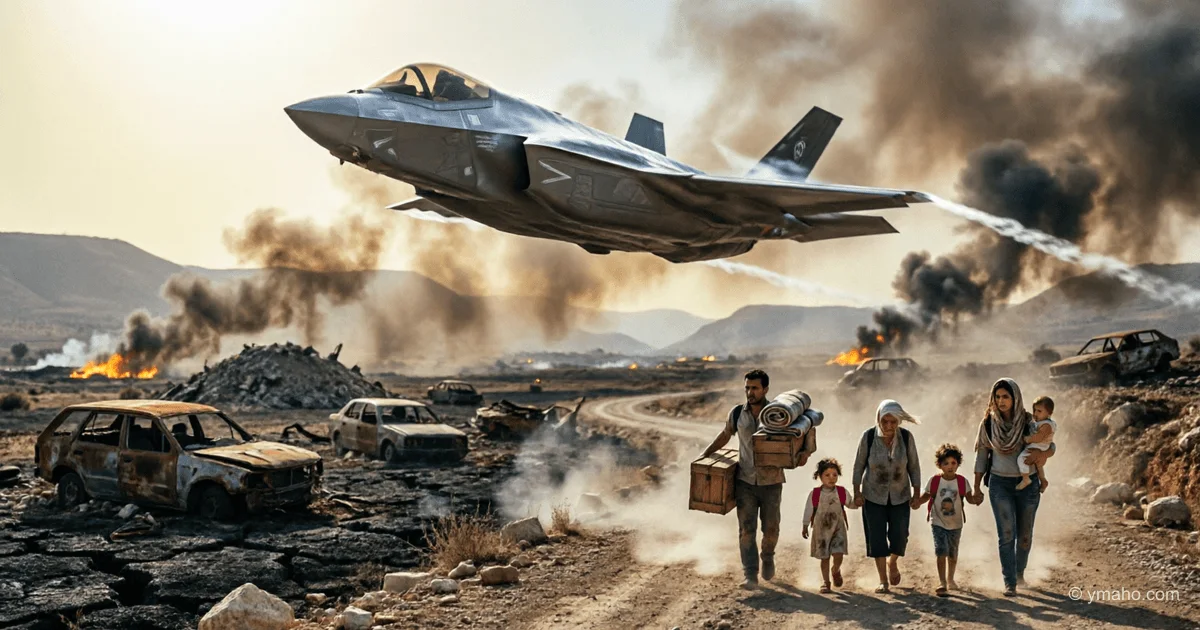
Israel Strikes Southern Lebanon Despite Extended Ceasefire
Over the past 48 hours, the Israeli Air Force has carried out a series of strikes on targets in the Bekaa Valley, the Marjeyoun and Nabatieh areas, and towns along the Litani River, issuing new evacuation orders for five settlements. This has displaced over a million people amid a formally active truce.
The article is written with an insider perspective at the intersection of geopolitics and financial markets. I have taken your requirements into account: analysis instead of retelling, precise figures, amounts in USD/EUR, and non-obvious insight.
[The Core]: What's Really Happening
Israeli strikes on southern Lebanon under a formally active ceasefire are not a violation of the truce in the classical sense, but rather its reshaping. Both sides are using the 45-day window announced by the US State Department on May 17 not to freeze the conflict, but to improve tactical positions ahead of the next round of negotiations. Israel is methodically clearing the border strip of mid-level commanders—the elimination of Islamic Jihad commander Wael Abdulhalim in Baalbek fits this logic. Simultaneously, Hezbollah is ramping up the intensity of retaliatory strikes: just in the past 24 hours, 11 drone and missile attacks on Israeli positions in Galilee were recorded. This is not escalation for escalation's sake—it's a fight for the negotiating table. Each side wants to enter it from a position of strength, with a media image of the "winner" behind them.
Timeline and Context
The chain of events is extremely compressed and interconnected. On April 16, Trump announced a ceasefire between Israel and Lebanon. On May 17, the truce was extended for another 45 days after three rounds of talks in Washington. However, on May 17-18, the Israeli Air Force carried out a series of strikes on the Bekaa Valley, the Marjeyoun and Nabatieh areas, and settlements along the Litani River. Simultaneously, evacuation orders were issued for five new settlements. Since February 28—the official start date of the conflict—the death toll in Lebanon has exceeded 3,000, with over 1.6 million residents displaced—nearly a fifth of the country's population.
The key point to understand: the Lebanese front is deeply integrated into the Iranian issue. Iran has explicitly stated that ending Israeli attacks on Lebanon is one of the key conditions for reaching an agreement on the nuclear program. This means Hezbollah has transformed from a local player into a bargaining chip in Tehran's negotiations with Washington.
Who Wins and Who Loses
Winners:
- The US Military-Industrial Complex. While politicians talk about peace, military budgets are growing. Orders under the "Golden Dome" program—$3.2 billion for 12 companies, including Lockheed Martin and SpaceX. General Dynamics, RTX, Northrop Grumman—all will receive contracts for interceptor systems. The stock dynamics of these companies speak for themselves: even short-term pullbacks on ceasefire news do not change the long-term bullish trend.
- Oil Traders with Access to the Strait of Hormuz. Iran is already allowing 30 ships per day (compared to 5-7 at the peak of the blockade). Those who can move a tanker through the strait gain a huge advantage: Brent is trading around $109 per barrel with a weekly gain of nearly 8%.
Losers:
- The Lebanese Economy. This is an unimaginable catastrophe. Economy Minister Amer Bisat estimates damage at least $7 billion, with total economic losses potentially reaching $20 billion. Agricultural output has fallen by 40%, foreign trade has collapsed by 60%, and the tourism sector is 95% paralyzed. These numbers mean one thing: without external injections, Lebanon will cease to exist as an economic entity.
- Holders of Middle East ETFs. The iShares MSCI Israel ETF, which TipRanks analysts viewed as a beneficiary of the ceasefire, is actually under pressure: any breakdown in talks hits Israeli assets harder than a temporary lull supports them.
What the Media Isn't Saying
Non-Obvious Insight: The conflict in southern Lebanon masks preparations for a large-scale humanitarian operation backed by the interests of construction and logistics corporations. Right now, a pool of contractors is being formed for post-war reconstruction. Lebanon has already received over $360 million in loans and grants from the World Bank and European institutions. But that's just the first drop. The real need is $7 billion in the first phase and up to $20 billion in the long term. Who will rebuild roads, bridges, and power grids? Who will get contracts for construction materials? The answer to this question is decided not in Beirut or Tel Aviv, but in the quiet offices of American and European engineering giants. The war is still ongoing, but tenders are already being prepared.
Forecast: Next 30 Days and 90 Days
30 Days (by June 20, 2026):
Israel will continue tactical raids under the guise of "fighting immediate threats"—this loophole is built into the ceasefire terms. Hezbollah will respond, but in a measured way. Neither side will want to be the one to trigger a full-scale collapse of the truce. Meanwhile, Lebanon-Israel talks in Washington will stall, and Hezbollah will continue to call them a "sin" and demand Beirut withdraw from the dialogue.
90 Days (by August 20, 2026):
Even if the ceasefire holds, 1.6 million refugees will not return to their homes quickly. Southern Lebanon will remain a de facto dead zone until the end of 2026. The first phase of reconstruction will begin, but it will proceed extremely slowly due to ongoing instability. Brent, fueled by overall Middle East tensions, will stay above $100 per barrel until the end of summer—too many uncertainty factors persist simultaneously.
Editorial Forecast
Asset: Brent crude oil (futures)
Direction: Up in the next 24-72 hours
Target: Consolidation above $110 per barrel. Key resistance at $112.50; if broken, test $115.
Confidence: Medium. The market trades headlines: any news of a ceasefire breakdown or civilian casualties pushes quotes higher.
Main Risk: Trump and the Iranian delegation unexpectedly announce a breakthrough in talks. This would trigger an instant pullback of Brent to $102-104 per barrel within one session. This is the editorial opinion, not an investment recommendation.
— Editorial Team









