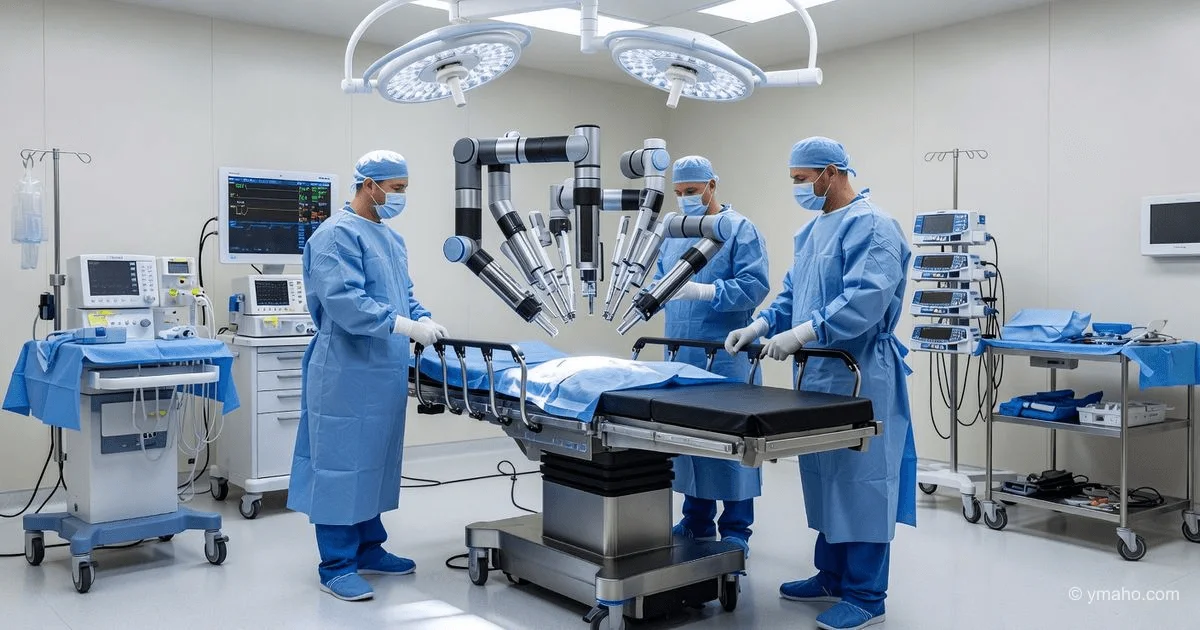
J&J's Ottava Surgical Robot Successfully Completes First Clinical Trials
The new Ottava robot, with arms integrated into the operating table, has been successfully used in bariatric surgery, demonstrating safety and the ability to operate in cramped operating room conditions.
[The Gist]: What's Really Happening
In reality, Ottava's success is not a victory over complex anatomy or even a technological triumph for J&J. It is a strategic blow to Intuitive Surgical's business model, which has held the market in an iron grip for two decades, not so much through software patents as through operating room architecture. Intuitive turned every OR housing a da Vinci into its own franchise: a bulky cart with arms, a separate surgeon console, miles of cables—all requiring room renovations and exclusive service contracts.
Johnson & Johnson, along with lead investigator Eric Wilson (UTHealth Houston), have just demonstrated that this model is outdated. Four arms integrated into a standard surgical table that retract underneath when not in use—this is an architectural answer to surgery's main pain point: space constraints. In five of the six hospitals participating in the FORTE study, surgeries were performed in ORs previously considered too small for a robot. These rooms ranged from 22.5 to 64.5 square meters.
But the main signal goes beyond that. J&J chose for its debut the gastric bypass—Roux-en-Y—one of the most technically challenging bariatric procedures, requiring work in multiple abdominal quadrants with simultaneous resection and reconstruction. A 0% conversion rate to open surgery in 30 patients for such a procedure is not "we can do robot too." It is a claim to versatility that no current system, including da Vinci 5, possesses.
Timeline and Context
To grasp the drama of the moment, rewind five years. J&J first unveiled the Ottava concept in November 2020, promising to upend the market. Then came nearly two years of near silence while engineering flaws were fixed, followed by a timeline shift to 2022. Many analysts had already written off the project. Revival began in October 2024 with an IDE submission, and by April 2025, the first surgeries were performed.
Key milestones in 2026 formed a clear line of attack: January 7—FDA De Novo submission with preclinical data, based on initial clinical experience at Memorial Hermann; May 4–5—presentation of FORTE results at the ASMBS 2026 Annual Meeting; meanwhile, J&J had already received IDE approval in late 2025 for a second trial on inguinal hernia repair. And finally, today, May 8, 2026—the market is digesting these numbers, and Intuitive's stock is dipping, though the broader public is not yet talking about it.
Context cannot be ignored: Intuitive just reported Q1 2026 results—revenue up 23%, and the new da Vinci 5 platform captured 85% of US placements. But this is the peak before the storm. Once J&J gets FDA green light, hospitals will begin not an Intuitive fleet upgrade, but a total contract overhaul.
Who Wins and Who Loses
Winners:
- J&J MedTech and its shareholders: The company has invested over USD 1 billion in Ottava since 2020, by various estimates. Division CEO Ebbe Cahill stated at JPM 2026 that commercialization is expected in 2026, with financial takeoff from 2028 when the robot reaches full capacity. If the FDA approves the De Novo in Q3 as planned, J&J will capture 10–12% of the robotic surgery market (currently about USD 5 billion) in the first two years.
- Bariatric surgeons and obesity patients: Obesity in the US is an epidemic affecting 40% of adults. Simplified logistics means more clinics willing to perform robotic bariatric surgery. The average weight loss of 13.6 kg (30 lbs) in 30 days in the study is a clinically significant result.
- Hospital administrators: Da Vinci with its carts requires major OR renovations. Ottava fits into a standard room of any size and can be easily moved out. This saves hundreds of thousands of USD on installation and allows one OR to be used for different types of surgeries throughout the day.
Losers:
- Intuitive Surgical: The da Vinci 5 is a great machine, but its dominance relied on a "platform moat": if a hospital invested in Intuitive-specific architecture, switching to a competitor was nearly impossible. Ottava fills that moat. I expect Intuitive to start aggressive discounting on service contracts within the next six months.
- Medtronic Hugo: Medtronic received FDA approval for urology in December 2025, but now they face two giants instead of one. Hugo risks getting stuck in third place in a race where only leaders get prizes.
- Classical surgical instrument manufacturers (non-Ethicon brands): Ottava is designed for Ethicon instruments—J&J's subsidiary. This is a closed ecosystem akin to Apple: robot + instruments + Polyphonic digital ecosystem. Competitors like Stryker are left out of this loop.
What the Media Isn't Saying
Everyone writes about 30 patients and zero conversions to open surgery. But no one discusses where this cohort came from and the conflict of interest behind it. Lead investigator Eric Wilson is not just a surgeon but a key opinion leader (KOL) for J&J, receiving consulting fees. His center—Memorial Hermann-Texas Medical Center—was the first trial site back in early 2025. This is standard practice for IDE studies, but it limits real-world extrapolation: in a routine hospital without professorial oversight, results may differ.
And another non-obvious insight: J&J is using the De Novo pathway, not PMA (Premarket Approval). De Novo is for low- to moderate-risk devices with no predicate on the market. This means the FDA views Ottava not as a da Vinci analogue with safety adjustments, but as a fundamentally new device class. If the regulator agrees, J&J will create its own regulatory precedent, which it will then protect with patents. That's why the company has been so aggressively patenting the "table-arm" architecture—they want to become the reference standard, not just a competitor.
Finally, the financial subtext: J&J announced that its orthopedics division will be spun off into an independent company no earlier than the second half of 2027. This means Ottava is needed by management as a flagship project to prove that MedTech without orthopedics is still a growing business. The entire J&J investment story for the next 18 months rests on this.
Forecast: Next 30 Days and 90 Days
Next 30 days (through June 7, 2026):
The FDA will begin formal review of the De Novo application and will likely request additional data on long-term safety beyond 30 days. J&J will respond that 90-day follow-up has already been collected and will be provided within two weeks. Meanwhile, a quiet war will unfold in the surgical community: Intuitive Surgical will send letters to chief surgeons at hospitals questioning the "unproven ergonomics" of the table architecture. This is a standard tactic—to slow adoption through seeds of doubt.
Investment banks will release 4–5 reports estimating the robotic surgery market at USD 50 billion by 2026 and USD 90 billion by 2036. These reports will feature three names: Intuitive, J&J, and Medtronic; others, including Chinese companies, will be ignored by analysts at this stage.
Next 90 days (through August 7, 2026):
If the FDA does not raise critical issues, the De Novo approval timeline will shift to late August–early September 2026. J&J will begin closed-door negotiations with 15–20 of the largest US hospital networks for pre-orders of the first commercial batch (likely 50–70 systems at USD 1.2–1.5 million each).
Intuitive's counterstrike will be harsh. They will announce a trade-in program: da Vinci Xi to da Vinci 5 with zero-interest installment over 3 years upon signing an exclusive contract. This will freeze some potential Ottava customers. J&J's first-year share will thus be limited not by technology but by contracts—around 6–8% of the market.
The Chinese factor cannot be dismissed either: surgical robots from MicroPort and other local players are actively entering Asian and African markets, offering systems for USD 500,000–700,000. If Ottava's cost turns out lower than da Vinci's due to the absence of a bulky console, it could become an export hit for J&J in emerging markets. This is a long-term horizon, but initial contracts in India and Brazil will likely be signed before the end of 2026.
— Editorial Team









