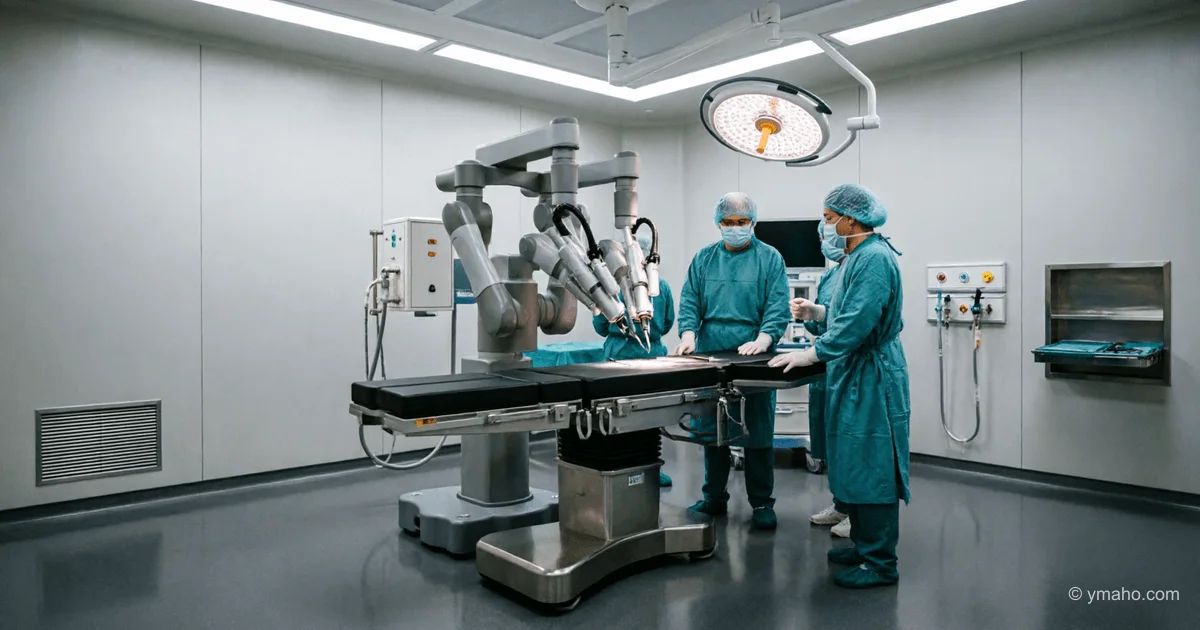
J&J Presents Trial Results of New OTTAVA Soft Tissue Robot Architecture
Johnson & Johnson announced successful results from the first clinical study of the new OTTAVA robotic system for bariatric surgery. The system, with arms integrated into the table, demonstrated safety and efficacy in cramped operating rooms where robots were previously not used.
Medical media are reporting the FORTE study results as a technical milestone: the robot performed without conversions to open surgery, and patients lost weight. But the essence of what is happening goes much deeper. Johnson & Johnson is not just catching up with Intuitive Surgical — the corporation is changing the rules of the game, stripping the competitor of its main protective moat.
The Core: What Is Really Happening
J&J has brought to market not just another robotic manipulator. The company has reinvented the very concept of the robotic operating room. The four arms of OTTAVA are built into a standard surgical table — no separate carts, no ceiling-mounted consoles, no overhanging structures. This sounds like an engineering detail, but in reality, it is a tectonic shift in hospital economics.
A traditional da Vinci robotic system completely occupies an operating room. Once installed, the room becomes "robotic" and loses its versatility. In the FORTE study, five out of six sites performed procedures in operating rooms that had never before been used for robotic surgery — some historically considered unsuitable due to limited space. The area of these rooms ranged from 22 to 64 square meters.
This means OTTAVA does not require a hospital to undergo major renovations. The robot rolls into a standard operating room, integrates into the workflow, and does not claim exclusive ownership of the space. This is not evolution — it is the demolition of an entry barrier costing between $500,000 and $2 million per room, which for decades limited the robotic surgery market to large academic centers with budgets for infrastructure projects.
Timeline and Context
The story of OTTAVA is a saga of how a giant with an annual turnover of $85 billion acknowledged its mistake and methodically corrected it.
In 2020, J&J first showed the robot concept. The market reaction was cautiously skeptical: yet another belated response to Intuitive Surgical's monopoly. At the end of 2021, the company suddenly announced a development delay of about two years. The official wording was "technical refinements," but insiders knew: the architecture with arms hanging from the ceiling proved clinically unviable. J&J had to completely redesign the system.
In October 2024, the company filed an IDE (Investigational Device Exemption) application with the FDA and received approval in less than a month. In early 2025, Eric Wilson performed the first OTTAVA surgeries at Memorial Hermann-Texas Medical Center. In January 2026, J&J filed a De Novo classification application.
And on May 4, 2026, at the annual conference of the American Society for Metabolic and Bariatric Surgery, the results of the first clinical study were announced: 30 patients, zero conversions to open surgery, all primary safety and efficacy endpoints met, average weight loss of 13.6 kg in 30 days.
The researchers deliberately chose Roux-en-Y gastric bypass — the most technically complex bariatric procedure, requiring work in multiple quadrants of the abdominal cavity and combining restrictive and reconstructive components. This was a stress test for the platform. That the system passed it without a single conversion is a signal addressed not so much to the regulator as to the surgical community.
Who Wins and Who Loses
Winners:
Patients with obesity. The bariatric surgery market was shrinking under pressure from GLP-1 drugs. Lowering barriers to robotic interventions means increased availability of surgeries in regional hospitals where robots previously simply could not fit physically.
Regional hospitals with limited space. They suddenly gain access to robotic surgery without major operating room renovations. For a hospital with an annual budget of $50–100 million, saving $1.5–3 million on room reconstruction is critical. The return on investment for a robotic program changes radically — the payback period shrinks from 5–7 years to 2–3.
Johnson & Johnson MedTech, but not immediately. CFO Joe Volk at the TD Cowen conference in March 2026 cautiously warned analysts: "We are not overly excited and are not counting on OTTAVA in terms of financial performance. It is much more important to launch the product correctly — slowly, so that we can go fast later." This is not modesty. It is a sober calculation by a corporation that understands: competing with an installed base of 11,395 da Vinci systems is a marathon, not a sprint.
Losers:
Intuitive Surgical. Not tomorrow, but on a 3–5 year horizon. The company has just completed a massive fleet upgrade to da Vinci 5: 85% of US installations in Q1 2026 were the new generation. Hospitals have spent capital budgets on these robots. But OTTAVA solves a different problem: it enters operating rooms that da Vinci can never access due to size constraints. This is not "robot vs. robot" competition — it is market expansion into segments Intuitive considered unreachable.
Medtronic with the Hugo system. The company received FDA approval for urological procedures in December 2025. But Hugo's architecture is still carts. The comparison with OTTAVA will not favor Medtronic once J&J obtains commercialization clearance.
Laparoscopic equipment manufacturers. When a robotic system can switch between robotic, laparoscopic, and open access in a single surgery, the line between the "manual" and "robotic" markets blurs.
What the Media Are Not Saying
First: the twin motion feature, which J&J mentions in passing, is not just "the table and arms move together." It is an architectural solution that eliminates the need for re-docking when transitioning between quadrants of the abdominal cavity. A standard da Vinci operation requires re-docking when changing the work area — this adds time, risk of contamination, and disrupts the surgical flow. Twin motion means a continuous operation, which directly translates into a reduction in anesthesia time of 15–25 minutes. At an operating room minute cost of $30 to $100, this amounts to thousands of dollars in savings per surgery.
Second: the Polyphonic ecosystem. J&J has announced that OTTAVA will connect to its digital platform, which will collect data from each surgery and use it to improve future procedures. Intuitive Surgical possesses a vast array of clinical data — this is its main intangible asset. But J&J, controlling the enormous portfolio of Ethicon consumables, has access to data from millions of non-robotic surgeries annually. Combining these data streams into a single platform creates a competitive advantage that no other player has. Analytics on instrument usage, predictive inventory planning, individualized surgical technique recommendations — this is not software, it is a business model.
Third: the choice of bariatrics as the first specialty is not accidental. Intuitive Surgical traditionally dominates in urology and gynecology. But in bariatrics and general surgery, robot penetration is significantly lower. J&J is deliberately entering a niche where competition is weaker and unmet demand is higher. Moreover, the company has already received an IDE for a second study — this time for inguinal hernia. Inguinal hernioplasty is one of the most common surgeries in the world, approximately 20 million procedures annually. If OTTAVA demonstrates economic efficiency there, it will be an even more significant sales driver than bariatrics.
Fourth: the most underestimated aspect is instrument compatibility. Ethicon instruments for OTTAVA are designed so that the user experience closely resembles working with traditional laparoscopic Ethicon instruments. Surgeons who have worked with these instruments "manually" for years will find familiar tactile feedback in the robotic version. This lowers the learning barrier and accelerates platform adoption. The learning curve for da Vinci is 50–100 surgeries; J&J hints that for OTTAVA it will be shorter, though specific numbers have not yet been published.
Forecast: Next 30 Days and 90 Days
30 days (by June 5, 2026):
The FDA will internally move to the final stage of reviewing the De Novo application. A decision is not expected before Q4 2026, but within the next month it will become clear whether the regulator will request additional data. Given that the application was filed in January and the FORTE study results are entirely positive, the likelihood of a request is minimal. J&J investors will begin to factor approval into stock valuations.
Intuitive Surgical will hold a conference call with key clients to gauge how many hospitals are considering OTTAVA as an alternative in the next purchasing cycle. Leaks from these meetings will move the company's stock over the month.
90 days (by August 5, 2026):
The inguinal hernia study will begin patient enrollment. Four to six additional sites will be announced, and initial results will appear by September. It can be expected that J&J will file for indication expansion even before receiving primary approval.
Key insight for this horizon: a quiet war for opinion leaders will begin. Surgeons who participated in FORTE will start speaking at conferences and publishing comparative analyses of OTTAVA versus da Vinci. The nature of these publications will determine the tone of the professional community's perception of the platform for years to come.
Strategic forecast for 12 months: J&J is deliberately pursuing a "slow launch" path. The first year of commercial availability will see 10–25 accounts, no more. This is Apple's strategy in medicine: create a pool of reference centers, collect real-world data, iron out the kinks, and only then scale. The market expects OTTAVA to immediately take share from Intuitive Surgical. Reality will be different: for the first 2–3 years, OTTAVA will grow by activating new segments — operating rooms that have never seen robots, not by poaching da Vinci customers. The robotic surgery market today penetrates only 8% of all surgeries. J&J is not targeting someone else's share, but the remaining 92%.
— Editorial Team









