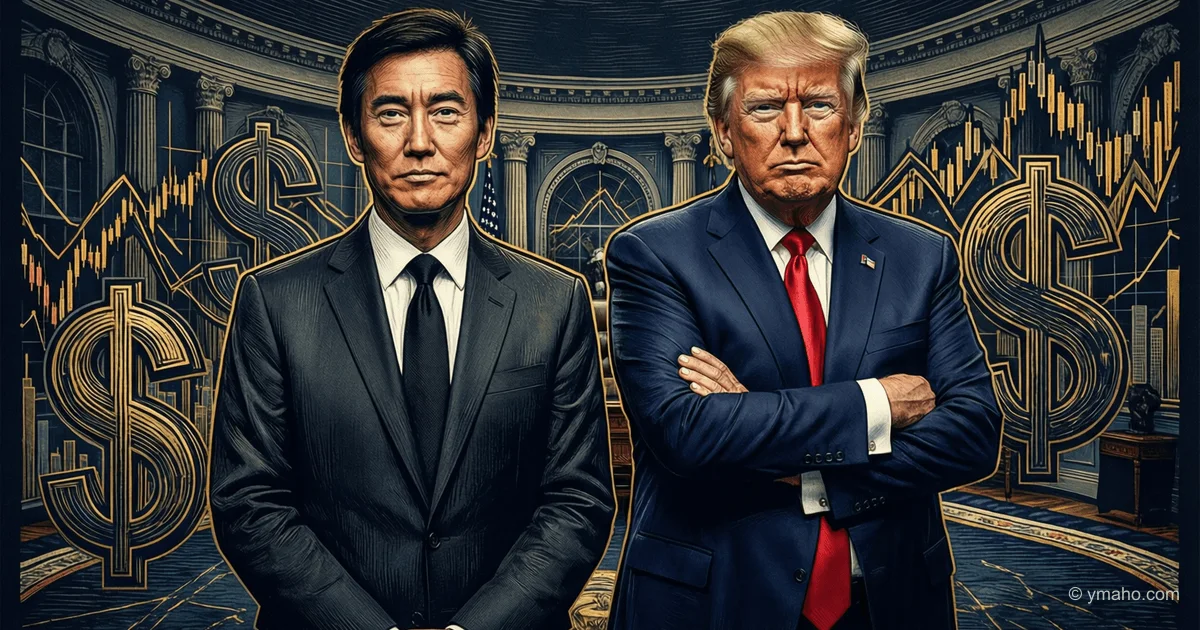
Kevin Warsh Officially Sworn In as New Fed Chair
The White House hosted the swearing-in ceremony for Kevin Warsh, appointed by Donald Trump as Chairman of the Federal Reserve. The ceremony took place amid ongoing market tensions related to geopolitics and expectations of tighter monetary policy.
Warsh's Fed: A Hawk in Sheep's Clothing
Trump asks for independence, while markets brace for the tightest monetary regime since Volcker. The gap between word and deed will be the main story of the summer.
[The Gist]: What's Really Happening
The May 22 ceremony in the East Room of the White House was more than just a swearing-in. It was a public ritual of subordination. Trump personally stood next to Kevin Warsh, while Supreme Court Justice Clarence Thomas administered the oath — the first time since 1987, when Ronald Reagan similarly presented Alan Greenspan.
The official line: "I want Kevin to be completely independent," Trump said. "Don't look at me, don't look at anyone. Just do your job."
Don't believe a word of it.
The "insider view" here is: Warsh is not a dove (proponent of easy policy), as some media try to portray due to his crypto portfolio. He is a Milton Friedman-trained hawk who is simply more skilled in communication than Powell.
Warsh criticized the Fed for "cutting rates too quickly" during the 2008 crisis and was the only governor to vote against QE2 in 2011 (a $600 billion Treasury bond purchase program). A man with that resume will not flood the market with cheap liquidity just because Trump wants low rates before the election.
The difference between Warsh and Powell is not hawkishness, but political savvy. Powell fought Trump openly and lost. Warsh will do the same, but with a smile and quotes from Friedman.
Timeline and Context
May 22, 2026 — Inauguration at the White House. Attendees: Speaker Mike Johnson, Treasury Secretary Scott Bessent, Commerce Secretary Howard Lutnick, former Secretary of State Condoleezza Rice. Does Warsh swear on a Bible? No — on a stack of economic treatises?
Context of the appointment: Senate confirmation passed by a razor-thin margin — 54 to 45. This is not a mandate of confidence. It is a party-line vote showing that Warsh has virtually no credibility among Democrats. Elizabeth Warren called him "Trump's puppet" right at the hearings.
Economic backdrop at the time of swearing-in:
- Inflation remains above 3% (Fed target is 2%) for the fifth consecutive year
- War with Iran pushed oil above $100 per barrel
- 10-year Treasury yields surged — markets are pricing in rate hikes, not cuts
- Next FOMC meeting: June 16-17, 2026
What happened right before the inauguration? Fed Governor Christopher Waller publicly called for abandoning the "easing bias," stating that "rate cuts are no more likely than rate hikes." This was a signal to Warsh: your colleagues have already taken a hawkish stance.
Who Wins and Who Loses
Warsh himself wins. Warsh's net worth is estimated at $131-209 million in personal assets, plus the assets of his wife, Estée Lauder heiress Jane Lauder (family fortune around $2.5 billion, father-in-law Ronald Lauder at $4.9 billion). He becomes the richest Fed chair since at least 1948. His personal crypto portfolio includes Solana, Optimism, and investments in dYdX, Lighter, and Dapper Labs worth over $100 million. He will make decisions affecting the value of these assets.
Big capital close to the Republican Party wins. Stanley Druckenmiller, for whom Warsh worked at Duquesne Family Office, is the number one beneficiary of "regulatory holidays" for the financial sector.
Long bond holders lose. Warsh is known for his skepticism of QE. The likelihood that he will aggressively shrink the Fed's balance sheet (selling bonds on the open market) is high. This means further yield increases and falling prices for long-dated Treasuries.
The tech sector loses. If rates remain high or rise, valuations of companies with long profit horizons (AI, biotech, climate tech) will suffer. The irony is that Warsh believes in AI productivity as an anti-inflationary factor, but his own monetary doctrine outweighs that optimism.
What the Media Isn't Saying
Non-obvious insight #1: Warsh is the most crypto-friendly Fed chair in history. And that's a problem, not a blessing.
Yes, he said Bitcoin "doesn't make him nervous" and called it an "important asset." Yes, he invested over $100 million in crypto projects. But this very connection creates a massive conflict of interest that Democrats will use to paralyze any of his decisions favoring digital assets.
If Warsh proposes easing regulations for banks dealing with cryptocurrencies (and he has stated that "digital assets are already an integral part of the U.S. financial industry"), he will immediately face accusations of using his position for personal enrichment.
Reality: Warsh will be tougher on the crypto industry than Powell, precisely because he is invested in it. He cannot afford even a hint of conflict.
Non-obvious insight #2: The White House inauguration is a signal to Wall Street, not the public.
Why would Trump hold the ceremony in the East Room rather than at the Fed headquarters on Constitution Avenue? This is not just a nod to tradition (though the last time was Reagan with Greenspan). It is a message: "Warsh is my man, and he knows it."
At the same time, Trump says, "Be independent." But the entire staging — from Justice Thomas's presence to the cabinet members — screams the opposite. Markets read this. The S&P 500 rose on the day of the ceremony, which usually doesn't happen when a hawk takes over. Investors mistakenly interpret the political theater as a signal for rate cuts. It's a trap.
Non-obvious insight #3: Powell remains on the Board of Governors — insurance for markets.
Jerome Powell, whose 14-year term as a governor expires only in 2028, decided to stay. This is an extremely rare case in Fed history — a former chair continues to work under his successor.
What does this mean? Warsh cannot act radically without convincing Powell and other board members. The FOMC has 7 votes. Warsh is one of them. Yes, as chair he sets the tone, but no more. Powell, Waller, and other "old hawks" will restrain Warsh if he tries to deviate too far in either direction.
Forecast: Next 30 Days and 90 Days
Next 30 days (until June 24, 2026): Markets will be in "waiting for the first signal" mode. Key date: FOMC meeting June 16-17. My forecast: The Fed will keep rates unchanged (currently 4.25-4.50%). But in the accompanying statement, Warsh will insert language that "the committee does not rule out any policy direction."
Emphasis will be on balance sheet reduction (selling bonds), not on the rate. This will allow Warsh to show "hawkishness" without killing markets all at once.
Next 90 days (until August 24, 2026): If inflation remains above 3% (and May PCE data comes out in late June), Warsh will have to choose: lose market credibility (by not raising rates) or lose Trump's support (by raising).
My forecast: a 0.25% rate hike in July or September. Probability: 60%. Warsh understands that his historical legacy will be defined by how he handles inflation, not by how he pleases Trump.
Key risk: escalation of the conflict with Iran. If oil heads to $120-130 per barrel, Warsh will have to raise rates more aggressively, despite the consequences for markets.
Editorial Forecast
- Asset: U.S. Dollar (DXY) / Direction: Up in the next 72 hours.
- Key levels: Dollar index trading around 103.5. On a break above 104.2, next target is 105.1. We expect dollar strengthening as markets realize Warsh is not the "dove" they were waiting for.
- Confidence level: High (given the gap between expectations of easy policy and Waller's actual comments).
- Main risk to forecast: If at his first press conference (June 17) Warsh makes a surprisingly dovish statement, saying that "AI productivity will allow rate cuts without inflation," the dollar will sharply reverse lower, and crypto and high-tech stocks will get a powerful boost.
— Editorial Team









