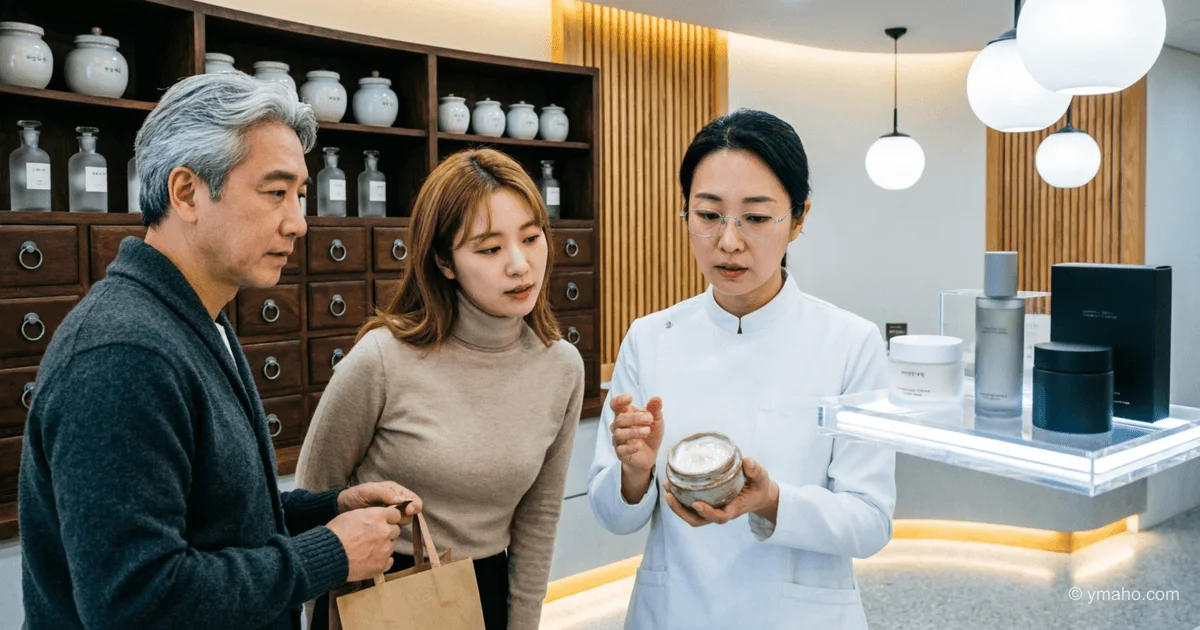
Korean Pharmacies Redefine the Beauty Market: Skincare Becomes Prevention
Pharmacists note a shift from treatment to prevention. Customers are increasingly coming to pharmacies not for treatment, but to build a daily skincare routine and get consultations on maintaining healthy skin.
Analytical article based on the provided news and data from May 2026.
Title: The Pharmacy as the New Seller: The End of 'Brand' and the Rise of 'Prescription Skincare'
If you think Korean pharmacies just "jumped on the bandwagon" and started selling creams alongside medicines, you are deeply mistaken. The event described in the news is not an assortment expansion. It is the collapse of the classic sales funnel in the beauty industry and a power shift from marketers to pharmacists. We are witnessing the birth of a new consumption model: "Skincare by Prescription."
Insiders call this "the cannibalization of cosmetic retail by pharmacy consulting." Let's break down the essence.
The Essence: What Is Really Happening
The news reports a shift "from treatment to prevention." While this sounds nice, the real essence is harsher: the consumer no longer trusts advertising and a pretty bottle. They seek sanctioned efficacy. The pharmacy has transformed from a place to buy band-aids into an entry point to the premium K-Beauty segment.
Data confirms this with numbers. In the first three months of 2026, Korean cosmetics exports grew by 21.5% to $3.13 billion, setting a quarterly record. But most importantly, 77.6% of this volume came from basic skincare, not decorative cosmetics. This indicates that women go to the pharmacy not for lipstick, but for the "infrastructure" of skin health.
Why does this change the game? Because you can't sell a "dud" in a pharmacy. In a K-Beauty store, the buyer chooses a brand by packaging and scent, but in a pharmacy, the seller (pharmacist) acts like a doctor: "I see flaking and rosacea — I recommend beta-glucan and PDRN for regeneration, and put away the acids."
Timeline and Context
To understand why this happened precisely in 2026, we need to rewind 36 months.
- 2023–2024: Peak of "smart" channels (Olive Young, online marketplaces). The consumer drowns in choice. Thousands of brands, identical formulas. Decision Fatigue sets in.
- 2025: Rise of "derm-wannabe" brands that mimic prescription cosmetics but are sold everywhere. The market is oversaturated with "clones" of creams priced from $5 to $200 for similar compositions.
- March-May 2026: The final transformation. Media capture a new trend: tourists in Seoul go not to duty-free shops, but to pharmacies in the Myeongdong area. During the first May holidays, foreign payments in pharmacies increased by 156% compared to last year.
The Korean consumer (and the global one following suit) concluded: "If the formula lacks a certified active ingredient and a medical logic of application, it's just an expensive moisturizer."
Who Wins and Who Loses
(+) Big Winners: 'Pharmacy Derms' and Pharmacists.
Brands with medical origins win. Brands built on ingredients like PDRN (polydeoxyribonucleotide, a skin regeneration stimulator) or beta-glucan. According to a survey of pharmacists, products with a "regeneration" and "treatment of chronic skin conditions" concept currently have the highest conversion rate.
The buyer is willing to pay a 300-500% premium for consultation. The average check in Seoul's tourist pharmacies was about 47,000 won (~$34) per visit, but this is a purchase of a routine (morning/evening) for 2-3 months ahead.
(-) Losers: 'Mute' Mass-Market Brands and Classic Beauty Advisors.
Those who built marketing on a "pretty label" but cannot prove pharmacological efficacy lose. Major chains like Olive Young report an increase in requests for medical ingredients (Tranexamic Acid, Exosomes), while brands with "empty" textures go to stock.
The sales consultant in the store loses influence. They are replaced by a pharmacist with a diploma. I call this "Juridicalization of Beauty": if a specialist cannot explain the mechanism of action of an ingredient at the cellular receptor level, they won't sell the product.
What the Media Are Not Saying
The media talk about "skincare as prevention." But they miss a hidden, highly non-obvious fact: pharmacies are becoming a collection point for biometric data.
The trend that is now growing 300% is not just selling cream. It is the synergy of pharmacy cosmetics with personalized nutraceuticals. When a client comes for acne treatment (e.g., with STIs), the pharmacist collects a history to prescribe not only an ointment but also a vitamin-mineral complex. We are witnessing the collapse of boundaries: Skin care = Health care.
What is hidden from the reader? Morgan Stanley data for May 2026 shows that 34% of adults in the US took laboratory tests on their own initiative. In South Korea, this figure is even higher. The consumer goes to the pharmacy already with a printout of test results (vitamin D level, ferritin).
The first pharmacist who integrates software into their POS to read client test results from a device (Apple Watch or lab) and generate a "prescription" of 2 skincare jars + 1 pack of probiotics will be a monopolist. Currently, this is done manually, but automation is a matter of 90 days.
Forecast
Next 30 Days (June 2026):
Expect explosive interest in "Pharmaceutical Tourism." Russians and Europeans, tired of local brands and the unavailability of exclusive ingredients, will start mass-ordering Korean pharmacy "sets" (day/night routine) through cargo services. Specifically: growing interest in products with exosomes and low-molecular-weight hyaluronic acid, which were written about in April interviews with CEOs. There will be a shortage of brands that produce exclusively for the "pharmacy" channel (Pharmacy Exclusive).
Next 90 Days (End of Summer 2026):
- Market split into 'Medicine' and 'Packaging.' Mass-market cosmetics will retreat to the "body wash" and "bath gel" segment, ceding facial skincare territory entirely to medical sales channels. We will see the first IPOs of pharmacy chains on NASDAQ precisely as "Tech-Health" companies, not retailers.
- War for 'Explainability.' The consumer no longer buys a product; they buy the concept of "Condition Management." Sales will be won by those who create not a cream, but a digital app-guide for its use (3-week cycle, before/after readings). The projected growth of the Health and Wellness market to $7.42 trillion by the end of 2026 will be driven precisely by this segment.
Conclusion for the investor and consumer: Ignore "loud" names and pretty bottles. Today, money and skin health are where the white coat and evidence base work. The beauty industry has stopped being about aesthetics. It has become about diagnostics and tissue engineering. Those who don't go learn pharmacology and chemistry will be left with pimples and an empty wallet.
— Editorial Team









