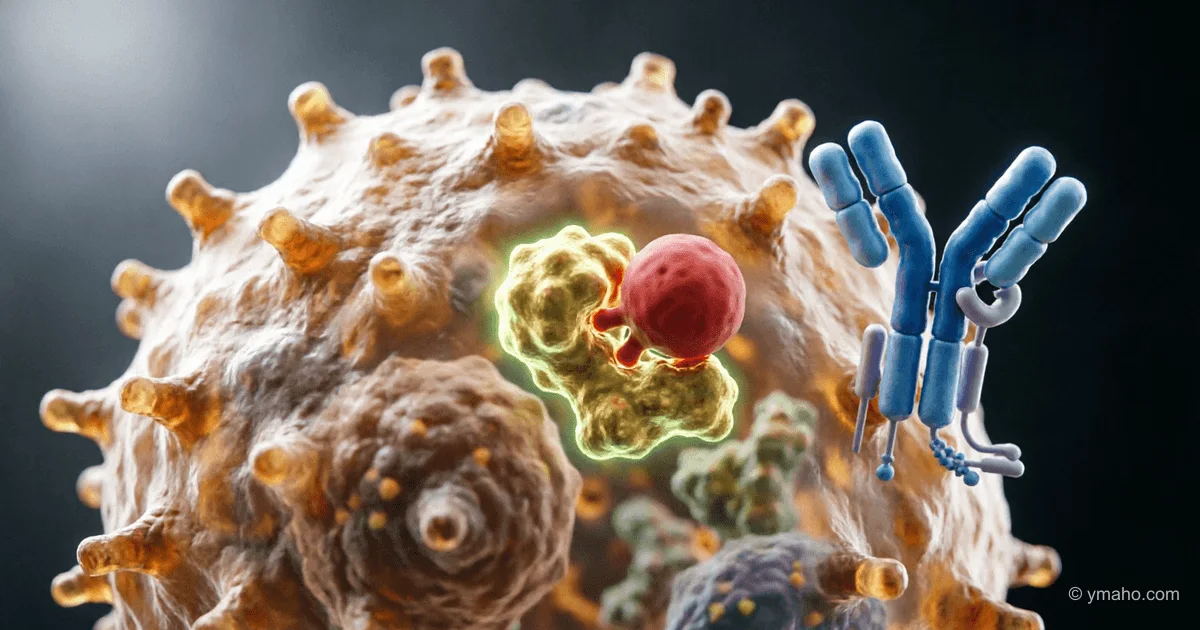
Breakthrough in Cancer Treatment: KRAS G12C Combination Shows Efficacy in Colorectal Cancer
Phase 3 CodeBreak300 trial shows that the combination of sotorasib and panitumumab significantly improves progression-free survival in patients with metastatic colorectal cancer.
Breakthrough in Cancer Treatment: KRAS G12C Combination Shows Efficacy in Colorectal Cancer
Introduction
KRAS gene mutations have long been considered the "Achilles' heel" of oncology. Discovered in the 1980s, these mutations are among the most common drivers of cancer, particularly in lung, colorectal, and pancreatic cancers. However, the protein encoded by mutant KRAS has a smooth surface without deep binding pockets, making it "undruggable" for over 40 years.
The breakthrough came in 2021 when the FDA approved the first drug directly targeting mutant KRAS G12C—sotorasib (Lumakras®) from Amgen for the treatment of non-small cell lung cancer. But the story didn't end there. Scientists quickly realized that for some cancer types, particularly colorectal cancer, monotherapy with a KRAS inhibitor is insufficient due to adaptive resistance mechanisms.
In 2026, results from the Phase III CodeBreak300 study led to a new FDA approval: the combination of sotorasib and panitumumab (Vectibix®) for the treatment of metastatic colorectal cancer (mCRC) with the KRAS G12C mutation. This event does not simply add another drug to the oncologist's arsenal—it changes the treatment paradigm for one of the most aggressive and difficult-to-treat cancers.
Event Details and Timeline
The Problem: Metastatic Colorectal Cancer with KRAS Mutation
Colorectal cancer (CRC) is the third leading cause of cancer death in the United States. For patients with metastatic disease (mCRC), the prognosis is particularly grim: less than 20% of people live more than five years after diagnosis. In the third-line setting, standard regimens provide a median overall survival of less than one year, and response rates are under 10%.
KRAS mutations are present in approximately 45% of colorectal cancer cases. The G12C mutation, although not the most common among CRC (occurring in 3-5% of cases), is historically associated with worse survival and more aggressive disease compared to non-mutated tumors.
A key issue: patients with KRAS mutations do not respond to EGFR inhibitor therapy (e.g., cetuximab or panitumumab) as monotherapy because the constitutively active KRAS protein "bypasses" the receptor blockade on the cell surface. A strategy that attacks the problem on two levels was needed.
The Solution: Dual Blockade of KRAS and EGFR
The scientific rationale for the combination was elegant. The KRAS G12C inhibitor (sotorasib) turns off the mutant protein, but tumor cells can activate alternative pathways, including signaling through EGFR. Adding an EGFR inhibitor (panitumumab) blocks this escape route, creating a "double hit" on cancer cells.
This approach was not obvious from the start. The first generations of KRAS inhibitors were developed for NSCLC, where resistance mechanisms are different. For CRC, additional research was needed, and CodeBreak300 became the pivotal trial proving the combination's efficacy.
CodeBreak300 Results: Numbers That Change Practice
The FDA approved the combination based on results from the CodeBreak300 study—a Phase III randomized controlled trial. Data showed that patients receiving the combination of sotorasib and panitumumab demonstrated:
- An increase in progression-free survival (PFS) of more than three months compared to standard therapy
- A statistically significant and clinically meaningful improvement compared to sotorasib monotherapy
- A manageable safety profile, acceptable for heavily pretreated patients
These numbers may seem modest compared to some targeted therapies for other cancers. But in the context of mCRC, where patients have already undergone several lines of chemotherapy and have extremely limited options, adding three months of life without progression is "a ray of hope where there were few alternatives before."
Concurrently with the drug approval, the FDA also cleared a companion diagnostic—the therascreen KRAS RGQ PCR Kit from Qiagen—which identifies patients with the KRAS G12C mutation eligible for this therapy.
Important Context: Lumakras®'s Path to Market
The approval for mCRC is the second major indication for Lumakras®. The first was in 2021 for non-small cell lung cancer—a historic event as it ended a 40-year "race for an elusive target."
However, despite its breakthrough status, Lumakras®'s commercial success has been modest. As of 2025, the drug showed modest growth: fourth-quarter sales rose 8% year-over-year to $92 million, and annual sales increased 4%. Reasons include a limited patient population (3-5% in CRC, ~13% in NSCLC), reimbursement challenges outside the US, and emerging competition from a second approved drug—krazati (adagrasib), now owned by Bristol Myers Squibb.
Impact and Significance
For Patients: New Hope in Refractory Cancer
For patients with refractory KRAS G12C-mutant mCRC, this combination means more than just numbers in clinical trials.
First, the emergence of a targeted option after standard chemotherapy and possibly immunotherapy have been exhausted. In the third-line setting, choices are traditionally limited to regorafenib or TAS-102, which have low efficacy and significant toxicity. The new combination offers a biologically rational, more tailored approach.
Second, the oral dosing regimen of Lumakras® in combination with intravenous panitumumab—at least part of the therapy can be taken at home, improving quality of life, which is critical in late-stage disease.
Third, potential for earlier lines of therapy. As experts note, trials are underway testing KRAS inhibitors in first-line settings and in combination with immunotherapy. The success of CodeBreak300 opens the door for using this strategy earlier in the course of disease.
For Medical Science and Oncology
The breakthrough is significant on several levels.
Validation of the combinatorial blockade principle. The KRAS story has shown that monotherapy with an inhibitor may be insufficient due to adaptive resistance. The combination with anti-EGFR is a "proof of concept" demonstrating that understanding resistance mechanisms can be translated into effective clinical strategies.
Expansion of the allostatic load of KRAS targeting. Success in mCRC, where the G12C driver mutation is less common than in NSCLC, shows that this approach can work in different tumor microenvironments and histologies.
Stimulation for next-generation drugs. As noted by Citeline analyst Neha Anand, the competitive landscape is rapidly evolving: Roche is developing divarasib with potentially superior potency (ORR >55%, PFS ~14 months in NSCLC), Merck & Co. has calderasib, Eli Lilly has olomorasib and G12D inhibitors. Each new success expands the boundaries of what is possible.
For the Pharmaceutical Industry
The CodeBreak300 approval comes at a time when the KRAS inhibitor market is at a critical juncture.
On one hand, commercial potential is growing but limited. Analysts forecast the KRAS inhibitor market at $3-4 billion by 2028. Given that drugs targeting G12C cover only a subset of KRAS-mutant tumors (in CRC, only 3-5% of patients), companies must aggressively expand into other indications and earlier lines of therapy, as well as develop pan-KRAS inhibitors.
On the other hand, intense competition drives innovation. Amgen is already developing AMG 410, a pan-KRAS inhibitor designed to target multiple KRAS mutations beyond G12C, including G12D and G12V, which are more common in pancreatic and colorectal cancers. Revolution Medicines is advancing daraxonrasib, a RAS(ON) multi-selective inhibitor targeting multiple RAS variants simultaneously, which received breakthrough therapy designation from the FDA.
However, analysts warn that payer scrutiny will be intense, and the criterion for success will be "cost versus durability." New drugs must demonstrate superior durability, safety, or efficacy compared to existing options.
Key Stakeholder Reactions
Amgen: Strategic Optimism
Amgen views this approval as an important milestone in its long-term strategy targeting KRAS. Jean-Charles Soria, MD, PhD, senior vice president of Global Oncology Development at Amgen, stated: "Our focus continues to be on the development of innovative therapies that help improve long-term outcomes for patients with severe and difficult-to-treat diseases, such as metastatic colorectal cancer. This new targeted combination therapy is a long-awaited advancement in the treatment paradigm for metastatic colorectal cancer and a demonstration of our unwavering commitment to delivering hope for these patients."
I-Fen Chang, vice president of oncology global development at Amgen, confirmed the company's commitment to expanding the use of Lumakras® in earlier lines of therapy and in combination with other drugs, including Vectibix®, Folfiri, and chemotherapy.
Expert Community: Cautious Optimism
The professional community received the news positively, but with important nuances.
On one hand, recognition of the breakthrough's significance. The American Chemical Society awarded Amgen the Heroes of Chemistry award for the development of the first approved therapy targeting KRAS, noting "the scientific and technical work behind this achievement and celebrating its potential to transform cancer care for patients worldwide."
On the other hand, a realistic assessment of limitations. As noted in a Nature review, only about 30-40% of patients respond to KRAS inhibitors, and the drugs extend median progression-free survival by about six months, after which drug resistance often develops.
Experts also emphasize that the G12C mutation represents only a small fraction of KRAS-mutant CRC. As DelveInsight notes, in colorectal cancers, G12D is the predominant variant (25-35% of patients with KRAS mutations), while G12C occurs in a significantly smaller proportion. This means that most patients with KRAS-mutant colorectal cancer still lack an approved targeted option.
Regulators: Accelerated Pathway
The FDA approved the combination based on CodeBreak300 data, reflecting a growing recognition of unmet need in this area. The simultaneous clearance of a companion diagnostic also underscores the importance of biomarker-driven approaches in modern oncology.
Forecast and Conclusions
Near Future: Era of Combinations and Expansion
- Move to earlier lines of therapy. Given encouraging data from CodeBreak300 and other trials, it is expected that KRAS inhibitors will be tested and potentially approved for use in first- and second-line therapy for mCRC, particularly in combination with chemotherapy or immunotherapy.
- Expansion of the KRAS target panel. The race to develop inhibitors targeting G12D, G12V, and pan-KRAS is already in full swing. Success with G12C sets a precedent and validates the approach, accelerating development for other mutations.
- Overcoming resistance. Combinatorial approaches like the one used in CodeBreak300 will become standard. Researchers will test combinations with SHP2, SOS1, MEK inhibitors, as well as immune checkpoint inhibitors.
Long-Term Forecast (5-10 Years)
Most likely development scenario: KRAS targeting will become a standard component of treatment for a subset of patients with NSCLC, CRC, and possibly pancreatic cancer. However, due to the heterogeneity of KRAS mutations and resistance mechanisms, monotherapy with an inhibitor is unlikely to be curative. Instead, KRAS inhibitors will be integrated into combination regimens, possibly as part of "doublet" or "triplet" therapies.
The breakthrough yet to come: The most challenging frontier remains pancreatic cancer, where KRAS mutations are present in 60-90% of patients, predominantly G12D, but effective targeted therapies are still lacking. Success in this indication will be the next major milestone.
Conclusions
The approval of the combination of sotorasib and panitumumab for KRAS G12C-mutant metastatic colorectal cancer is not just another FDA approval. It is:
- The culmination of a 40-year scientific quest to "crack" KRAS—a target considered undruggable
- Validation of a combinatorial strategy to overcome adaptive resistance, which will serve as a blueprint for other targeted therapies
- New hope for a small but real subset of patients with chemorefractory mCRC who previously had minimal options
However, it is important to keep perspective. A drug targeting a mutation that occurs in only 3-5% of CRC patients will not solve the problem for the majority. Work continues—on G12D inhibitors, pan-KRAS agents, and combinations that can address a broader population.
As one analyst noted, "KRAS is going through one of its most exciting shifts in the oncology field." And the CodeBreak300 approval is a crucial part of this shift, demonstrating that persistence, creativity, and a willingness to challenge scientific dogmas can transform the landscape of cancer care.
— Editorial Team









