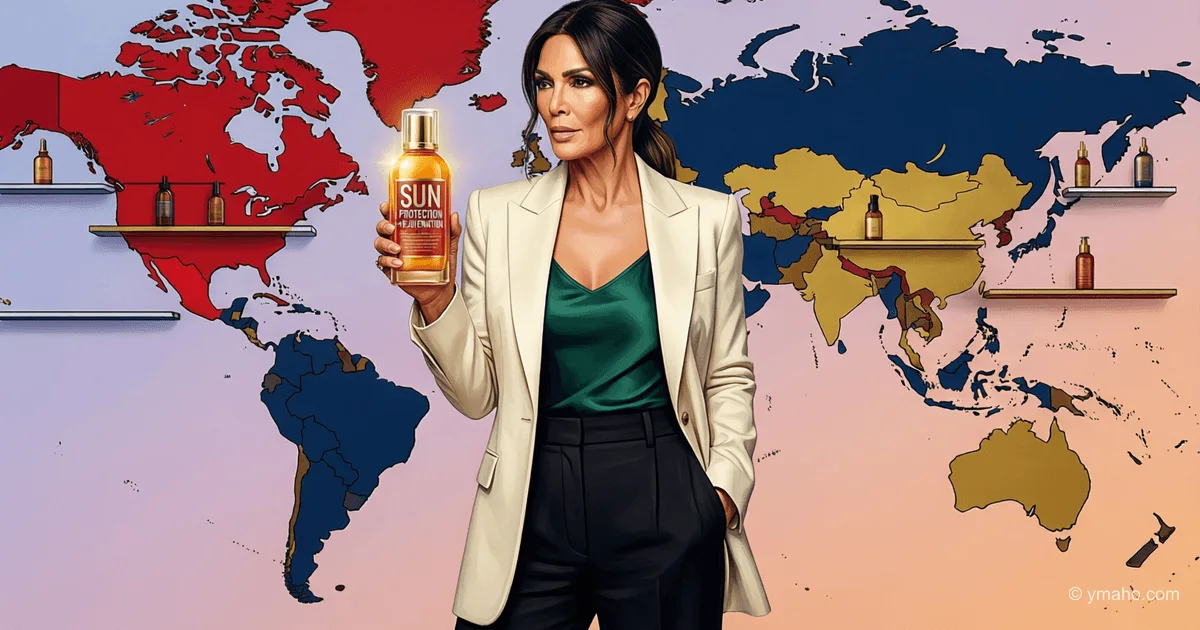
Kris Jenner Causes Global Shortage of Thai Sunscreen
The Kardashian matriarch featured a Thai sunscreen serum in her Instagram Stories, sparking a frenzy among fans. This incident solidified the reputation of Asian skincare as an effective alternative to luxury brands.
Kris Jenner, Thai Sunscreen, and the Quiet Death of the Western Beauty Block
What looks like another influencer whim is actually a documented moment of shifting global power in the billion-dollar industry
I'm writing this on May 24, 2026, and right now, online retailers of Thai cosmetics worldwide are clearing out remaining stock after the 65-year-old matriarch of the Kardashian-Jenner clan wiped out inventory of an unknown brand with a single tap.
But don't be fooled. The Thai sunscreen is not a coincidence. It's a perfect storm that has been brewing for the past five years. Kris Jenner just pulled the trigger.
[The Gist]: What's Really Happening
On May 22, 2026, Kris Jenner posted a photo of her daily skincare routine on Instagram Stories. Among the bottles and jars, a bottle of Thai sunscreen appeared—described as a lightweight serum texture for the body.
Here's what happened next. Not "hype." Not "increased demand." But a complete collapse of supply chains for at least three Thai brands, whose names Western media didn't even bother to publish.
This isn't a story about "Kris Jenner loves Thai cosmetics." It's a story about how Western conglomerates (L'Oreal, Estée Lauder, Shiseido—yes, Japanese, but with global distribution) have kept the sunscreen market on a short leash for years, while Asian manufacturers quietly built factories and waited for their moment.
Timeline and Context
First wave (2024-2025) was subtle. Korean sunscreens (Beauty of Joseon, Round Lab, Skin1004) took over Amazon USA through second-tier influencers. None of the "big family" promoted them, but sales grew 40% quarter over quarter.
Second wave (April-May 2026) became critical. Korean brand COSRX launched its Ultra-Light Invisible Sunscreen SPF50 PA++++ and within four weeks (April 14 to May 8, 2026) claimed the top spot in the sunscreen category on Amazon UK, then on Amazon Germany. It has 4.9 stars on Shopee Thailand and TikTok Shop Thailand based on over 16,300 verified reviews.
Why does this matter? Because Europe is the most conservative sunscreen market in terms of regulation. If an Asian sunscreen is legally sold in Germany and becomes number one there, the barriers have fallen.
Third wave (May 21-22, 2026) — Kris Jenner's post. In fact, she didn't discover Thai sunscreen. She legitimized it for the audience that still buys La Mer and Clé de Peau.
Who Wins and Who Loses
Winners: Thai manufacturers—but not the ones you think.
Euromonitor's May 2026 report shows a paradoxical picture: Beiersdorf Thailand's (Nivea, Eucerin) market share fell from 21% to 19%, Shiseido (Thailand) from 16% to 15%. Traditional leaders are shrinking.
Who's growing? Thai brands that built digital strategies from scratch: Her Hyness and Ingu Skin. They didn't copy Western formats. They created what the industry report calls "clinical positioning with ingredient transparency"—simply put, they list what's inside on the bottle, starting with niacinamide concentration, without marketing fluff.
And yes, COSRX, now leading in Europe, is a Korean brand that simply moved production to Thailand to optimize logistics in Southeast Asia. Taiwan News published their press release on May 19, 2026, as news about "Thailand's leadership." That's globalization in its purest form.
Winners: Consumers in emerging markets.
The reason Western sunscreens lose in Thailand is simple: climate. In Bangkok, the UV index reaches 11+ (extreme level) year-round. Western sunscreens, designed for beach vacations in Nice, just can't handle it—they run, get greasy, and pill.
Thai sunscreens were created for people living in 35°C heat and 90% humidity. Light, watery textures that absorb in 5-10 seconds without stickiness, with collagen, aloe vera, and niacinamide. This isn't vacation skincare. It's everyday skincare.
Losers: Western mass-market brands in Asia.
L'Oreal, Nivea, and Neutrogena are losing ground in their native Asian market because Thai brands have done what Western giants can't: combine SPF50 PA++++ with whitening effects (the cult of fair skin in Asia is still strong) and completely eliminate alcohol, oils, parabens, and talc.
What the Media Isn't Saying
Insight: Kris Jenner didn't "accidentally" show Thai sunscreen. She's part of Coty's quiet war for survival.
In February 2026, Coty announced a $600 million deal with Kylie Cosmetics—Kourtney and Kylie launched joint gummy supplements for skin at €39. And in May 2026, Coty bet on Kylie Jenner with her 270 million followers to attract a younger audience to its brands.
Now connect the dots. Why would Kris Jenner, Kylie's mother and the family's business architect, praise a Thai sunscreen if the family has its own cosmetic lines? The answer is simple: she's testing the market. She's seeing how fast her audience will buy a product she doesn't sell. It's market research with a $0 budget and a sample size of 10 million people.
If the reaction is sufficient (and judging by the shortage, it's more than sufficient), within 90 days you'll see a licensing agreement between Kardashian-Jenner and one of the Thai manufacturers. A fat payday for the Thai factory and another monetization channel for the family.
Second thing they're not saying: the counterfeit problem is already underway.
Thai sunscreens are produced in volumes designed for the local market. Kris Jenner instantly created global demand that Thai factories physically cannot meet. Within 30 days, Amazon, Shopee, and TikTok Shop will be flooded with fakes. Buyers from the US and Europe, who don't know Thai, will buy "Sunscreen Whitening Cream" of dubious origin and end up with burns or allergies.
And who will be blamed? The Thai manufacturer, of course. Though the real culprit is the gap between global marketing and local production capacity.
Forecast: Next 30 Days and 90 Days
30 days: a wave of exposés and warnings from the FDA and European Medicines Agency.
Asian sunscreens use filters (e.g., certain types of oxybenzone) that are either unapproved or in a regulatory gray zone in Europe and the US. When thousands of bottles flood in through parallel imports, regulators will start seizing batches.
Official warnings will be framed as "consumer safety concerns." But the real reason is protecting domestic manufacturers who can't compete with Asian formulas on price and quality.
90 days: a licensing contract between Kardashian-Jenner and a Thai factory.
A deal will be struck. The Thai manufacturer gains access to global distribution and the family's marketing genius. The family gets royalties from every bottle sold under a brand like "Jenner Sun Seoul" or "Kris UV."
Western media will call it an "innovative partnership." Analysts will call it what it is: an admission that the West no longer leads in skincare. Asia creates formulas. The West sells stories.
Business takeaway for those reading between the lines: If you're investing in the cosmetics industry, don't look at brands. Look at manufacturers of active ingredients for Asian sunscreens—niacinamide (DSM, BASF), hyaluronic acid (Bloomage Bio), plant extracts for brightening. They will see guaranteed growth regardless of which brand wins the race.
And if you're just a woman who wants to protect her skin from the sun, buy COSRX on Amazon while it's still in stock. And thank Kris Jenner for accidentally (or not) opening your eyes to the fact that sunscreen doesn't have to feel like sour cream.
— Editorial Team









