Real-Time Laser-Acoustic Imaging to Enhance Safety of Robotic Surgeries
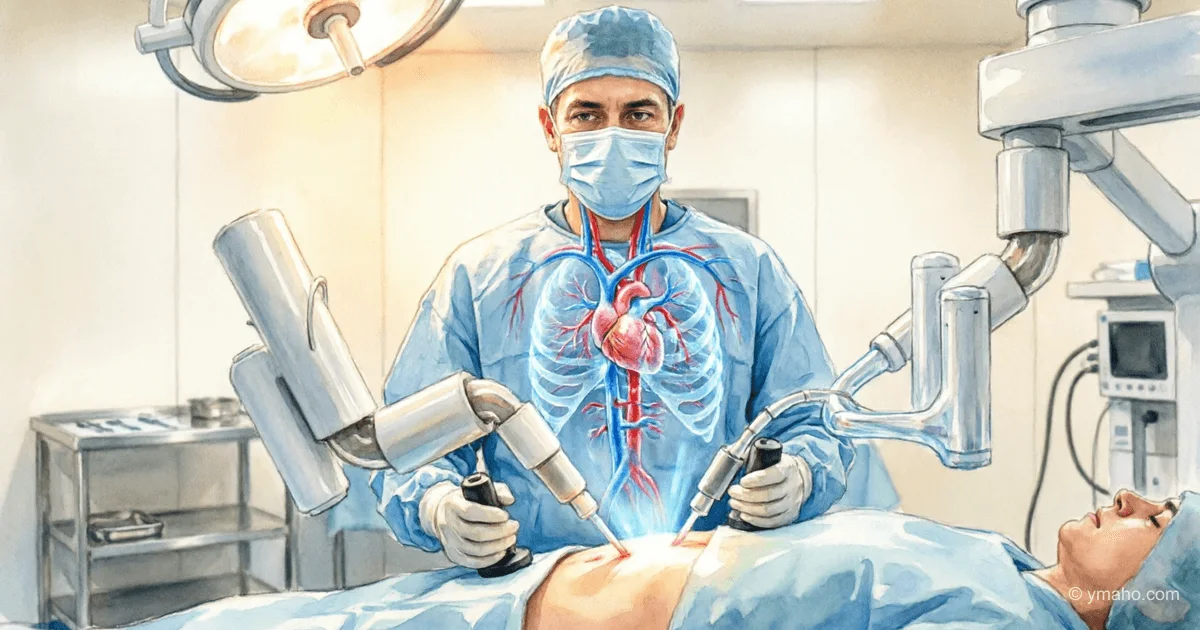
Engineers at Worcester Polytechnic Institute have integrated photoacoustic imaging into laparoscopy. The technology, presented at the ASA congress on May 11, allows surgeons to see nerves and blood vessels hidden beneath tissues in augmented reality, helping avoid accidental damage during operations.
The announcement by engineers at Worcester Polytechnic Institute (WPI) about "laser-acoustic imaging" is not just another engineering novelty. It marks the entry point into the race for sensory retrofitting of all surgical robotics. While headlines are filled with words like "safety" and "augmented reality," the real game revolves around who will supply the "eyes" for the thousands of already installed da Vinci robots and future platforms.
The Core: Not Visualization, but a Control Interface
The formal description of the work seems modest: at the Acoustical Society of America (ASA) congress on May 11, 2026, Kai Zhang's group presented a system integrating photoacoustic (PA) imaging into the laparoscopic workflow. But the essence is not in the PA technology itself—it has been known for decades. The essence lies in the architectural solution that allows overlaying three-dimensional maps of hidden nerves and blood vessels directly onto the laparoscope video stream in real time.
And here is the key point: the WPI team created not just a device, but a control interface over the surgical field. Whoever controls what the surgeon sees controls the movement of instruments. If PA imaging becomes the standard, the manufacturer of this system will gain leverage over all aspects of the operation—from incision planning to insurance protocols.
Timeline and Context
The story did not start in May 2026. The Medical FUSION Lab under Zhang has been publishing results on this topic since 2023. In November 2023, their work appeared in IEEE Transactions on Biomedical Engineering on a miniature optical fiber probe with side illumination. Then came a publication in Biomedical Optics Express on integration specifically with the da Vinci robot. So by the time of the ASA presentation, the team already had a portfolio of verified technological blocks: optical fiber, reconstruction algorithms, AR overlay.
Meanwhile, pressure from the clinic was growing. According to Zhang, the incidence of accidental damage to hidden blood vessels during robotic laparoscopy is 1–2% depending on the procedure. That seems small, but with over 20 million cumulative operations performed by Intuitive Surgical systems alone by the end of 2025, that translates to 200,000 to 400,000 incidents—hemorrhages, paralysis, fatalities.
The market context adds to this: Intuitive Surgical is already transforming from a "hardware" manufacturer into a provider of a surgical ecosystem, including data analytics and digital platforms. Their da Vinci 5 already includes Force Feedback, reducing applied force by 43%. The next logical step is sensory feedback about what lies beneath the tissue surface.
Who Wins and Who Loses
Several parties win. First, WPI itself and Kai Zhang personally—if the patent landscape is clear, the university gains a licensing asset worth tens of millions of USD. Second, Intuitive Surgical, which is likely already negotiating acquisition or exclusive licensing: PA imaging fits perfectly into their "ecosystem" strategy. Third, insurance companies: a reduction in complication rates by 50% or more, as analysts predict for integrated imaging systems, directly reduces payouts.
Losing are manufacturers of alternative intraoperative systems. Fluorescence imaging from Stryker and others is the current standard, but it requires contrast agents and has limited penetration depth. PA imaging requires no exogenous contrast—it uses natural chromophores like hemoglobin. This is a blow to the fluorescence agent market, valued at about 1.2 billion USD.
What the Media Isn't Saying
No one discusses the latency problem. The PA system generates raw data arrays that require immediate processing to build a 3D model. Even a small delay between instrument movement and AR image update creates a risk of surgeon hypercompensation—when movement lags on the screen, the person instinctively amplifies it, which with robotic manipulators can lead to disaster. WPI engineers solved this problem in the lab, but scaling to streaming surgery with tens of thousands of operations is a completely different challenge.
A second non-obvious point concerns training computer vision models. For the AR overlay to work accurately, the system must segment neurovascular bundles in real time. Training such algorithms requires a labeled dataset of in vivo human tissue images obtained under different perfusion conditions, varying depths, and anatomical variations. No such public dataset exists. Whoever controls the training data controls the accuracy of the entire system. If WPI or Intuitive Surgical collects this dataset, they create a barrier to entry for competitors.
Forecast: Next 30 Days and 90 Days
In the next 30 days, I expect WPI to file a new patent application covering the real-time fusion algorithm of PA data with the laparoscope video stream—a key part that may not yet be protected. Simultaneously, Intuitive Surgical will likely intensify negotiations for an exclusive license or outright acquisition of the technology from WPI. The deal size could range from 50 to 150 million USD depending on the stage of patent examination.
In the 90-day perspective, the FDA will announce the start of an Early Feasibility Study program to evaluate PA imaging in robotic surgery. This will be a signal to the market, accelerating investment attraction for companies developing complementary technologies—primarily miniature laser sources and AI segmentation algorithms.
The main forecast: within 90 days, we will see at least one major competitor of Intuitive Surgical (most likely Medtronic through the Hugo program) announce a partnership with a lab working on a similar PA system. The stake in this race is not just improved safety, but control over the "vision" of the next-generation surgical robot. And whoever controls vision ultimately controls instrument movement and surgical outcomes.
— Editorial Team









