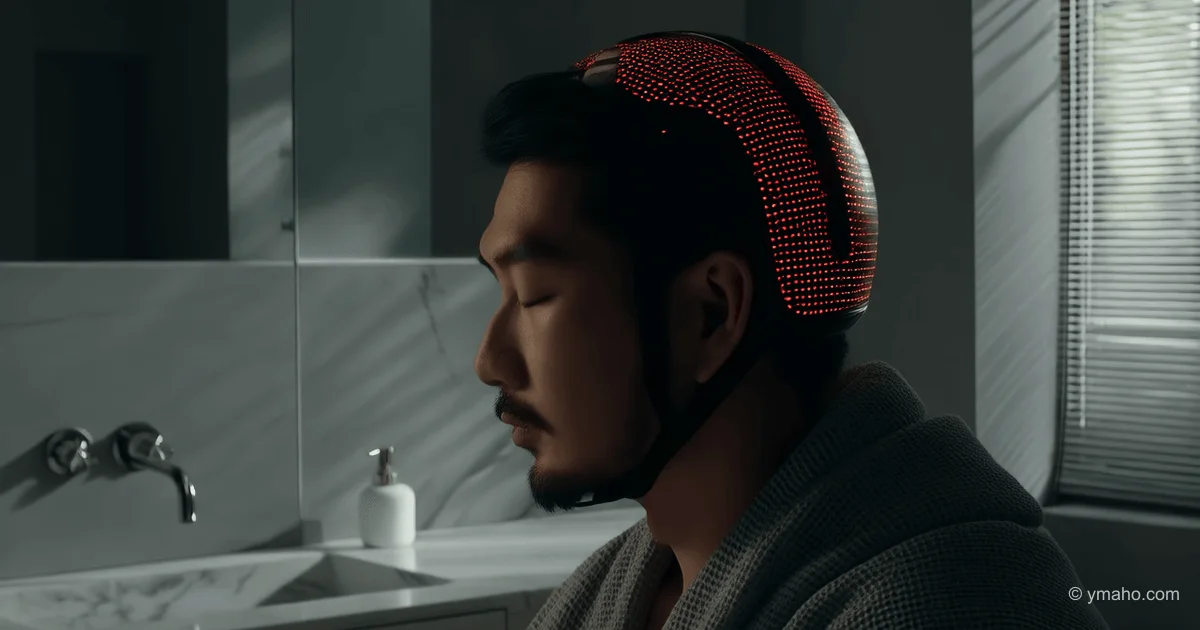
Red Light Therapy Goes Beyond the Face: LED Masks for the Scalp
Manufacturers are expanding their lines of LED devices for hair growth stimulation. The new helmets with red and infrared spectrum are reported to strengthen follicles and speed up recovery after coloring.
The beauty device market is in a frenzy. Just yesterday, an LED face mask was a symbol of high-tech skincare, a gadget for the initiated, willing to sit with a red glow for 20 minutes in front of a mirror. Today, May 13, 2026, the focus has sharply shifted 30 centimeters upward. LED helmets for the scalp are the new hot spot. CurrentBody, Theradome, iRestore, and at least four Asian brands have simultaneously updated their device lines, promising to stop hair loss and revive dormant follicles using red (633 nm) and near-infrared (830 nm) spectra. This is not just a product line expansion. It is a tectonic shift that will rewrite the balance of power in three adjacent industries simultaneously.
The Essence: What Is Really Happening
The market is transitioning from a mask-accessory to a helmet-medical device. The difference is fundamental. An LED face mask is a cosmetic tool working at the epidermal level: stimulating fibroblasts, collagen synthesis, mild anti-inflammatory action. A scalp helmet is a completely different engineering and medical challenge. It requires penetration to a depth of 3-5 mm to reach the hair papilla, where the follicle stem cells reside. This is the domain not of a cosmetologist, but of a trichologist.
What is really happening: a technology that has been refined for decades in clinics for treating androgenetic alopecia has suddenly become portable and relatively affordable. The cost of a clinical course of low-level laser therapy in New York starts at $2,500 for a series of sessions. New home helmets offer a similar light flux density (about 40-60 J/cm² per session) for $600-$900 one-time. Manufacturers omit that effectiveness critically depends on protocol adherence: 25 minutes daily, at least 6 months without breaks. Missing two weeks sets back results by months—follicles lose the accumulated photochemical impulse.
The key technological shift of May 2026 is the emergence of hybrid helmets combining LED with micro-vibration and thermal heating up to 42°C. Vibration solves the problem of tight diode-to-skin contact through hair—the main issue of previous-generation devices. Heat dilates scalp capillaries, increasing local blood flow by 30-40% and enhancing follicle oxygenation precisely during photostimulation. This is not marketing; it is physics.
Timeline and Context
The first home laser helmet, HairMax, received FDA clearance back in 2011. So why the explosion now? Because three factors converged that were not present before.
First—post-COVID hair loss. A Harvard Medical School study published in the Journal of Investigative Dermatology in March 2025 confirmed that 22% of COVID-19 survivors experience telogen effluvium within 3-6 months after infection. That is millions of women worldwide looking for a solution right now. They will not go to a trichologist—they will buy a helmet.
Second factor—semaglutides. The mass craze for GLP-1 agonists (Ozempic, Wegovy) for weight loss triggered a wave of "Ozempic hair loss"—sudden diffuse thinning due to body stress from rapid weight loss. An audience paying $1,200 a month for the drug is ready to add $800 for a helmet to keep their hair.
Third factor—beauty salon economics. An LED scalp procedure in a salon costs $90-$150 per session. A course of 24 sessions is $2,160-$3,600. A home helmet for $700 pays for itself in 5-8 sessions. Consumer arithmetic is relentless, and salons feel it.
Who Wins and Who Loses
Winners: LED manufacturers. Nichia Corporation, controlling about 40% of the global medical LED market, ramped up production of 830 nm diodes by 60% in the last quarter. Winners: contract manufacturers in Shenzhen churning out housings for dozens of new brands. Winners: trichologists receiving a flow of patients who "already bought a helmet but want to know if they are doing it right."
Losers: beauty salons and spas. They are losing one of their most profitable procedures. If a client buys a helmet for home, they will not return for a course of 12 sessions. Losers: manufacturers of minoxidil and finasteride—some patients will try to replace pharmacology with phototherapy. Clinical data show that LED+minoxidil combination is 35% more effective than monotherapy, but consumers do not know this and often choose "no chemicals."
Also losing: professional salon hair care brands like Kerastase and Oribe. Their restoration rituals are built on serums applied by a stylist. The helmet changes behavior: now the ritual happens at home, and the client chooses what to apply under the helmet. This opens a window for pharmacy and mass-market brands that previously could not compete in the salon segment.
What the Media Are Not Saying
The media paint a picture: "put on the helmet and your hair will sprout." Reality is far more nuanced, with three uncomfortable facts.
First: LED therapy does not work for scarring alopecia and advanced stages of androgenetic alopecia where the follicle has been replaced by connective tissue. Analysis of reviews on Amazon and Dermstore shows that 30-40% of negative ratings are related to this—users with irreversible hair loss bought the device without a diagnosis. Manufacturers are not interested in loudly warning about this.
Second: phototoxicity when using essential oils. The trend for natural care has led women to apply rosemary, peppermint, tea tree oils to the scalp and then put on an LED helmet. Some components of essential oils are photosensitizers—under intense light they generate free radicals, causing the opposite effect: oxidative stress on the follicle instead of stimulation. No helmet manufacturer includes such a warning on the packaging.
Third, the most non-obvious insider point: the problem of "shadow zones." The design of most helmets assumes uniform distribution of diodes over a hemisphere. But the human head is not a perfect sphere. The occipital area, temples, crown receive different irradiation density. The difference can reach 40%. This means that a user who does not adjust the helmet fit may get uneven stimulation: effect on the temples, placebo on the crown. Engineering teams of three major brands are currently working on systems with contact sensors, but commercial launch of such helmets is at least 8 months away.
Forecast: Next 30 Days and 90 Days
In the next 30 days, Amazon and Wildberries will be flooded with first-generation models priced from $199. These will be devices with insufficient diode density (less than 100 LEDs per helmet) and power below 20 mW/cm². They will cause disappointment and a wave of returns. Summer sales will clear warehouses but damage the entire category's reputation.
In the next 90 days, by August 2026, the market will sharply segment. Low segment ($199-$299): devices with low diode density sold as "preventive" and essentially placebos. Mid segment ($600-$900): helmets with clinically proven power, FDA Class II certification, warranty, and a tracking app. Premium ($1,400-$2,000): devices with AI cameras analyzing the scalp before and after, individual zone calibration, and integration with telemedicine trichologist consultations. The gap between segments will widen, and reputational damage from cheap devices will drag down the entire category.
The most important forecast: in 90 days we will see the first patent conflict. LED scalp helmet technology is protected by several patent families, including HairMax (Lexington International) patents on diode distribution design. When the market grows to $2.5 billion—and it will by early 2027—patent holders will aggressively defend intellectual property. The first lawsuits will halt sales of several Chinese brands in the US, causing a temporary shortage in the mid-price segment that European manufacturers will try to fill.
The LED helmet market is not hype; it is a long-term structural shift in hair care. But like any shift in its early stages, it will be accompanied by disappointments, reputational losses, and margin redistribution. The winner will be the one who not just sells hardware but builds an ecosystem: diagnosis—device—tracking—telemedicine. And the first outlines of such an ecosystem will appear this fall.
— Editorial Team









