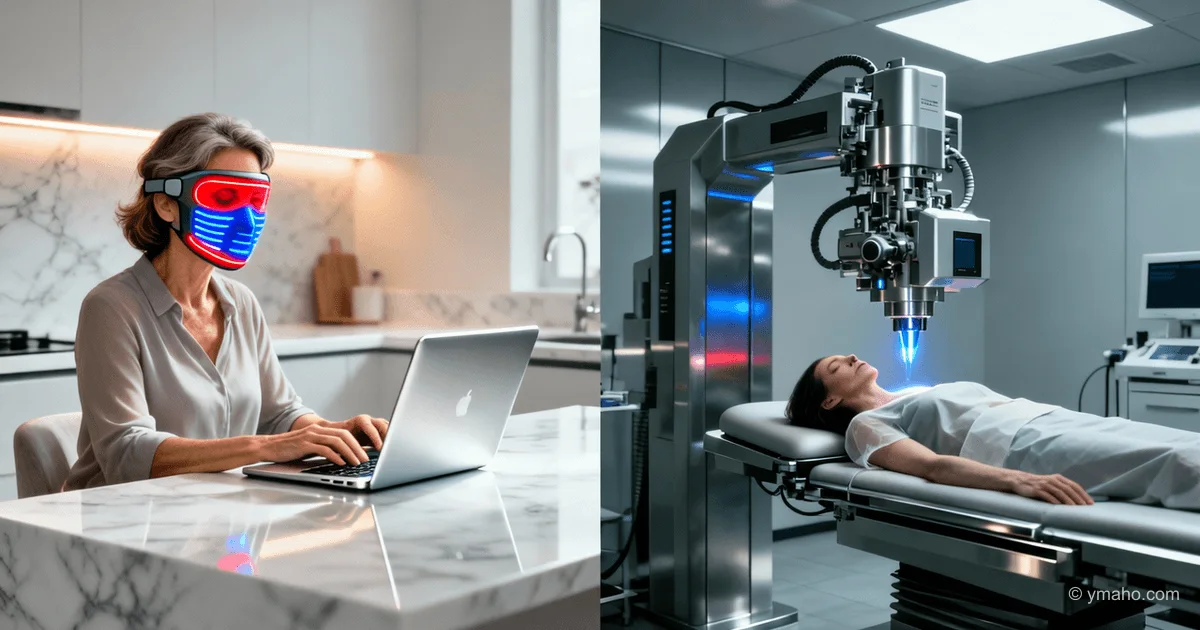
LED Masks and Microcurrents: Home Anti-Aging Gadgets Become a Daily Staple
After 40, beauty editors are switching to high-tech home care: Byrdie's daily recommendations include the Megelin Duo-Lux LED mask for fighting wrinkles and inflammation, as well as an LED gua sha for facial sculpting. The focus is on device comfort and laser zoning for different types of age-related changes.
The Gist: Home Medicine vs. Professional Cosmetology
Byrdie's recommendations featuring the Megelin Duo-Lux LED mask and LED gua sha are not just an upgrade to home care. They represent the final stage of medical aesthetics being taken over by consumer electronics. A paradigm shift is occurring: women over 40 are no longer patients of a cosmetologist but operators of their own physiotherapy rooms. The market, estimated by analysts at $1.2 billion by the end of 2026, is growing not due to innovations in LEDs but due to a collapse of trust in injectable methods.
The key driver is fatigue with the "cosmetologist face." After a decade of aggressive fillers and botulinum toxins, consumers see hypercorrection and gel migration around them. A home gadget promises control: you decide when to stop. It's not about beauty; it's about autonomy.
Timeline and Context: Why Now
The first home LED masks appeared back in 2018 with the Dr. Dennis Gross SpectraLite FaceWare Pro at $435. But then they were a niche product for geeks. The turning point came in 2024-2025 when the FDA approved several devices for home use with clinically proven efficacy. Masks with flexible designs (CurrentBody Series 2 for $469) and combined gadgets integrating radiofrequency, LED, and microcurrents in one unit emerged.
The Megelin Duo-Lux, featured in Byrdie's recommendations in May 2026, is a logical continuation of this trend. The manufacturer bet on zoning: the forehead gets one wavelength for wrinkles, the cheeks another for inflammation. But the main thing is wearing comfort. Women over 40 are not willing to lie flat for 20 minutes. They demand hands-free solutions: put on the mask, check email, take it off. Ergonomics, not diode power, has become the battlefield.
Winners and Losers
The winners are contract manufacturers in Shenzhen. The cost of an LED mask in the mid-price segment is $18-25, while the retail price is $250-350. Margins exceed 90%. This explains the avalanche of new brands: in 2025, over 120 new LED devices launched on Amazon, most with identical internals and different marketing.
The losers are mid-tier cosmetology clinics. An LED therapy session in a clinic costs $80-150 per session. A course of 10 sessions costs $1200-1500. The Megelin Duo-Lux home mask sells for $280. Consumers quickly calculate: five visits to the cosmetologist or a gadget for a year of daily use. The choice is obvious. Clinics lose not just a procedure but traffic: LED therapy was the "entry ticket" for introducing other services. Now the patient doesn't come at all.
What the Media Isn't Saying
Non-obvious insight: LED mask manufacturers deliberately ignore the problem of battery degradation. Lithium-ion batteries in these devices lose 20-30% capacity after 180-200 charge cycles. The reduction in LED power is invisible to the eye but critical for collagenogenesis. Fibroblasts require a precise irradiation dose: 4-6 J/cm² for the red spectrum at 633 nm. When current drops by 25%, you're just warming your face without therapeutic effect.
No brand specifies battery lifespan in marketing materials. Consumers think the mask works for two years, but in reality, after 8-10 months it turns into an expensive selfie accessory. This is planned obsolescence in an industry masquerading as medicine.
The second omission: the LED gua sha mentioned by Byrdie is a conceptually contradictory product. Gua sha requires mechanical sliding over the skin with oil. LED irradiation is effective only with static contact on the surface. When you move the device, exposure time at each point drops to 1-2 seconds. That's insufficient to trigger photobiomodulation. You're paying $120 for a massage with a pretty light.
Forecast: Next 30 Days and 90 Days
In the next 30 days, expect counter-marketing from professional associations. The American Academy of Dermatology (AAD) will release a statement on the risks of uncontrolled use of LED devices while taking photosensitizing drugs. The pretext is ready: increased cases of hyperpigmentation in women combining home LED masks with doxycycline. This is an attempt to bring the procedure back under medical supervision.
Within 90 days, market segmentation will occur. A premium category of "smart" masks with current sensors and app feedback will emerge. Prices will rise to $650-800. Brands like Omnilux and Dr. Dennis Gross will introduce masks with automatic dose calibration based on skin tone (melanin absorbs light, changing the effective dose for deep layers). Simultaneously, price dumping from AliExpress will happen: masks with identical specs to the Megelin will go for $40-60. Consumers will face a choice: overpay for service or risk it with an untested manufacturer.
The home anti-aging gadget market has entered the stage that smartphones went through in 2010: functionality is almost the same, the difference is only in marketing and ecosystem. The winner will not be the one with more powerful diodes, but the one who first patents a system for monitoring real irradiation dose and turns skincare into quantified self for the skin.
— Editorial Team









