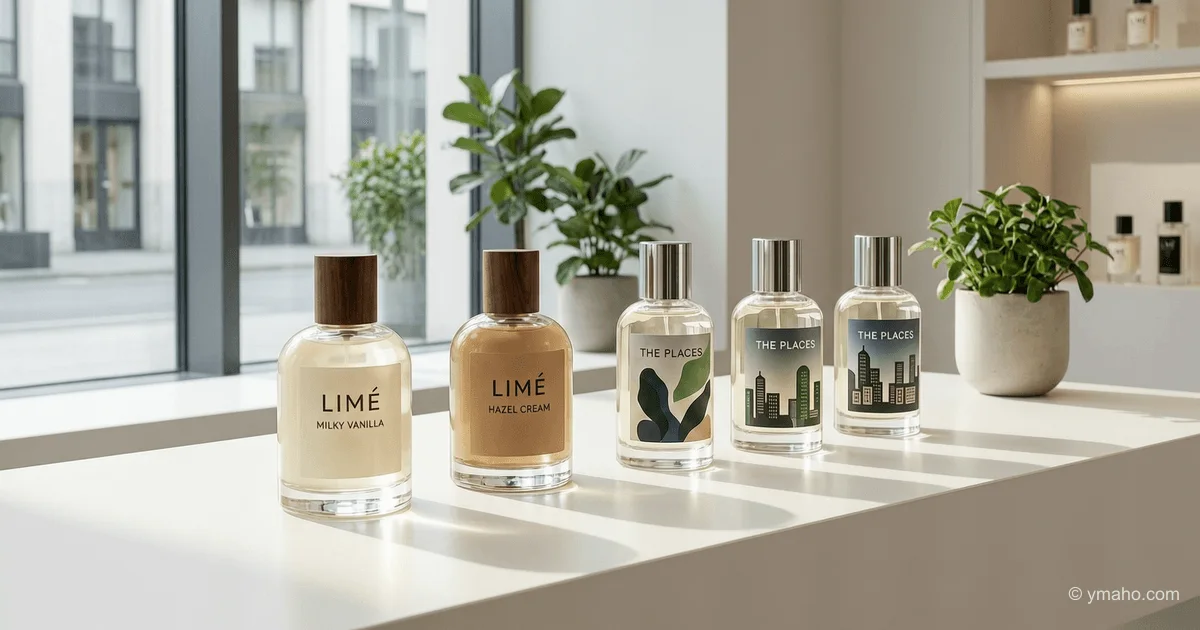
Perfume Brand LIMÉ Launches New Women's and Unisex Fragrances
The Essentials collection expands with gourmand Milky Vanilla and fruity-floral Hazel Cream, while the complex unisex fragrance line The Places adds three new compositions inspired by nature and cities.
Gourmand grab and unisex maneuver: How Lime is rewriting the rules of the perfume game
The Gist: What's Really Happening
At first glance, the launch of five fragrances by Russian fashion retailer Lime is a local story, worthy of a line in a weekly beauty editor newsletter. But from an insider perspective, it's a statement about a massive strategic overhaul. Lime is not just a "perfume brand" or even just a "clothing brand that makes perfumes." It's a vertically integrated machine that posted an operating profit of RUB 12.8 billion in 2023, now using its capital, a logistics network of over 100 retail stores, and mass retailer instincts as weapons for an aggressive grab of the perfume shelf. And these weapons are aimed at the hottest spot in global perfumery in 2026: the gourmand and unisex segment.
The limited-edition line is merely a pretext for entering the global market story, whose volume is estimated at $64.47 billion by 2026. And given the dynamics of the niche segment, which is projected to grow to $4.85 billion in 2026 with a potential of $14.79 billion by 2035, every spot on the beauty shelf today is a bet on tomorrow's billions.
Timeline and Context
Lime's roadmap has been built sequentially: from the brand's founding in Samara in 2008 to the launch of its perfume line in 2025. Now, in early May 2026, we see the second wave—precisely hitting two major global vectors. The first is gourmand fragrances (Milky Vanilla and Hazel Cream), which, according to industry analytics, account for nearly 42% of consumer preferences in modern perfumery. The second is unisex, here realized through the lens of a sophisticated destination concept (The Places line).
The context of the gourmand boom cannot be separated from a macro trend: sales of perfumes to consumers using GLP-1 drugs (such as Ozempic) grew by 23% in the US in 2025. Food is losing its power as a source of sensory satisfaction—compensatorily, demand for "edible" scents (vanilla, caramel, chocolate) is rising. By launching Milky Vanilla, Lime is riding not just a trend but a compensatory mechanism spawned by the pharma industry.
Simultaneously, the Russian market is restructuring, where domestic brands have captured 45% and show 40% demand growth in monetary terms. Delivery of fragrances from the UAE, broken logistics chains with Europe, and growing requirements for formula stabilization in local aggressive environments have all led local players to stop competing with global catalogs and instead move to custom formula development and building their own ecosystems.
Who Wins and Who Loses
The most obvious beneficiary is Lime itself. With a physical retail network of 100 stores where consumers come for jeans and dresses, the company can afford a luxury unavailable to pure niche players or multinational corporations: a free offline showcase with direct "scent-body-clothing" communication. The cost of contact with a fragrance in a clothing store is an order of magnitude lower than renting a corner in a department store or promoting through bloggers, allowing retail prices to stay in a neutral zone while clearly explaining to the buyer why this is "affordable luxury."
Major gourmand ingredient manufacturers (Givaudan, Firmenich, IFF), which control nearly 80% of the global fragrance market, benefit in the short term from every new brand betting on vanilla, cream, and caramel. Demand for key gourmand profile molecules is skyrocketing.
However, traditional luxury houses, accustomed to the "cult flanker every two years" model, lose out. In 2026, the prestige of Dior or Chanel is no longer enough—58% of buyers say their choice is driven by a desire for emotional warmth and comfort, not status display. The speed at which fashion retailers like Lime can test, launch, and kill trends prevents conservative brands from maintaining their usual positioning. Their limited collections come out with a 12-18 month delay, and such a lag in the influencer economy is akin to death.
Independent Russian perfumers, who have built niche reputations over years, also lose. When a retail giant enters the market with three complex unisex fragrances "in the spirit of nature and cities" at a dumping price, a marginal niche producer can only fight for remaining audience, not expand the funnel.
What the Media Isn't Saying
First insider insight. Lime's perfume launch is not so much about olfaction as it is about solving a logistics problem. The fashion retailer has long grappled with where to put excess shelf space and how to get customers to visit not once a season but once a month. Clothing, even trendy, is a product with a long consumption cycle. Perfume, especially gourmand, is a product of quick emotional release with a repurchase cycle comparable to skincare.
Add to that Lime's announced plans to create a home goods line "similar to Zara Home." Fragrances become a key element in building a lifestyle ecosystem: a gourmand candle at home, the trail of Milky Vanilla on clothes, a linen spray with hazelnut notes. The global gourmand perfume market was valued at $35.19 billion in 2025 and is projected to reach $45.34 billion by 2032. By grabbing shelf space now, Lime is aiming for a cross-category empire.
Second insight: the ingredient strategy is fundamentally different from what is declared. The press release talks about "complex unisex fragrances inspired by nature and cities." But more telling is the choice of the gourmand pair: Milky Vanilla and Hazel Cream. The modern trend toward unisex in gourmands is not a rejection of gender stereotypes but a way to maximize audience. A vanilla scent doesn't need to be labeled "for him" or "for her": it hits the emotional need of a teenager, a man, and a woman over 45.
The words "milky vanilla" and "hazelnut cream" are hyper-stimuli, similar in effect to ASMR content: they promise safety, edibility, childhood. In a world where 52% of new products include unique ingredient pairs or sustainable elements, gourmand becomes the main bridge between consumer and brand. Lime understands this better than others.
Third insight concerns formula logistics. The Russian market faces imported formulas behaving unpredictably in local aggressive bases (high surfactant and acid content). Lime, as a major local player with centers in Samara, Moscow, and Dubai, gains access to expertise that stabilizes the fragrance in the desired environment without note collapse during scaling. This provides a production advantage unattainable for small importers and is a silent technological victory that the press release simply had to omit.
Fourth point: sensory compensation. The 2026 trends record the phenomenon of "edible" scents as a substitute mechanism against the backdrop of appetite suppression (GLP-1 boom). Milky Vanilla and Hazel Cream are not just pleasant smells but a highly accurate response to a global shift in sensory consumption, allowing compensation for skipping dessert without waistline consequences.
Forecast: Next 30 Days and 90 Days
30 days (by June 7, 2026). The new Lime line will sweep through social media: the retailer uses its own retail as a sampling platform. A surge of reviews, comparisons with iconic gourmand bestsellers (likely Vanilla Diorama or Gentle Fluidity Gold). Organic UGC will begin, fueled by the fact that in an era of scarce affordable luxury, any notable launch is discussed more intensely. Perfume category turnover will spike, and key distributors will record increased orders for the gourmand family block, signaling that Milky Vanilla is becoming for Lime what Tobacco Vanille was for Tom Ford.
90 days (by August 7, 2026). If the wave doesn't fade, a third phase will follow: converting the unisex line into "capsule collections" rotating every 5-6 months, typical of fast fashion. First attempts to scale beyond own stores into chains like Zolotoe Yabloko will cement the trend. By the end of summer, price and assortment calibration will begin, and competitors (similar fashion players) will urgently try to create their own gourmand-unisex lines, realizing the window of opportunity is closing. On the scale of the global gourmand market, growing to $45.34 billion by 2032, the Russian Lime case will become a notable precedent of how structural market changes (exit of some players, logistics transformation) create space for new formats.
Final conclusion: this launch is not about five bottles. It's a demonstration of how fashion retail, armed with a retail network and production flexibility, is intercepting from classic perfume houses the right to dictate trends. In an era of sensory hunger and emotional compensation, the winner is not the one with the loudest luxury label, but the one who can provide an instant response to the need for comfort. Lime does exactly that—and does it with a production scale that competitors cannot yet replicate.
— Editorial Team









