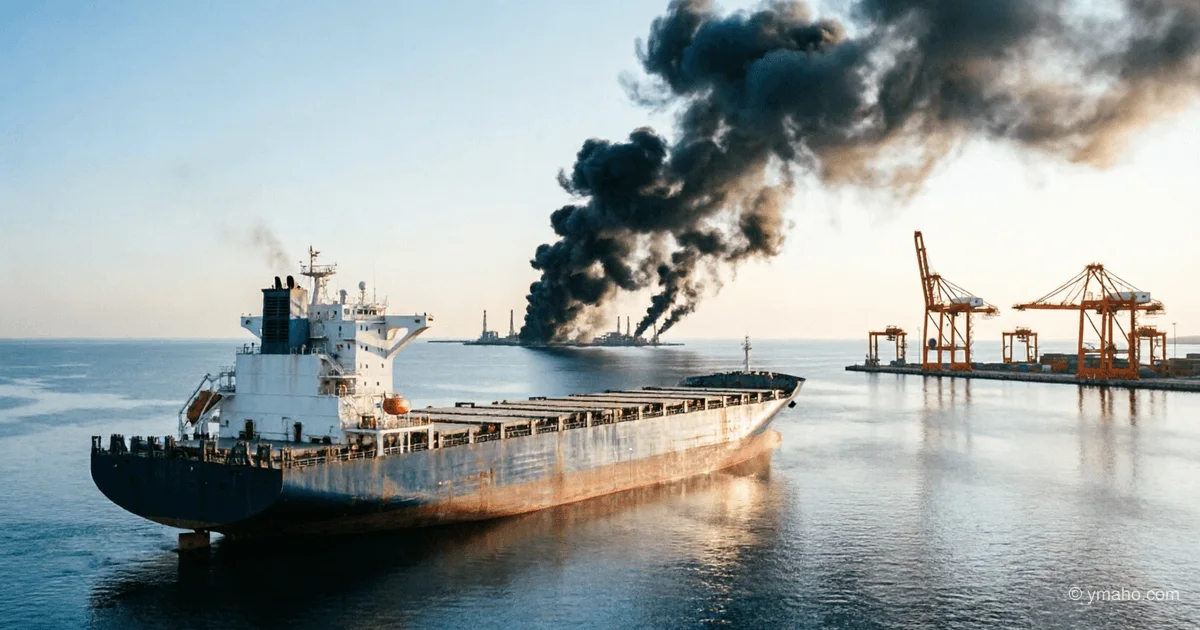
Escalation in the Strait of Hormuz and Iranian Strikes Trigger Logistics Collapse in the Region
Ship insurance costs have surged 12-fold, airlines are canceling flights, and the world's largest container carrier Maersk has suspended cargo acceptance to Persian Gulf countries.
Logistics Collapse in the Persian Gulf: How the Blockade of Hormuz Is Strangling Global Trade
Introduction
The Strait of Hormuz, a narrow artery about 50 kilometers wide through which approximately 20% of global oil supplies and 20% of liquefied natural gas pass, has virtually ceased functioning since February 28, 2026, when the US and Israel launched a military operation against Iran. In response, Tehran announced a blockade of this strategic shipping route.
By early May 2026, the transport collapse in the region had reached proportions unseen since the oil crisis of the 1970s. Ship insurance costs have skyrocketed to 8% of the vessel's value — 12 times or more above normal levels. The world's largest container carrier Maersk has suspended cargo acceptance to Persian Gulf countries. Airlines are canceling flights. Global energy prices are hitting records, and economists are talking about the "largest oil supply shock in modern history."
The crisis in the Persian Gulf is no longer a regional conflict — it is a blow to the global trading system with cascading effects from ports in Malaysia to the shelves of European supermarkets.
Event Details and Timeline
Day One — February 28, 2026. In response to US-Israeli strikes on Iranian territory, Tehran plays its main geopolitical trump card — the threat to block the Strait of Hormuz. From this moment, shipping through the strait, which normally sees about 120 vessels per day, virtually ceases.
First Week of March — Shock to Shipping. From March 1 to April 8, only 315 vessels passed through the strait — a traffic drop of over 93%. The insurance market reacts instantly: seven key members of the International Group of P&I Clubs simultaneously withdraw insurance coverage for voyages through Hormuz, warning of coverage cancellation from March 5.
Early March — Maersk Stops Accepting Cargo. On March 5, the world's largest container operator issues an emergency notice: temporary suspension of cargo acceptance to the UAE, Oman (except Salalah), Iraq, Kuwait, Qatar, Bahrain, and the Saudi ports of Dammam and Jubail. Exceptions are made only for critical food and medical supplies.
March-April — Crisis Spreads. By mid-March, the crisis spreads from maritime transport to aviation and ground transport. Attacks on Dubai and Abu Dhabi airports, damage to fuel infrastructure. KLM Royal Dutch Airlines announces on April 29 an extension of flight suspensions to Dubai until June 22, and to Dammam and Riyadh until June 14.
April — Overload of Alternative Routes. Container flows redirected away from the Persian Gulf overwhelm transit ports in Southeast Asia. By late April, Port Klang in Malaysia begins refusing vessels bound for the Middle East due to capacity collapse.
May — Protracted Crisis. Even with a hypothetical reopening of the strait, insurance will remain expensive for months. Pentagon estimates: clearing the fairway of mines could take up to six months.
Impact and Significance (for the World / Industry / Society)
Insurance: From 0.25% to 10% of Vessel Value
The insurance crisis has become the "invisible killer" of global trade. Before the conflict, the war risk premium was 0.2-0.25% of the vessel's value. Today, according to analysis of global ports, rates have risen to 1-3%, with some quotes reaching 7.5-10%.
Staggering numbers: For a tanker worth $138 million, the usual war risk premium was about $345,000. Today — potentially up to $14 million. A 40-fold increase.
As one London Lloyd's broker put it: "Our reinsurers have simply fled." The terms, if insurance is even available, have become draconian: renewal every 7 days, requirement for armed escort, flag state approval, policy validity of just 48 hours.
Maersk and Maritime Shipping: Complete Halt
Maersk's decision on March 5, 2026, was a turning point. The company suspended cargo acceptance to the UAE, Oman (except Salalah), Iraq, Kuwait, Qatar, Bahrain, and the Saudi ports of Dammam and Jubail. Refrigerated cargo, dangerous goods, and oversized shipments were banned. Exceptions only for critical food and medicine.
Simultaneously, Maersk rerouted its ME11 (Middle East-India-Mediterranean) and MECL (Middle East-India-US East Coast) services around the Cape of Good Hope — a route that adds weeks and tons of extra fuel.
By mid-March, Malaysian ports began refusing cargo. Tanjung Pelepas and Port Klang, receiving redirected goods, became overwhelmed by coinciding urgent shipments from Australia and New Zealand.
Air Freight: Skies Closed
By late April, the situation in the air became nearly as dramatic as at sea. On April 29, KLM announced an extension of flight suspensions to Dubai until June 22. Other airlines followed suit. As of April 22, 42 flights had been canceled and 87 delayed in the region alone.
Most affected airports:
- Sharjah (UAE): 14 cancellations, 8 delays
- Dubai (UAE): 4 cancellations, 34 delays (the world's largest hub is choking)
- Cairo (Egypt): 9 cancellations, 12 delays
- Qatar: 1 cancellation, 16 delays
- Jeddah (Saudi Arabia): 2 cancellations, 15 delays
Direct consequence: about 25% of air cargo capacity on the China-Europe route, which normally transits the Middle East, is at risk.
Economy and Industry: Hidden Effects
Cascading consequences extend far beyond logistics. Russian Prime Minister Mikhail Mishustin on April 7 presented a frightening picture of global damage:
- Energy: About 10% of global liquid hydrocarbon production was instantly taken offline.
- Fertilizers: About 40% of global urea exports halted; prices in some markets more than doubled.
- Industrial raw materials: Up to half of global sulfur supplies (metallurgy, batteries, electronics) at risk.
- Helium: Global supply reduced by nearly a third — affecting medical MRI scanners, semiconductor production, AI systems, and advanced scientific research.
- Consumer goods: Arab supplies of naphtha and liquefied petroleum gases reduced, hitting the plastics market.
Reactions of Key Players
Maersk and Shipping Lines. Maersk introduced a "each vessel, individual decision" regime. For cargo already in transit, the company began rerouting for temporary storage at ports in the region to avoid overloading key hubs like Salalah. Existing bookings not yet shipped will be canceled.
London Insurance Market (Lloyd's). Lloyd's brokers report: "The risk is too high; our reinsurers have fled." Many simply refuse underwriting rather than raise rates. Those who remain require armed escort, flag state approval, and renewal every 7 days.
US Government responded with an unprecedented step. President Trump publicly stated that US military would escort vessels and that the federal government would provide insurance coverage if it cannot be obtained through normal channels.
Shippers and Exporters. According to Ti Insight, companies are shifting to multimodal routes. For example, ports and airports in the UAE and Oman on the eastern side of the strait remain open (though under attack), and goods can be trucked across the border. Saudi ports on the Red Sea (Jeddah, King Abdullah Port) operate via pipeline and trucking from the Persian Gulf.
Forecast and Conclusions
Mine Clearance Will Take Months
Even if hostilities cease, the Strait of Hormuz will not open the next day. US military officials estimate that clearing the fairway of mines could take up to six months due to uncertainty about the number and location of explosives.
Insurance Will Remain Expensive for a Long Time
Oscar Seikaly, CEO of NSI Insurance Group, explains the fundamental problem: "The market can insure volatility, but it cannot insure uncertainty." Underwriters need predictable rules of the game — a stable ceasefire regime without attacks and vessel seizures. This means that even with an official reopening of the strait, the economics of shipping through Hormuz will remain structurally more expensive throughout the recovery period.
Domino Effect on Global Inflation
Marco Thiemann of LBB International warns: rising maritime transport costs are the first sign of inflation that will then hit raw material prices and ultimately consumer prices. Since about 80% of global trade is carried by sea, the impact will not be limited to a few individual goods.
Experts believe that importers and manufacturers will be the first to suffer from rising delivery costs — and consumers will feel the full impact if the situation persists.
Largest Energy Shock in Modern History
The International Energy Agency (IEA) characterized the current disruption as the largest oil supply shock in modern market history. Some 7-10 million barrels per day of OPEC+ production were instantly taken off the market.
Conclusion
The logistics collapse in the Persian Gulf in 2026 is not a temporary anomaly but a systemic crisis that has demonstrated the fragility of global supply chains. Even if hostilities cease today, restoring normal trade will take months: clearing the strait of mines, bringing insurers back to the market, clearing congested transit ports, and rerouting.
The world has faced a harsh reality: one narrow strait, one conflict, one country with the ability to block it — and the entire global economy, from gas prices at the pump to the availability of chips in smartphones, becomes a hostage. The consequences of this crisis will be felt for a long time, even when (and if) the guns fall silent.
— Editorial Team









