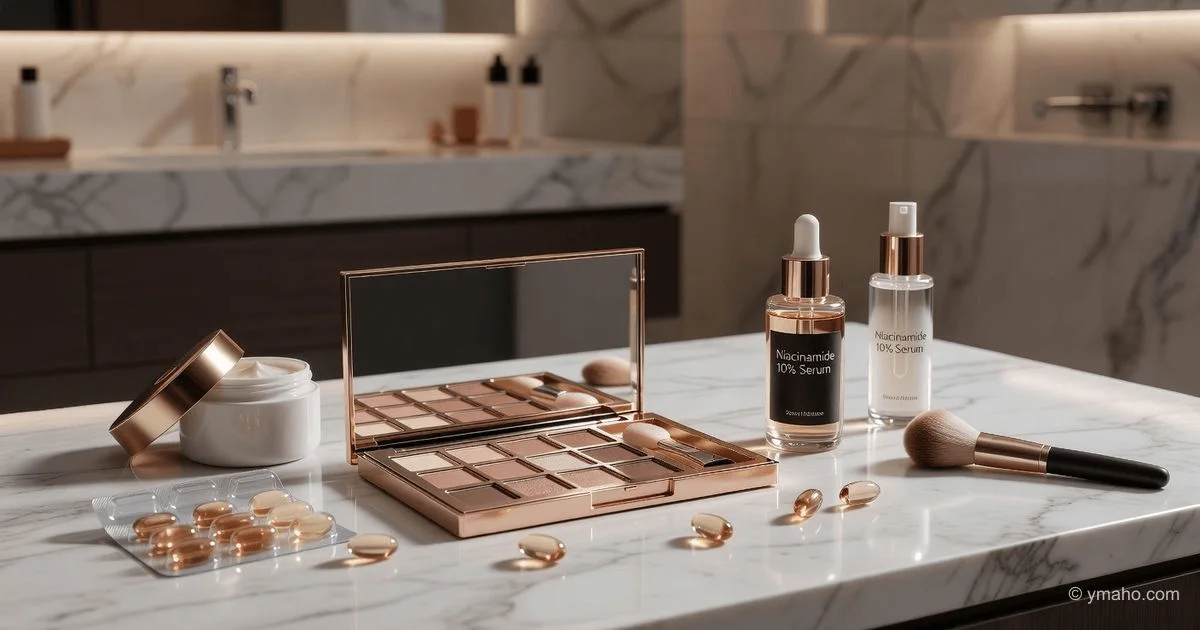
Makeup Merges with Skincare: Tinted Moisturizers and Eyeshadows with Therapeutic Effects
The new generation demands multifunctionality: foundations now care for the skin, and eyeliners stimulate lash growth. The traditional divide between "cosmetics" and "skincare" is rapidly disappearing.
The news of makeup merging with skincare sounds like another harmless story about "hydrating foundations" and "eyeliners with peptides." But if you read what DIDN'T make the headlines, the picture is completely different. This isn't product evolution—it's a power shift between industry giants, triggered by a legal deadlock and massive sums of money sitting in the "gray zone" between cosmetics and medicine.
[The Core]: What's Really Happening
This isn't about foundation now caring for the skin. It's about the industry finding a way to bypass regulators and decades-old definitions. The traditional division was simple: cosmetics beautify or cleanse, medicine heals. The bridge was "cosmeceuticals"—a term coined by marketers and not recognized by the FDA. Now the bridge has collapsed, and there are no boundaries left.
Why is this happening now? By 2026, the hybrid makeup market has grown to $27-28 billion and continues to grow at a CAGR of over 6%. The money isn't just big—it's comparable to the budgets of small nations. But the real storm isn't caused by money; it's regulation. In January 2026, the FDA updated labeling rules, tightening requirements for claims. A product that promises to "treat acne" is a drug. A product that "hydrates and covers acne" is technically a cosmetic. The line has thinned to the size of a molecule. And brands are rushing into that gap.
Timeline and Context
2024-2025: Explosion of BB/CC cream formats in the West. Korean brands, which have been producing such products for decades, see a 174% year-over-year sales increase on platforms like Lookfantastic. Meanwhile, social media—TikTok and Instagram—become the main driver of the "skininification of makeup" trend.
Early 2026: Studies emerge clinically proving the effectiveness of dual-purpose formulas. One shows that a serum-lotion with Tripeptide-29 increases hydration by 72.5% over 4 weeks. But such studies are funded by manufacturers, and their design rarely meets evidence-based medicine standards.
February-March 2026: Major analytics firms (ResearchAndMarkets, GlobalInfoResearch) publish reports estimating the hybrid makeup market at $27.4 billion by 2030. Key drivers: Generation Z's demand for efficiency and the merging of beauty rituals with wellness habits.
April-May 2026: Mass media picks up the theme "makeup merges with skincare." This very publication triggered our discussion.
Who Wins and Who Loses
Winners:
Large corporations like L'Oréal, Estée Lauder, Shiseido. They have R&D budgets for clinical trials, allowing them to put niacinamide in a foundation and claim "barrier strengthening" without risk of lawsuits. The cost of error is minimal for them, while the gain is capturing the niche between cosmetics and dermatology.
Korean and Japanese brands (Laneige, Biodance, Anua)—historical leaders in BB/CC formats. They gain legitimacy in the West, where they were once seen as exotic.
Losers:
Pure "decorative" brands without access to expensive ingredients. A classic $12 lipstick vs. a "lipstick with hyaluronic acid" for $25 loses in the eyes of consumers, even if the difference in effectiveness is zero.
Dermatologists and public health experts. Their voices are drowned out by beauty bloggers promoting "therapeutic makeup" without regard for evidence.
Consumers with real dermatological issues. Rosacea or acne require treatment, not a foundation with niacinamide. But marketing convinces them otherwise.
What the Media Isn't Saying
First non-obvious insight: The merger of makeup with skincare benefits the manufacturer, not the consumer. Why? The cost difference between a jar of moisturizer and a jar of foundation with the same "hydrating complex" is $2-3. But the retail price difference is $15-30. The margin on a hybrid product is 40-60% higher than the sum of "cream plus foundation separately." Brands aren't combining products—they're selling you two for the price of three.
Second non-obvious insight: Claims of "clinical effectiveness" for decorative cosmetics are almost always fiction. Studies are conducted on 30-50 women over 4 weeks. Sample representativeness is near zero, the design is open-label, and no placebo is used. But legally, the brand is protected: it doesn't call the product a drug; it says "improves skin appearance." And the consumer reads "heals." This is a deliberate exploitation of a semantic loophole.
Third omission: Ingredients in hybrid formats are often in inactive forms or are degraded by pigments. Retinol in foundation oxidizes in light within 2-3 weeks after opening. Niacinamide loses activity when in contact with metal oxides in mineral pigments. Brands know this well but only test stability in closed containers before opening. It's not a lie—it's an omission.
Forecast: Next 30 Days and 90 Days
30 days (by June 7, 2026):
Retailers like Sephora and Ulta will launch navigation filters for "Makeup with Skincare Benefits" as a separate category. This legitimizes the segment without requiring clinical evidence. Meanwhile, one major dermatologist-blogger (likely Dr. Dray) will publish a scathing review of five hybrid products, showing no significant difference from regular skincare plus makeup. This will cause short-term hype but won't affect sales.
90 days (by August 8, 2026):
I expect the first lawsuit against a major brand (probably ILIA or Kosas) for false advertising. A plaintiff with diagnosed acne will claim they chose a foundation "with salicylic acid" instead of seeing a dermatologist, leading to worsening. The outcome will depend on jurisdiction, but the litigation itself will force corporate lawyers to rewrite all claims on websites and packaging.
Closer to the end of 2026, expect FDA decisions on specific claims regarding hybrid products. It's likely that several popular claims (e.g., "clinically proven to repair skin barrier") will be deemed drug claims, prompting brands to change slogans en masse. But by then, the market will have exceeded $30 billion, and consumers will have accepted "therapeutic makeup" as the new norm.
My conclusion: The merger of makeup with skincare is a perfect marketing storm, where science plays a decorative role, and the real mechanism is a legal loophole multiplied by margin. Consumers are sold this story under the guise of "now your cosmetics work for you." In reality, it works for quarterly reports.
— Editorial Team









