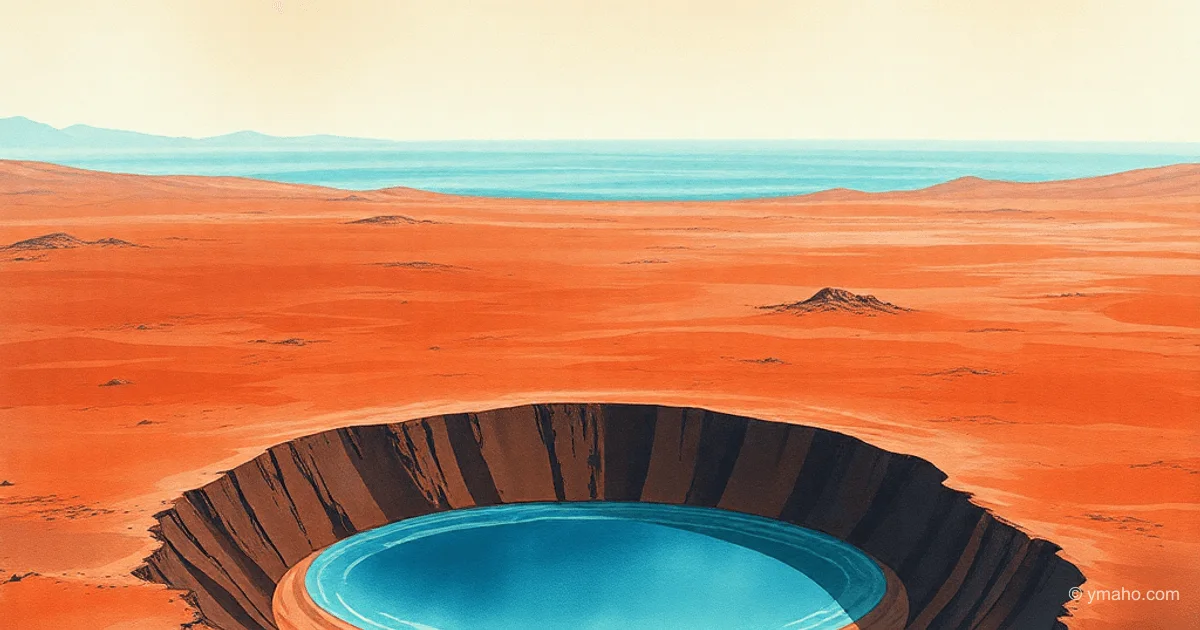
Mars’ Hidden ‘Bathtub Ring’ Points to an Ancient Ocean
Scientists just spotted a massive geological "bathtub ring" etched into the surface of Mars, and it might be the strongest clue yet that the Red Planet once hosted a vast, long-lasting ocean. If confirmed, this discovery reshapes our understanding of whether Mars ever had the right conditions to support life as we know it.
Think of a shoreline like the wet line left on a beach after a wave pulls back. It moves constantly with tides, storms, and seasonal changes. A continental shelf, on the other hand, is like the sturdy, flat ledge at the bottom of a swimming pool. It stays put for millions of years, quietly recording exactly where the water used to sit. That stability is exactly what researchers needed to solve a decades-old puzzle.
How Scientists Spotted the Hidden Shelf
For years, planetary geologists have debated whether ancient Mars held deep oceans or just scattered lakes and rivers. Previous orbiters found features that looked like old coastlines, but they sat at wildly different elevations across the planet. A real, stable ocean would leave a level mark, much like how Earth’s sea level stays consistent globally. To cut through the uncertainty, scientists at the University of Texas at Austin and Caltech ran computer simulations that essentially drained Earth’s oceans to see what geological fingerprints would remain behind.
They discovered that while shorelines shift dramatically over time, the flat underwater ledges known as continental shelves stay remarkably stable. These shelves wrap around continents like a mineral ring left behind in an empty tub. When the team turned their attention to high-resolution topographic maps of Mars, they found a striking match. A massive, flat zone stretches across the planet’s northern hemisphere, sitting roughly 6,000 to 12,500 feet below where a Martian sea level would have been.
The confirmed satellite data shows this feature aligns perfectly with ancient river deltas. These are fan-shaped deposits of sediment that form when rivers spill into larger bodies of water. On Earth, those deltas almost always pile up on continental shelves. The researchers suggest this Martian shelf would have taken millions of years to carve out, meaning any ocean there was not a temporary puddle. It was a stable, enduring sea. Of course, this remains a working hypothesis. We do not yet have ground samples to prove it, and scientists openly admit that even on Earth, the exact forces that shape these shelves are not fully settled.
Key Takeaways
- Researchers used Earth-draining computer models to identify stable geological markers of ancient oceans.
- A massive flat zone in Mars’ northern hemisphere matches the structure of a continental shelf.
- The shelf aligns with ancient river deltas, strongly suggesting long-standing liquid water.
- While highly promising, the theory still requires physical rock samples for absolute confirmation.
- A stable ocean lasting millions of years dramatically improves the odds that microbial life could have emerged.
What does this mean for regular people?
It reminds us that planets go through dramatic life cycles, and Mars may have once looked surprisingly like our own home. Understanding how Mars lost its water helps us appreciate the delicate balance that keeps Earth’s oceans and climate stable today. It also turns abstract space science into a tangible hunt for answers about our place in the universe.
— Editorial Team









