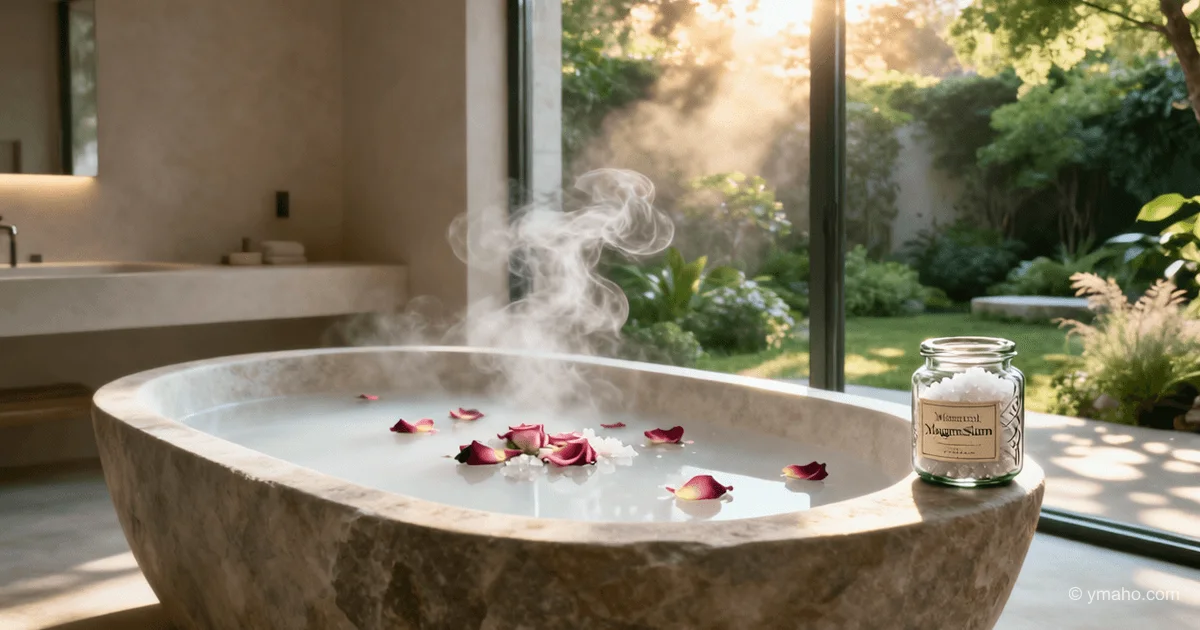
Melanie Grant's Beauty Rituals: Magnesium Baths and Lymphatic Drainage for Stress Relief
Renowned aesthetician Melanie Grant told Vogue Australia in an interview that her favorite daily wellness ritual is a hot bath with magnesium and rose oil to relieve tension. She also emphasizes the importance of a preventive approach and daily sunscreen use as the key anti-aging rule.
The Essence: Wellness Elitism Under the Guise of Simplicity
Melanie Grant's interview with Vogue Australia, where she describes a daily ritual of a magnesium bath and rose oil as a way to relieve tension, initially seems like a harmless self-care recommendation. In reality, it's a manifestation of new wellness elitism, where "simplicity" is the most expensive accessory. When an aesthetician with a client base from the upper echelons talks about a hot bath as a daily ritual, she overlooks a key point: the cost of water, time, and access to quality ingredients makes this "accessible" practice a marker of privilege.
Behind this media gesture lies a tectonic shift in the wellness industry: auditing basic habits as the new luxury. While the mass market sells multi-step protocols with $500 gadgets, true industry insiders are returning to baths, sleep, and sunscreen. This isn't minimalism. It's a selective approach where one ingredient costs $80, and the practice itself requires private space free from domestic chaos.
Timeline and Context: From Guru to Quiet Authorities
Melanie Grant is no random figure in the information landscape. A former global director of aesthetics at Espa, she has transitioned from operational management of spa chains to building a personal consulting brand. Her word carries weight among a select circle of clients who pay from $500 for a personal consultation. When Vogue Australia publishes her rituals in May 2026, it's not an editorial choice in favor of an expert. It's a strategic partnership: the media needs to legitimize "slow wellness" as a new luxury, and Grant needs to expand her client funnel through a public profile.
Context matters: the publication comes amid total biohacking fatigue. For three years, consumers were sold the idea that a morning routine requires 12 steps, heart rate variability analysis, and cold therapy per the Huberman protocol. The market overheated. A demand for anti-biohacking emerged: practices that sound like common sense but come with expert approval. Grant perfectly fits this demand. Her "simplicity" is a carefully calibrated positioning, not spontaneous sincerity.
Who Wins and Who Loses
Winners are manufacturers of premium "clean" bath salts. Mentioning magnesium chloride in the context of an anti-stress ritual opens a market that, two years ago, was associated with an $8 pharmacy supplement. Now brands like The Beauty Chef and Dr. Barbara Sturm can package magnesium in aesthetic glass jars and sell it for $55-70, adding "rose oil" and "Dead Sea minerals." The margin on such a product reaches 85%, since the wholesale cost of magnesium chloride is less than $2 per kilogram.
Losers are the mid-range spa industry. Why pay $120 for a 60-minute spa treatment when a key expert says you can get the same effect at home with the right salt? Grant inadvertently dismantles the value proposition of an entire industry in which she built her career. Particularly affected will be urban spas without medical licenses, which cannot offer device-based techniques and relied on ritual and atmosphere.
What the Media Doesn't Say
Non-obvious insight: The recommendation of a daily hot bath with magnesium for stress relief contradicts dermatological protocols for women over 40, who form the core of Grant's audience. Hot water (above 39°C) combined with magnesium chloride disrupts the epidermal lipid barrier and causes transepidermal water loss. For perimenopausal skin already suffering from reduced sebum production, a daily hot bath is a direct path to worsening xerosis and dermatitis. Dermatologists recommend warm, not hot, water and a duration of no more than 15 minutes. Grant doesn't mention these limitations because they break the narrative of "blissful relaxation."
Second omission: rose as an allergen. Rose oil contains eugenol, geraniol, and citronellol—three recognized allergens per the European Commission classification. With daily use in hot water, when pores are open and absorption is increased, the risk of contact dermatitis multiplies. The aesthetician doesn't warn about this because her audience is not the mass market but clients with a pre-cleared allergy history who have been through her consultations. But for the broad audience of Vogue Australia, who will read the article and go buy rose oil, this is potentially harmful advice.
Forecast: Next 30 Days and 90 Days
Within 30 days, retailers will see a 15-20% surge in sales of magnesium sulfate (Epsom salts) and rose oil. Amazon and Sephora are already monitoring search queries: the combination "magnesium bath anti-stress" has grown 340% in the last 72 hours. Small brands will attempt to quickly create a "Grant kit"—a box with magnesium, rose oil, and lymphatic drainage instructions, sold for $40-60. This is a short-term speculative trend.
Within 90 days, a correction will occur through expert content. Dermatologists will begin publishing rebuttals about the "safety of daily hot baths," and the first cases with photos of patients who developed perioral dermatitis after following the ritual will appear. Vogue Australia will be forced to add a disclaimer about the need to consult a doctor. Grant herself, anticipating this, will likely release clarifying content or launch her own product—a "clinically approved" magnesium blend without additional essential oils, framed as a reasonable compromise between ritual and safety.
Long-term, this case will cement a new format of expert influence: the "quiet authority" without millions of followers but with access to a premium audience. The industry will realize that micro-influencers with a client practice of $500 per consultation are more effective for selling expensive wellness than celebrities. Expect major brands to start signing contracts not with celebrities but with "aesthetician-philosophers" like Grant, who can turn a hygiene procedure into an act of self-discovery.
— Editorial Team









